What a Citation Rate Means Without a Sample Size Behind It
Small samples hide massive uncertainty behind confident-looking percentages.
Your brain is wired to count good outcomes, not weigh them against the total chances they had to occur. Psychologists call this denominator neglect. Kahneman and Tversky documented a related pattern called base-rate neglect, where people latch onto a specific number and ignore the broader context that gives it meaning.
Here's a classic example from the research. People consistently rate a treatment that saved 100 lives out of 700 as more effective than one that saved 90 lives out of 400. The bigger raw number wins, even though the first treatment's rate is actually worse. The 100 just feels more real.
Same thing happens when a slide deck says "73% citation rate." The 73 lands immediately. It feels like something you can work with. The missing denominator fails to register because there's nothing there to push back against it. You're handed a map with no scale. The distances look meaningful right up until you realize you have no idea how far anything actually is.
This is a System 1 problem. Fast, automatic thinking treats absolute numbers as more tangible than ratios. To actually reason through a rate, you have to slow down and do some real work. Most people don't do that on slide four of a vendor deck. They're not being lazy. They're being human.
The bias gets worse when the metric is new. AI citation rates didn't exist a few years ago, which means most buyers have no gut sense of what a normal baseline even looks like. There's no internal reference point to trigger skepticism. You don't know what you're missing until someone tells you what to look for.
And here's the thing that actually bothers me about this: it's not an intelligence problem. Research shows the bias holds even in people who can solve ratio problems easily when asked directly. It's the framing that does it. A confident-sounding percentage, dropped without context, gets inside your head before you've had a chance to ask a single question. The percentage just sits there looking authoritative, and nothing about the slide is going to correct it for you.
What the denominator actually controls in a citation rate calculation
A citation rate is a ratio. Queries where the brand got cited, divided by total queries asked, times 100. The denominator is not decorative. It's doing real structural work.
It controls statistical stability. How confident can you be that the number isn't just noise? A rate built on a small sample can swing wildly if one or two answers change. The headline looks the same whether it came from 10 queries or 1,000, and the difference in what that headline actually means is enormous.
It controls reproducibility. Would someone running the same queries get a similar result? With a small sample, the honest answer is probably not. And if the number isn't reproducible, it isn't really a measurement. It's a snapshot that will fail to repeat.
It controls comparability. If two vendors both report 65%, were those numbers measured against the same volume and type of questions? You have no way to know without the denominator.
Academic research hit this exact wall with journal impact factors. Journals that published fewer articles saw their impact factor jump, sometimes dramatically, without any actual change in quality. A small denominator amplifies random variation. One extra citation starts to look like a trend when the pond is shallow enough.
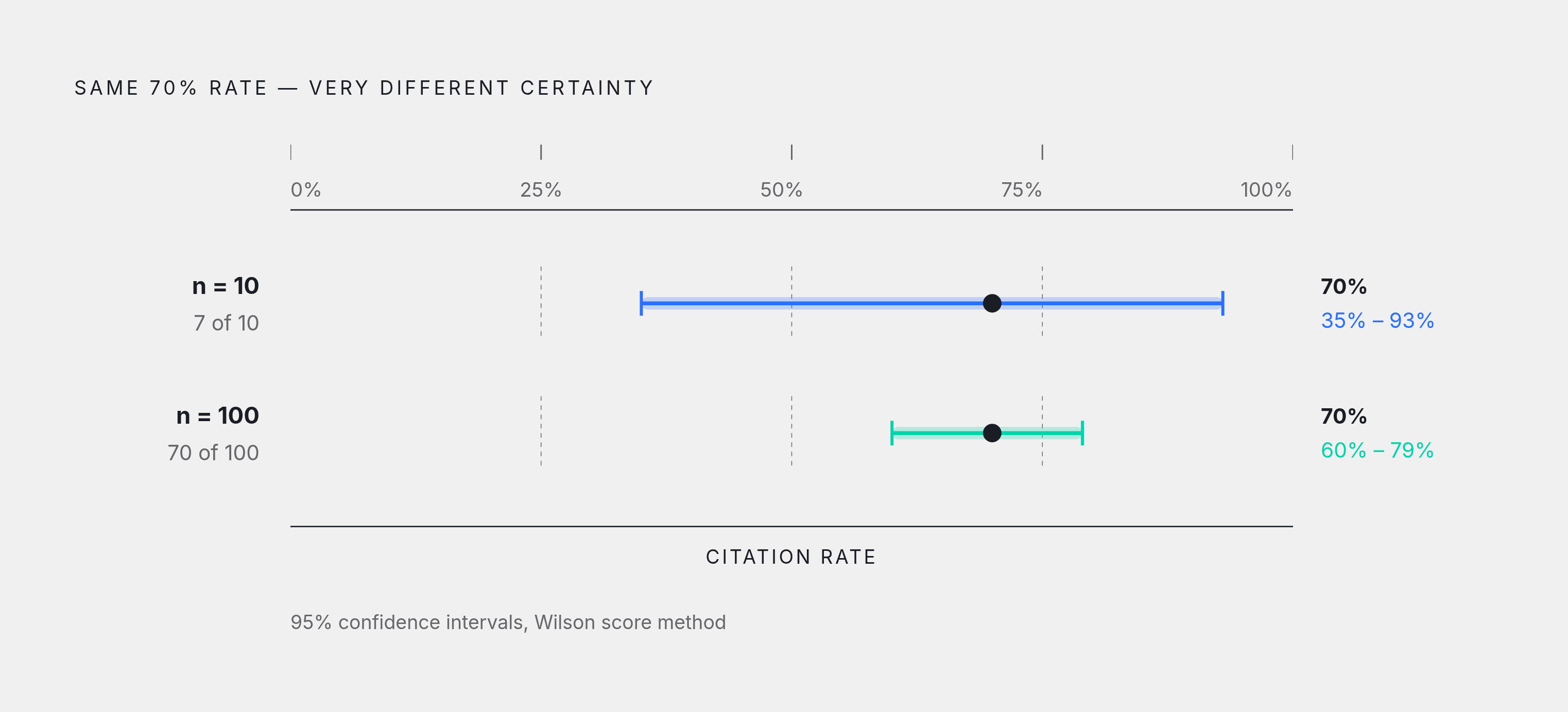
The same math applies to AI query samples. A brand cited in 7 out of 10 test queries has a "70% citation rate." The confidence interval on that number is wide enough that the real rate falls anywhere from roughly 35% to 93%. The percentage buries all of that variation inside a single tidy figure.
A rate without a sample size can't be placed in a confidence interval. Which means it can't be confirmed, compared, or checked against anything. You're being asked to act on a number that has no floor and no ceiling, and the slide isn't going to tell you that.
How vendors can make a citation rate look better by shrinking the denominator
The denominator isn't just unknown in most vendor reports. It's often chosen, and that choice shapes the output in ways that are almost impossible to detect from the outside. There are a few levers that can be pulled without disclosing any of them.
Query selection is the most common one. Test only question types where a brand is already likely to show up and the citation rate will be much higher than if you test the full range of things a real buyer will actually ask. The queries are picked, not sampled. The difference between those two things is everything.
Model selection matters too. Query a single AI model on a favorable day instead of sampling across ChatGPT, Claude, Gemini, and others across multiple time windows and prompt variations, and you get a best-case result. Not a typical one.
Then there's what you call denominator shrinkage, which is the most direct version of the problem. Run fewer total queries and a small absolute count becomes a high percentage. Some academic journals actually improved their impact factor this way: publish fewer papers, not earn more citations. A 2016 PLOS ONE analysis found that a meaningful share of impact factor increases in one studied cohort came from the denominator shrinking, not from citations going up. The number went up. The underlying reality didn't.
AI citation measurement has no peer review, no auditing process. A vendor can publish a rate and never show the query set, the model list, or the sample count. Nobody's checking.
So here's the practical problem this creates. Without the denominator, you can't tell whether a citation rate went up because the brand got more visible, or because someone quietly changed how they were measuring. Both outcomes look identical on a slide. You'd need the denominator to tell them apart, and the denominator isn't on the slide.
Why the query universe is itself a hidden denominator that rarely gets disclosed
Even if a vendor tells you the sample size, say 200 queries, that number still doesn't tell you what those 200 queries actually were. And the what matters as much as the how many. Probably more.
200 brand-adjacent queries and 200 category-wide buyer queries will produce very different citation rates for the same brand. The query universe is the population the sample is drawn from. Its scope defines what the citation rate actually means in practice.
Breadth is one dimension. Does the query set cover the full space of questions a real buyer asks, or only the territory where the brand already has strong content? One produces a useful number. The other produces a flattering one.
Specificity is another. Branded questions ("what does Company X do?") versus category questions ("what tools help B2B SaaS companies with content marketing?") are measuring very different things. Branded questions almost always produce higher citation rates, because you've already told the AI who you're asking about. It's a little like asking someone to name a word that starts with the letter you just handed them on a card.
Prompt phrasing is the third dimension, and it's subtle enough that it catches a lot of people off guard. AI models are sensitive to exact wording. A rate built on one phrasing per topic is not the same as one tested across several variations of the same question. Small wording changes can shift whether a brand appears at all.
Without knowing the query universe, the rate can't be connected to a real business question. "We're cited 80% of the time" doesn't tell a buyer whether that's 80% of the questions their actual prospects are typing, or 80% of a curated set that was built to perform well. Those are not the same thing, and a percentage alone can't tell you which one you're looking at.
The buyer needs to evaluate not just the numerator and denominator, but the population that denominator was drawn from. That's a third layer of context that almost never gets disclosed. Most reports fail to even acknowledge it exists.
What a citation rate that can actually be trusted looks like in practice
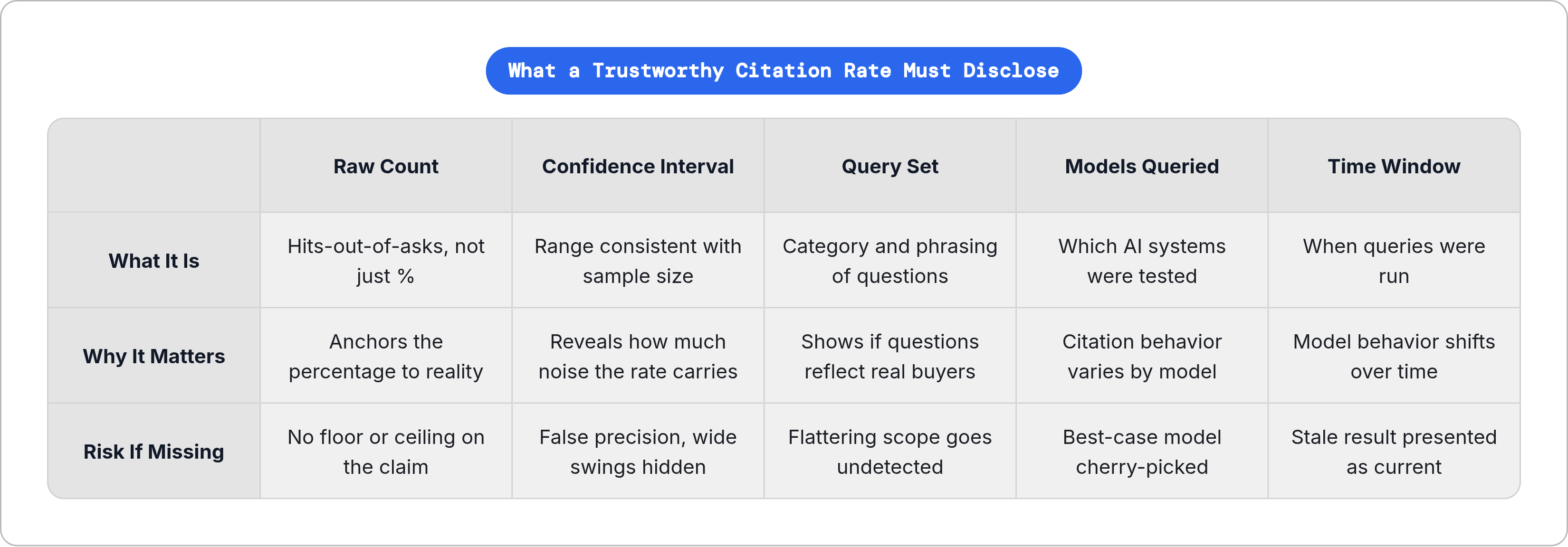
A defensible citation rate discloses five things. These aren't aspirational. They're what separates a measurement from a marketing claim.
The raw count. How many queries were asked, how many produced a citation. Stated as hits-out-of-asks, not just a percentage. This is the starting point, not a bonus detail.
The confidence interval. What range of true rates is the observed number consistent with, given the sample size? A rate of 7 out of 10 and a rate of 70 out of 100 are both "70%," but they carry very different levels of certainty. That difference belongs in the report.
The query set. The category and phrasing of questions asked, enough that a reader can judge whether they reflect real buyer behavior. You don't have to publish every query verbatim, but enough context to evaluate the scope is not optional if the number is supposed to mean something.
The model or models queried. Which AI systems were tested. Citation behavior varies across ChatGPT, Claude, Gemini, and others in ways that actually matter, and a rate from one model on one day is a narrower claim than it usually gets presented as.
The time window. When the queries were run. AI model behavior shifts as models retrain and update. A result from six months ago does not reflect current behavior at all.
Zero results need the same treatment. A zero from 10 queries and a zero from 500 queries are not the same finding. One points to a real visibility gap. The other means you barely looked. Both deserve to be labeled accurately.
Tracking AI citation as hits-out-of-asks, surfacing confidence ranges alongside the rate, and requiring human review before any claim about a client or competitor goes out are all achievable practices. The rate should be tied to the actual query set, not floated in isolation.
None of that is a high bar. It's just the information you actually need before you do anything with the number. A vendor who won't show the denominator is asking you to skip the context and trust the headline. And your brain, for reasons that have nothing to do with intelligence and everything to do with how fast thinking works, is already inclined to do exactly that.