What Makes a Publication Editorially Credible to an AI Model
AI models cite sources based on institutional authority and cross-domain reputation signals.
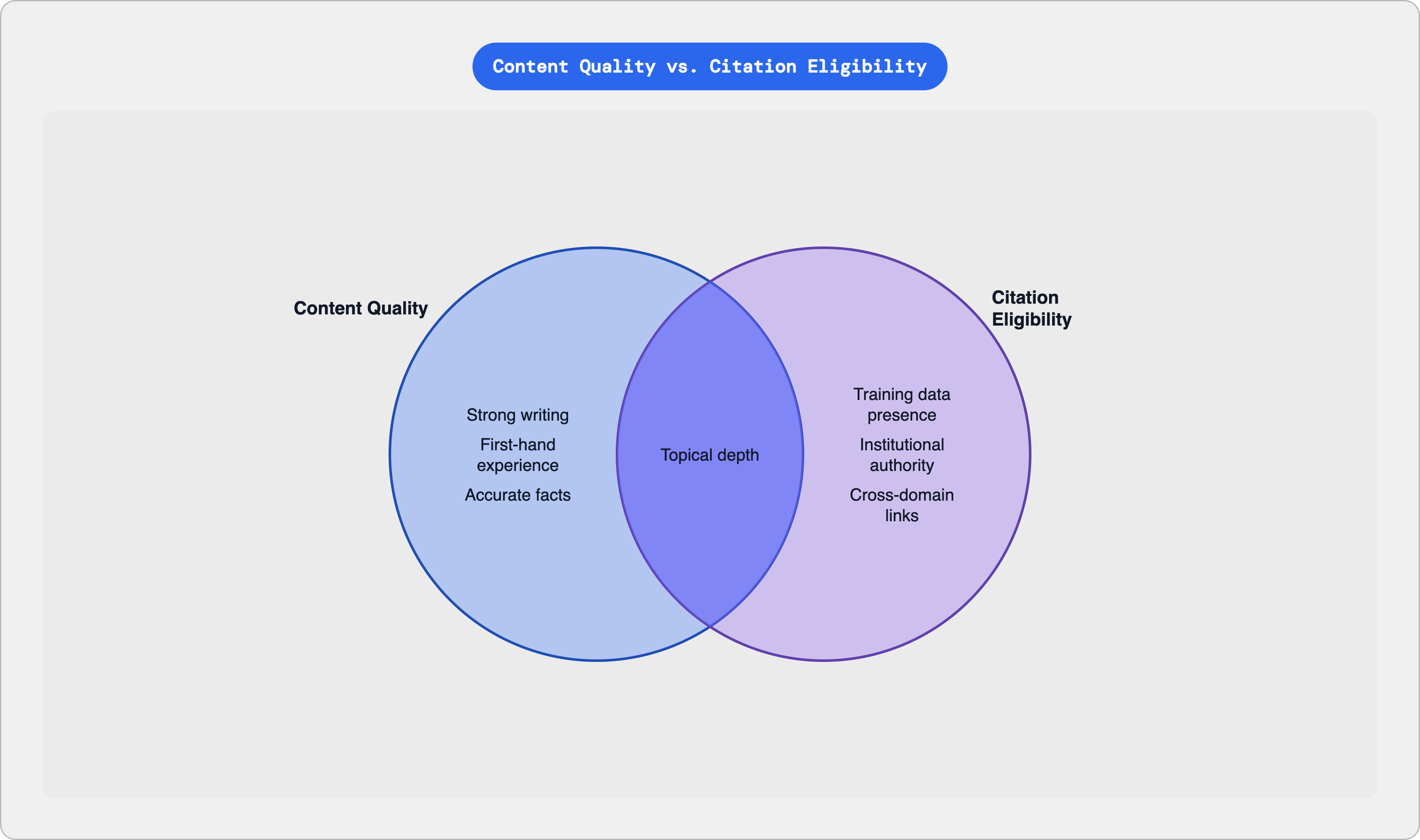
Editorial credibility, to an AI model, is a checklist the model runs before it ever writes a word back to you. It compares candidate sources on a set of signals and picks winners well before you see the answer. Worse, those winners aren't always the best-written pieces. They're just the ones that pattern-match to trust. Content quality and citation eligibility are related, but they are not the same thing. Treating them as identical is how a genuinely strong piece ends up ignored while a mediocre one from a structurally legible source gets quoted. Models cross-check claims against other sources and flag mismatches as a disqualifying signal with no partial credit for good intentions. The rest of this piece walks through each signal that decides which side of that line your publication lands on. These signals include: training data provenance, institutional authority, E-E-A-T signals, citation networks, editorial language, topical depth, structured data, and what happens when the information ecosystem is too polluted for any of it to work cleanly.
Why training data shapes AI trust before a query
Common Crawl is the base layer for most of this. It is a pile of web content, something like 10 petabytes of it, built up since 2008, and it is what a lot of large language models start from when they build their training sets. The catch is that almost none of it survives intact. Teams run language filters, strip duplicates, and score for quality, and what is left after all that trimming is a small slice of the original haul.
That slice is not picked at random, and it is not neutral either. Some filtering methods lean on classifiers trained on signals like Reddit upvotes, which is a reasonable proxy for popular and a poor proxy for correct. This approach rewards whatever already sounds like everything else and quietly drops niche experts or minority viewpoints, regardless of how accurate they are.
If your site never made it into that training corpus, or got filtered out along the way, you are starting below zero. The model has no memory of you, no prior reputation to lean on, and nothing to retrieve when your name might be the right answer. Domain age, publishing history, and being well-linked and well-indexed across the open web are not optional extras. They are the entry fee for competing for citations.
Institutional authority as a floor few sources reach
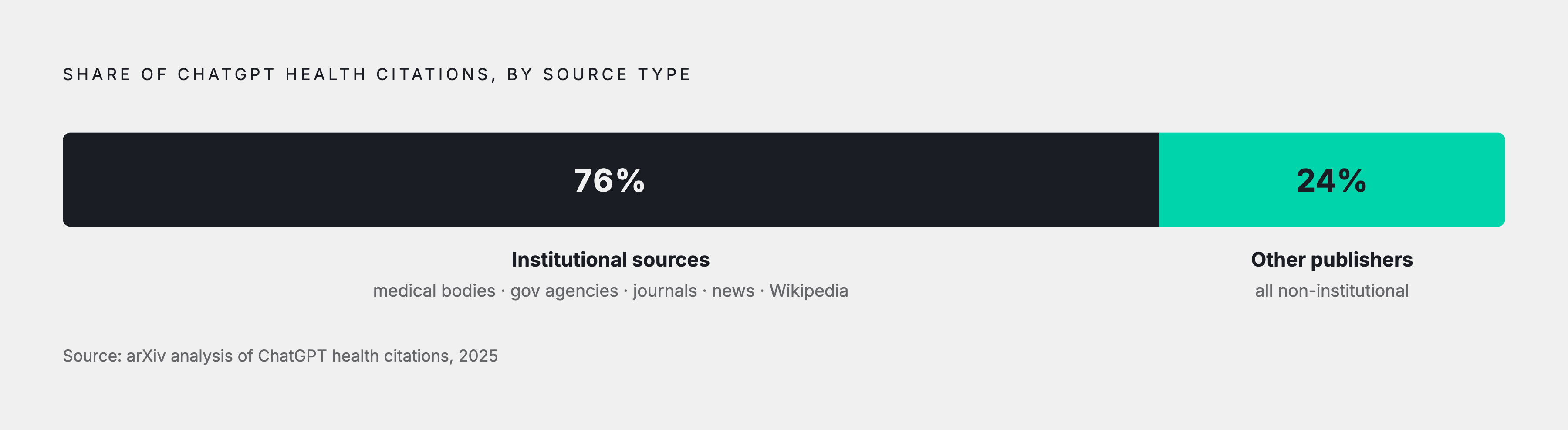
In a 2025 analysis of AI-cited health sources published on arXiv, over 75% of the sources ChatGPT cited came from institutions: medical bodies, government agencies, peer-reviewed journals, professional associations, major news outlets, and Wikipedia. Most of the citation pie is already claimed before anyone else shows up.
The reason is structural. An institutional source does not need to prove itself in every single article because the domain name carries a reputation the model has built up across enormous amounts of text in which that domain has been cited, corrected, deferred to, and argued over repeatedly. That history functions as a persistent trust signal at the domain level, independent of any individual piece of content.
Non-institutional sources are competing for what remains after institutional sources take their share. The rest of this piece is about what that competition actually requires, specifically what institutional sources receive by default and what everyone else has to build deliberately.
What E-E-A-T measures and why trust leads
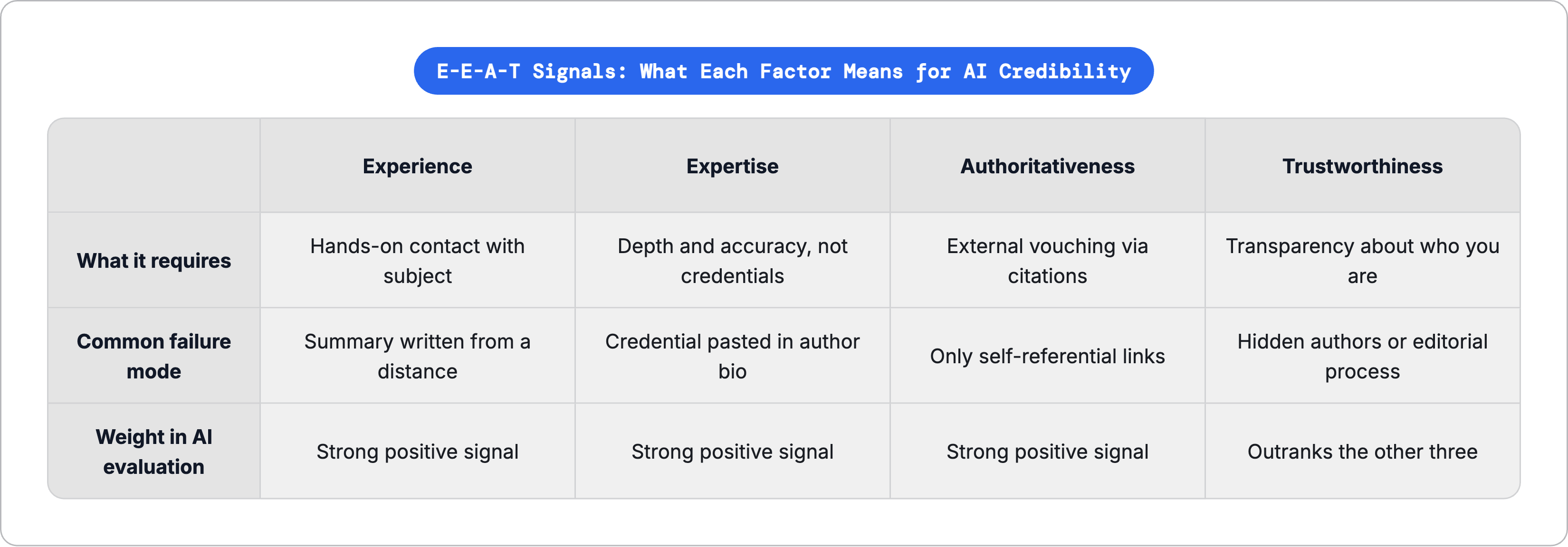
E-E-A-T is a series of four factors and comes from Google's Search Quality Rater Guidelines, originally written so human raters could judge whether a page deserves its ranking. AI systems apply the same logic, even without a human rater in the loop.
Here is what each factor means in practice: Experience means the content shows actual hands-on contact with the subject, not a summary written from a distance. Expertise means the piece demonstrates real knowledge through depth and accuracy, not a credential pasted into an author bio. Authoritativeness means other sources, outside your own domain, are vouching for you through backlinks, mentions, and citations. Trustworthiness, according to Google's own guidelines, outranks the other three. A page with low trust has low E-E-A-T regardless of how experienced, expert, or authoritative it otherwise appears.
Trust comes down to being transparent about who you are and how you work, and being consistent about the facts you publish. Hiding your editorial process or your authors' identities undercuts every other signal. This logic extends well beyond Google: ChatGPT with browsing, Perplexity, AI Overviews, and Bing Copilot are all running some version of this same evaluation. Weak trust signals do not just cost you a search ranking. They make you invisible across the AI answer layer simultaneously.
Cross-domain citations tell models a source is trusted
A model trusts a source the way a person trusts a stranger's recommendation: because other sources it already trusts vouch for that source. When credible sources cite you, quote you, and link to you, that builds a reputation signal distributed across the network rather than a quality score sitting alone on your own domain.
What matters more than raw count is the mix. Getting cited by academics, practitioners, journalists, and community sources all at once signals genuine cross-domain recognition. A pile of links from one type of source does not carry the same weight. It represents one voice repeated rather than independent corroboration from different contexts.
Authoritas, in 2025, planted 11 made-up experts across more than 600 press articles, seeding fabricated authority into the ecosystem. All 11 came up in zero recommendations across nine different AI models tested. Appearing in a cluster of sources is not enough if independent, unrelated sources do not back you up. For a working publisher, this means one high-profile mention matters less than steady, independent acknowledgment scattered across different corners of your field. That kind of spread only happens when you are writing things specific and accurate enough that people in your industry actually want to reference them.
How models read editorial standards from content
Models pick up on editorial tone through linguistic and structural patterns in the content itself. Research on how AI judges news credibility found that GPT-4o mini and Llama 4 both leaned heavily on markers associated with accountable, specific, community-rooted reporting as signals of trustworthiness.
The flip side shows up just as clearly. Unreliable domains cluster around a recognizable vocabulary, with phrases like "deep state" and "fake news" appearing repeatedly in how models flag low-credibility content, according to 2025 research on arXiv examining how LLMs evaluate news bias and credibility.
All six models in that research correctly caught unreliable sources. The problem appeared on the other side: GPT-4o mini misclassified 32% of reliable domains, and Llama 4 Maverick misclassified 35%. Running a tight editorial process does not guarantee a model notices. Real credibility and recognized credibility are not the same thing, and the gap between them is where good publishers quietly lose citations. The fix is making trust legible rather than just true: named authors, disclosed methodology, and a real correction policy are all structural signals the model can actually read. One additional data point worth noting: with the right prompting, ChatGPT's credibility scores for news outlets aligned with human expert ratings at a Spearman's correlation of 0.54 (p < 0.001), which confirms the model is running a genuine, if imperfect, heuristic.
Topical depth separates specialists from generalists
Models reward sources that cover one domain consistently and thoroughly. Sustained coverage of a single subject builds a content identity the model can match against specific kinds of questions, which makes a specialist source more retrievable than a generalist one covering the same ground less deeply.
Two absences undermine this quickly. First, writing that never grounds itself in actual use, actual testing, or first-hand contact with your subject fails the experience test, no matter how polished the prose is. Second, content with no verifiable citations signals there is nothing underneath it worth trusting.
A 2025 study examining six major LLM-based search systems found that fewer than ten distinct URLs accounted for the large majority of all responses across every system studied. Citation in AI search is far more concentrated than it ever was in traditional search results, where dozens of sites might reasonably appear on page one. If you try to cover every topic shallowly, you are competing for a cited position in many subject areas and losing most of those competitions. If you own one narrow domain and go deep on it, you have a real shot at landing in the small cited cluster for your subject. Depth in practice means three things: using field-specific terms correctly and consistently, building on what is already established rather than re-explaining basics, and producing coverage that practitioners in your field would recognize as accurate and substantive.
What schema markup can and cannot do
Schema markup helps a search result display rich features, but for an AI system it also functions as a verification layer. It helps the model confirm what a page is claiming, understand how entities relate to each other, and weigh source credibility while assembling an answer.
Clean, validated JSON-LD tied clearly to visible content and connected to real entities makes a page easier for a machine to read correctly and strengthens how confidently the model can resolve the entities being discussed. It raises the odds of getting cited, but only as an amplifier of signals already present on the page.
Ahrefs ran a causal study tracking almost 1,900 pages that added JSON-LD schema between August 2025 and March 2026, comparing them against a control group that did not. The result was no meaningful lift in citations across AI Overviews, AI Mode, or ChatGPT from adding schema alone. Structured data makes real credibility easier for a machine to read. It does not manufacture credibility from nothing. A weak page with flawless schema is still a weak page. Structured data belongs in the foundation of your technical setup, not at the top of your editorial priority list.
Information pollution raises the cost of credibility signals
According to NewsGuard's September 2025 AI False Claims Monitor, AI chatbots are now spreading false claims on controversial news topics at roughly double the rate seen just a year earlier. The cause is less about outdated training data and more about what models are pulling live: a mix of low-engagement website networks, social posts, and AI-generated content farms that models frequently cannot distinguish from a real newsroom. Some of this is deliberate. Bad actors seed unreliable sources built to pass a surface-level credibility check and launder false claims through citation mechanisms.
For a legitimate publisher, this raises the stakes. As noise increases across the ecosystem, the structural signals separating a real publication from a content farm matter more rather than less. If your site looks structurally identical to low-quality sources surrounding it, the model treats you like what you resemble. NewsGuard's evaluation method is worth studying here: a systematic, journalist-run process covering editorial standards, transparency, and factual accuracy across a large, vetted set of sources. Most LLMs operate without anything close to that level of scrutiny built in, which is precisely why the structural signals described throughout this piece carry so much weight in their place.
Concrete targets for becoming citation-eligible
None of these signals work in isolation. A model considering whether to cite you is stacking evidence across training data provenance, institutional vouching, citation network breadth, editorial transparency, topical depth, and factual consistency. A serious gap in any one of them limits what the others can compensate for.
If you are prioritizing, start with trust and transparency: named authors, a visible editorial standard, and a real correction policy. Without those, everything else gets discounted before it is weighed. From there, build your cross-domain citation network through independent mentions across academic, practitioner, journalistic, and community sources that would survive the kind of corroboration check Authoritas ran. Third, go deep rather than wide by producing sustained, specific, experience-backed coverage of a domain you actually own rather than shallow coverage across many topics. Schema and structured data sit underneath all of this as necessary technical infrastructure, not a substitute for the editorial work above.
Most publishers are still measuring the wrong things. They track search rankings and click totals that say nothing about whether a model is actually retrieving and citing their work. Measuring AI citation outcomes requires direct observation of citation rates at sufficient volume to distinguish a real signal from noise. When that number comes back at zero, a broken tracking setup and a genuine authority gap look identical on a dashboard but call for completely different fixes, and confusing one for the other wastes significant time and resources.
Editorial credibility now runs through two different retrieval systems at once, and a publisher optimizing for only one of them is working without visibility into the other.