Why Brand-Owned Content Gets Less AI Trust Than Third-Party Editorial Coverage
AI models trust independent sources over self-promotion, and the numbers prove it decisively.
AI models don't cite brand-owned content nearly as often as they cite third-party editorial coverage, and that gap isn't some quirky bug in the system. AI answer engines generate a response first, then go hunting for sources to back it up, and that source-selection process runs on a trust hierarchy that treats "the brand talking about itself" as one of the weakest signals available.
That's the whole piece, really. Let's get into why.
Analysis from AirOps looked at 548,534 pages and found that ChatGPT cites roughly 15% of what it retrieves, throwing away the other 85%. That's not a coin flip, and the discard pile has a shape to it. The shape comes from three things the model checks before it trusts a source: does this source have a reason to be impartial, does the claim show up independently in more than one place, and does the page actually contain verifiable specifics instead of vague assertions.
Human feedback baked this in during training. Reviewers rewarded answers that leaned on sources people already found credible, and after enough rounds of that, the pattern hardened into something like muscle memory for the model. Nobody sat down and wrote a rule that says "trust journalists over press releases." It just emerged, the way a habit does after you've done something the same way a thousand times without thinking about it.
Why corroboration across independent sources beats any single authoritative page
Picture one page making a claim. Doesn't matter how well it's written, how many citations it drops, how confident the tone is. To the model, that's one data point, floating alone, with nothing to check it against.
Now picture that same claim showing up on a review site, in a forum thread, and in a news article. Three sources, none of them coordinating with each other, all landing in the same place. The model reads that repetition as reliability, because coordinated messaging looks different from independent agreement, and it can tell the difference.
This is exactly why forums punch above their weight. A thread where someone makes a claim, someone else questions it, a third person corrects a detail, and a fourth confirms it, that whole messy back-and-forth is a trust signal in disguise. The disagreement is the point, since it proves nobody planned this out in advance.
Brand-owned content can't participate in that loop, structurally. A company's blog, its press releases, its product pages, all of it comes from the same throat. One entity, one voice, no matter how many URLs it lives on. A brand could publish a hundred pages on its own site and the model still logs that as a single source, saying the same thing a hundred different ways.
So the real unit of influence isn't the page. It's the independent mention. Only independent mentions stack.
The empirical gap between earned and owned citation rates
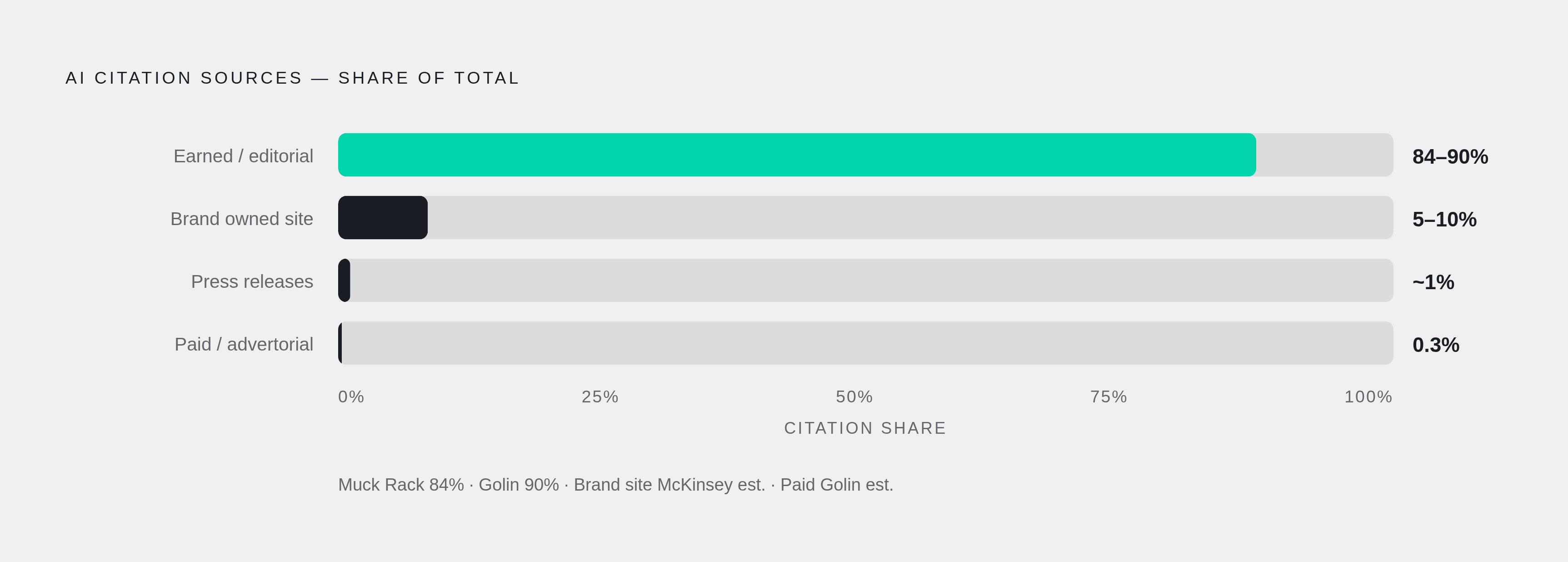
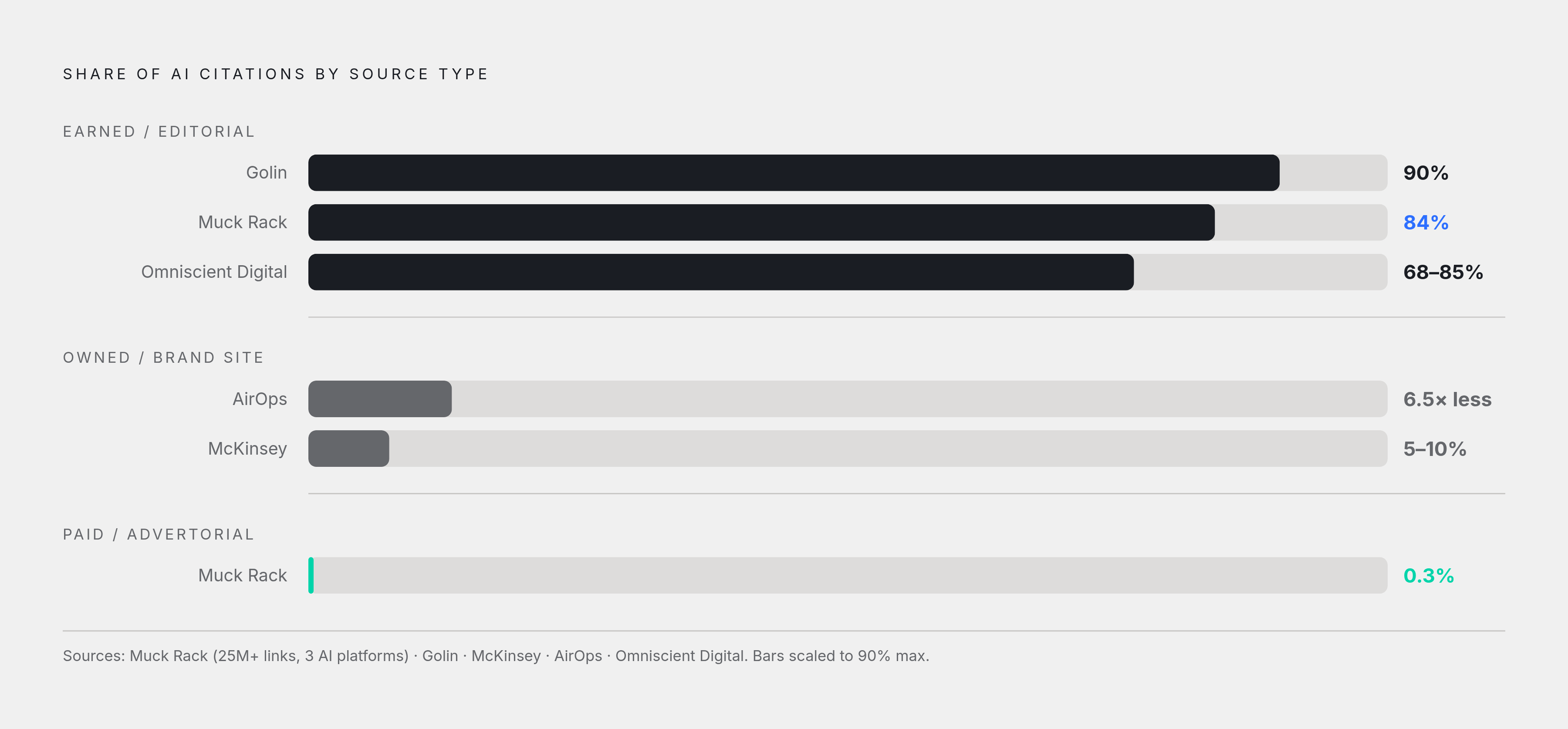
The numbers here aren't close, and they come from more than one place, which is exactly the point of the last section applied to research itself.
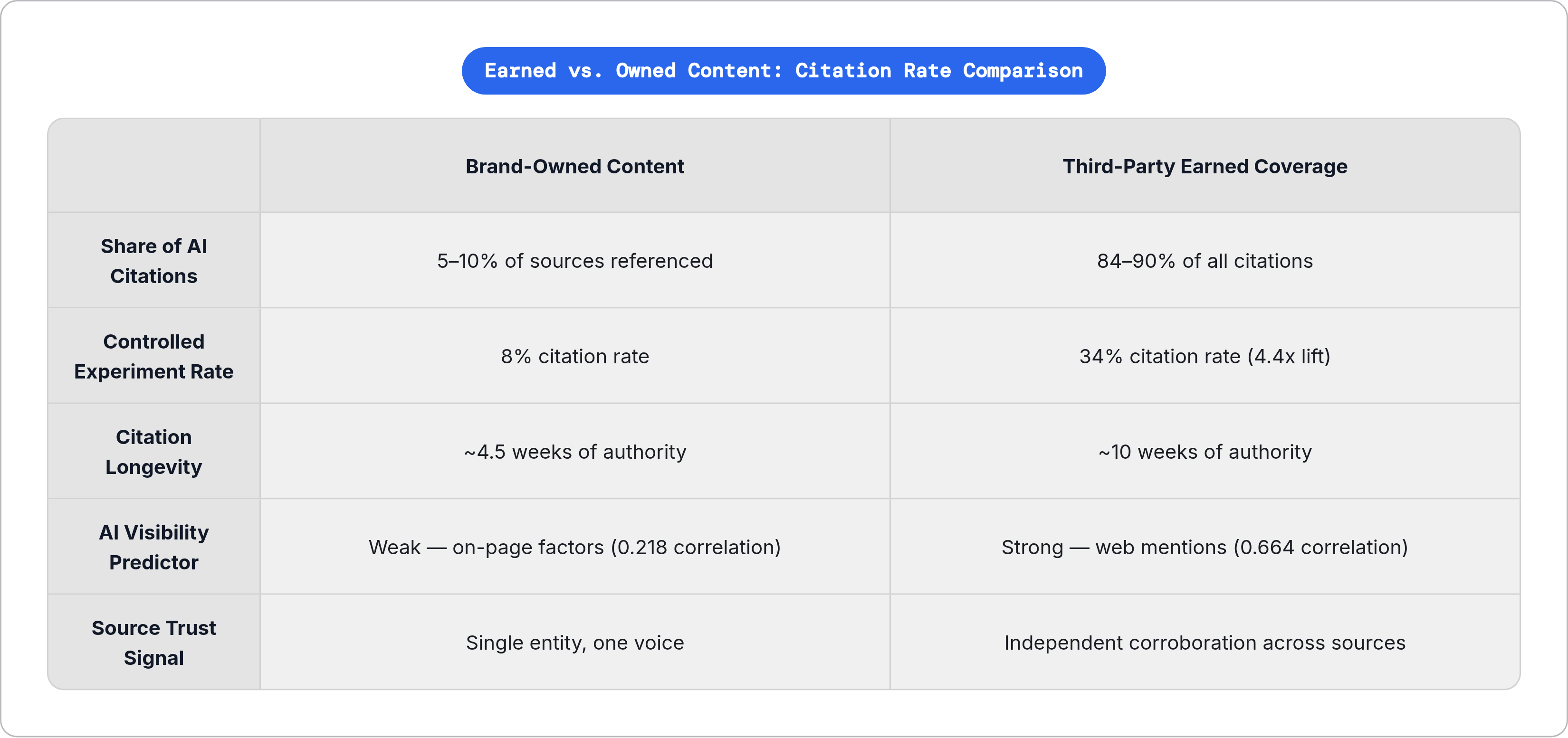
Muck Rack's May 2026 study looked at more than 25 million links cited by ChatGPT, Claude, and Gemini across 17 industries. Earned media (that's coverage a brand didn't pay for or write itself) accounted for 84% of all AI citations, while paid and advertorial content came in at 0.3%. Not a typo. Across three editions of that same study, going back to July 2025, the earned share has held between 82% and 89%. It barely wobbles, which tells you this isn't noise, it's a settled pattern.
Golin presented a similar figure at PR Moment: 90% of AI visibility comes from earned editorial citations.
Flip to the brand's side of the ledger and the picture matches. McKinsey's AI Discovery Survey from October 2025 found a company's own website accounts for only 5 to 10% of the sources AI search tools reference. The rest comes from third-party editorial coverage, review sites, and user-generated content. AirOps found brands are 6.5 times more likely to get cited through third-party sources than through their own domains.
Here's the detail that should sting a little: Omniscient Digital looked at 23,387 citations specifically on branded queries, meaning someone typed the company's actual name into the prompt. Even there, 68 to 85% of citations came from third-party sources. You'd think asking about a company by name would surface the company's own answer, but it mostly doesn't.
What the controlled experiment revealed — same content, different source, radically different outcome
Most of the research above can't separate two things that usually travel together: good content and third-party publication. Stacker and Scrunch ran a study in December 2025 that pulled them apart on purpose, and the result is the cleanest evidence in this entire conversation.
They took identical content and put it in two places: brand-owned channels, and third-party news publishers. Same words, same structure, same facts. Then they tracked 944 prompt-platform combinations across five AI platforms to see what got cited.
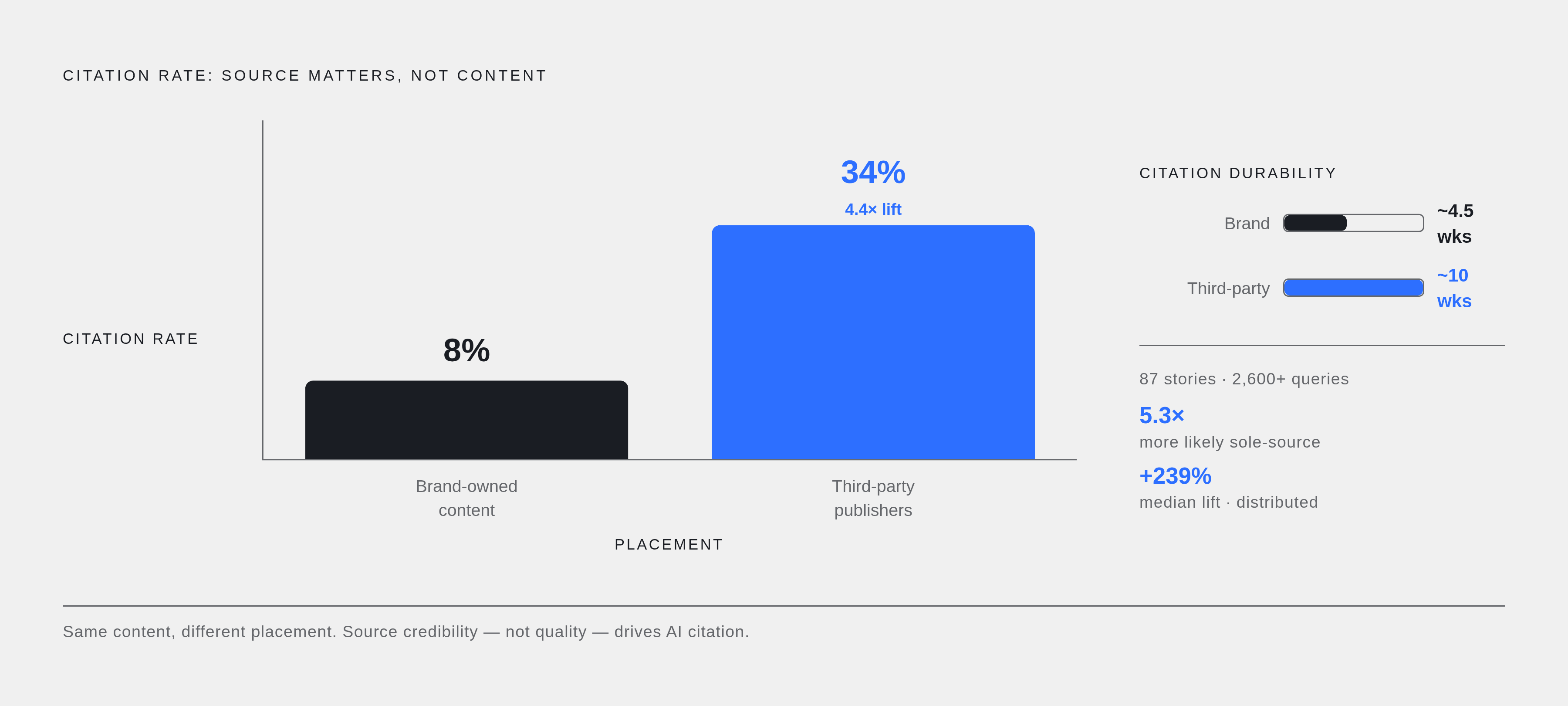
Brand-only version: 8% citation rate. Same content on a third-party news site: 34%. That's a 4.4x lift, or put another way, a 325% increase, from nothing but a change of address. In close to one out of every five answers, the AI cited the third-party version of a story and skipped the brand's original entirely, even though the words were the same.
A follow-up in March 2026 scaled this up, tracking 87 stories across 30 clients, queried more than 2,600 times across eight AI platforms. The pattern held and then some. Distributed versions were 5.3 times more likely to be the sole source behind a story's AI visibility, compared to the brand's own site. 64% of citations traced back to third-party publishers, and the median lift in AI search visibility from earned distribution came to 239%.
And it's not just a bigger splash at launch. Distributed content held its citation authority for roughly 10 weeks, versus about 4.5 weeks for brand-only content, a gap of 2.1x. The advantage compounds, and it doesn't fade the way a press release fades.
Same content. Different mailbox. Wildly different outcome. If you needed one chart to explain this whole article, that's the chart.
How AI models categorize brand content before they even evaluate it
Here's the part that feels almost unfair until you sit with it: models sort content by source type before they ever get around to judging quality. Call it the promotional content default.
Think about it from the model's side for a second. Every brand claims to be the best at what it does, and that's the job description of marketing. So when a model sees a brand telling you its own product is great, that sentence carries almost no information, because it would say the same thing regardless of whether it's true.
This is actually a pretty sound instinct. If a source stands to gain financially from a claim, a model trained on human feedback learns to discount that claim, the same way you'd raise an eyebrow at a car salesman telling you this particular car, the one he's selling you right now, is definitely the best one on the lot.
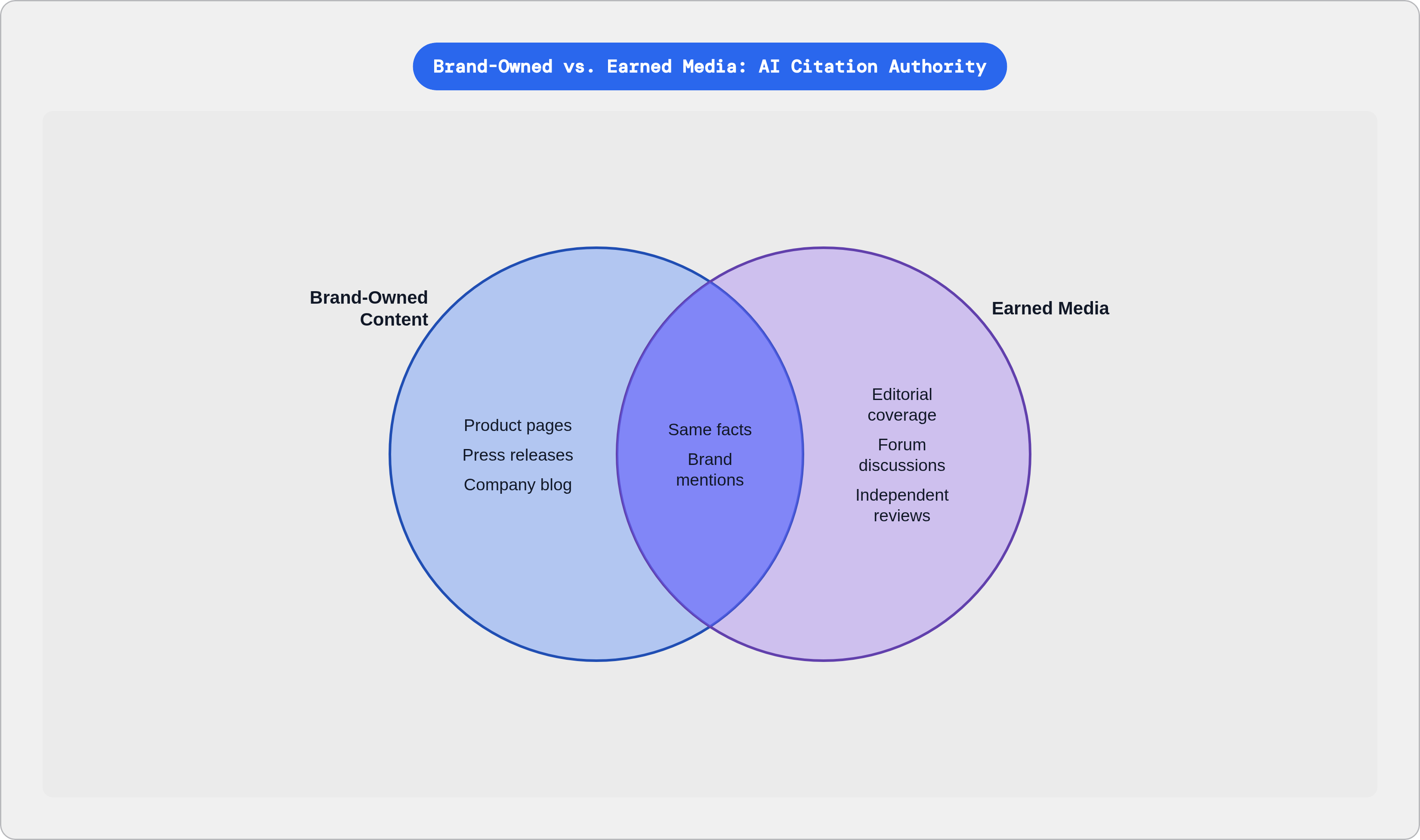
Identical information lands differently depending on where it sits. The same fact, published on a brand's product page versus written up in an independent review, gets weighted differently before the model even parses the sentence. Context signals intent, and intent gets judged first.
Training data reinforces the pattern too. High-authority, editorially independent publications were over-represented in what these models learned from in the first place. The credibility hierarchy that human editors already used to decide what was worth printing got inherited wholesale by the machines that came after them.
A brand can't write its way out of this. The content can be genuinely excellent, sharp, well-researched, useful, and the citation rate can still sit near zero. The classification happens before the substance gets a hearing.
Why SEO performance does not transfer to AI citation, and what that means strategically
Here's a natural assumption that turns out to be flat wrong: if you rank on page one of Google, surely AI models will cite you too. They're both search, right?
The numbers say otherwise. Moz ran an analysis in February 2026 across tens of thousands of search queries and found that 88% of Google AI Mode citations don't appear anywhere in the organic search results for that same query. Only a small fraction of AI Mode citations match a URL sitting in Google's top 10. Two systems, asking similar questions, pulling from almost entirely different pools of sources.
That makes sense once you separate what each system optimizes for. SEO rewards on-page structure, backlink authority, how easily a crawler can get around your site. AI citation rewards corroboration across independent sources, editorial distance from the subject, and how many concrete, checkable specifics sit on the page.
A brand can hold the top spot on Google for years and have almost no AI citation presence at all. These two outcomes are drifting apart, not converging.
Ahrefs studied 75,000 brands and found that web mentions (references to a brand across pages the brand doesn't control) predict AI visibility far better than anything else measured. The correlation ran at 0.664, compared to just 0.218 for backlinks. Brands in the top quartile for web mentions showed up dramatically more often in AI Overviews than brands in the bottom half, who were mostly invisible in AI answers altogether.
The strategic upshot: money spent improving your Google ranking doesn't automatically buy you AI citations. They're different games with different scoreboards. Only one input, independent mentions out in the wild, moves the needle on both at once.
Where citation rates vary by platform — and what the variation reveals
Earned media wins everywhere, but not by the same margin everywhere, and that gap between platforms tells you something useful.
Meltwater's platform breakdown shows ChatGPT leaning hardest into earned and news media. It's the most third-party-biased of the major engines by a wide margin. Claude runs more balanced, with owned content claiming a noticeably bigger slice of its citations than it does on ChatGPT. So a strategy built entirely around ChatGPT's habits will quietly underperform the moment you check it against Claude.
Inside the third-party bucket, categories aren't equal either. Otterly AI's Citation Report, drawn from more than a million citations, found editorial and media content leading decisively among third-party types, at 20.3% of citations, well ahead of forums and blogs. Press releases sit around 1%, and advertising earns effectively nothing. Which, honestly, checks out, since nobody trusts an ad to tell them the truth about the thing being advertised.
Reddit deserves its own footnote here, because its citation numbers look enormous and it's tempting to draw a lesson from that. Don't, not directly. Reddit's presence comes from specific licensing deals that gave AI companies direct access to its data, combined with a format that naturally produces the multi-voice corroboration models already favor. It's a special case built on infrastructure most brands don't have access to, not a repeatable playbook.
What holds up across every platform, every engine, every quirk in the data: earned editorial placement in a credible outlet. Everything else is a platform-specific tweak sitting on top of that foundation.
What brands can actually do about a structural disadvantage they cannot optimize away
None of this means brands are stuck. The fix lives somewhere other than where most people are looking for it.
The intervention point is the ecosystem of independent voices talking about the brand elsewhere, more than the brand's own content calendar. Remember that Ahrefs number, 0.664 correlation between web mentions and AI visibility, stronger than any on-page factor they measured. External presence is the lever, and owned content, on its own, mostly isn't.
That said, structure still matters once you're inside an earned placement. Statistics, tables, clean semantic HTML, dense concrete evidence, these things raise the odds that a placed article actually gets cited rather than skimmed and skipped. Research on generative engine optimization, including work presented at ACM SIGKDD in 2024, found targeted content optimization inside third-party placements boosting AI visibility by 22 to 41%, with the biggest gains showing up on pages that were sitting in the middle of the pack. Structure amplifies a good placement. It doesn't manufacture one out of nothing.
So what does a brand actually build? A few things, and they're not complicated, they're just unglamorous:
A steady program of genuine third-party editorial placements, not press releases dressed up in a suit, not advertorials pretending to be articles. Consistent, accurate representation of the brand across independent sources, so the corroboration signal actually agrees with itself instead of contradicting itself. And measurement that tracks AI citation rates as their own line item, not as an afterthought bolted onto an SEO report.
That last one matters more than people give it credit for. A citation rate handed to you without a denominator (how many prompts, across which platforms, at what confidence) isn't a result. It's a number wearing a costume. Ask what it's built on before you believe it.
This is more or less the whole model behind Letterbrace: a network of independent, editorially credible publications that produce real coverage on a client's behalf, built specifically to earn the third-party trust signal that a brand's own pages can't manufacture no matter how well they're written. Search performance and AI citation get tracked as separate, equally weighted outcomes, not one masquerading as a proxy for the other. And a human stays in the loop on every call that touches how the client actually gets described, because corroboration only works if what's being corroborated is true.
You can't optimize your way around a trust hierarchy the model learned from millions of human judgments made over years. You can go earn the kind of coverage that hierarchy was built to reward in the first place. That's just the job now.