The Real Annual Cost of API Versioning
API versions require continuous management, not a one-time fix.
Most engineers picture a versioning event as a one-time thing. A provider announces a breaking change, the team schedules a sprint, engineers migrate, and the work is done.
That is not what actually happens in practice.
The 2024 Lunar.dev survey of 200 companies found that 88% deal with third-party API issues on a weekly basis, and a third of those are documenting problems several times a week. API versioning is not a project you finish. It is a condition you manage continuously, with the source of the problem constantly shifting.
The work itself is relentlessly unglamorous. It involves reading changelogs when they exist and when you can actually find them, auditing which endpoints your code is really hitting, updating authentication flows after a provider quietly tightens their security requirements, and rewriting tests that broke because a response schema changed with no announcement. It means coordinating deploys across services that share the same connector, and handling rate-limit failures that surfaced in production before anyone caught the underlying policy change.
None of that shows up cleanly in a sprint. It gets absorbed into story points, bug fixes, and catch-all tasks labeled miscellaneous, making sprints feel slower without anyone being able to name exactly why.
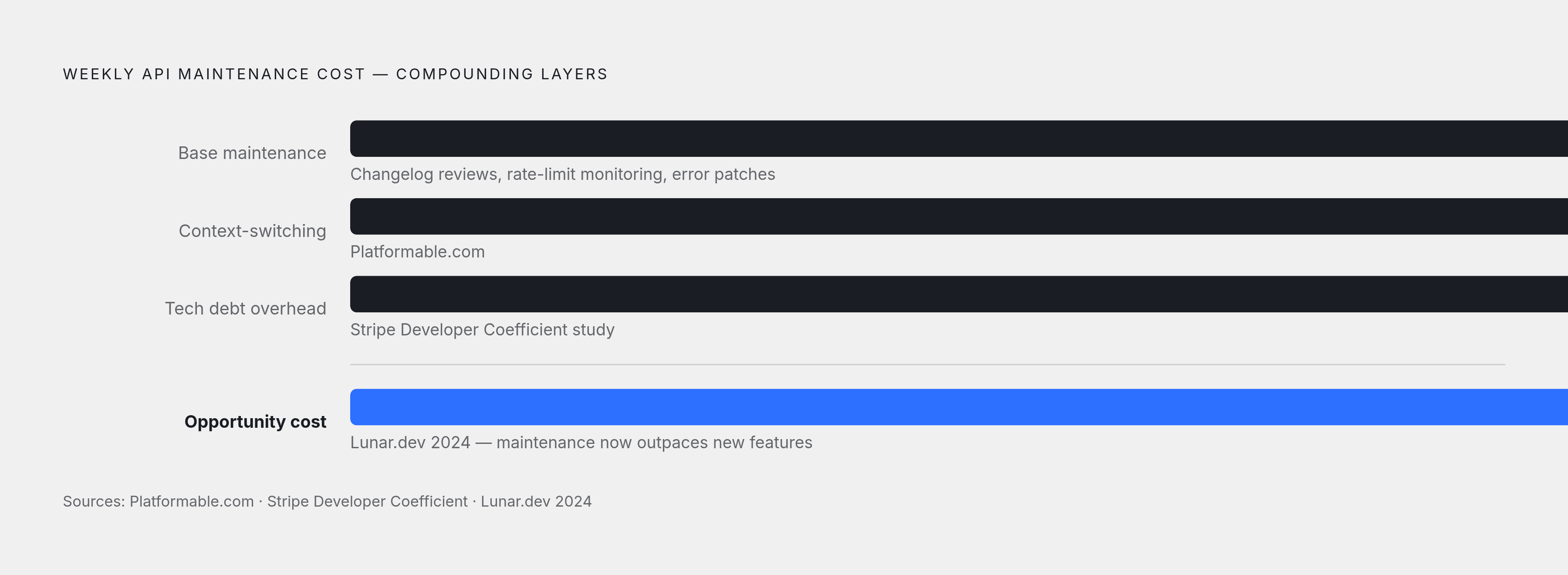
Every time someone gets pulled out of deep work to chase a deprecation notice or a broken response schema, they pay a re-entry cost on the other side. Platformable.com estimates that context-switching adds the equivalent of two to three weeks of developer time per year per API, before counting the actual time spent on the fix itself. Multiply that across twenty integrations and the number stops being theoretical fairly quickly.
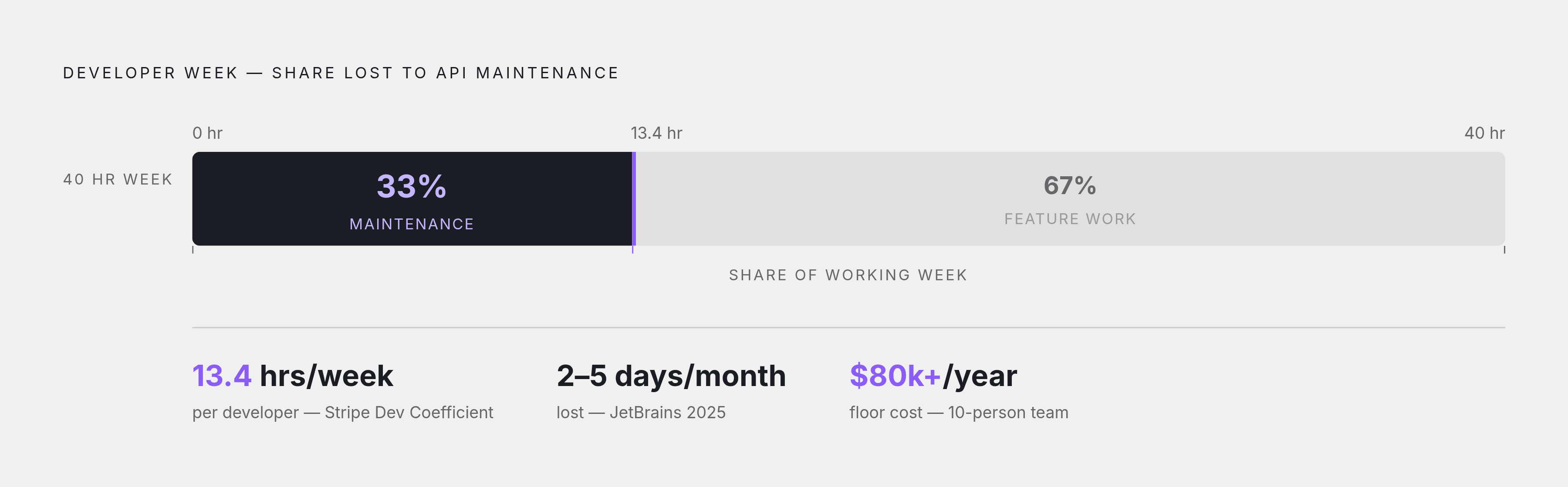
Stripe's Developer Coefficient study puts average time spent on technical debt at 13.4 hours per week, roughly 33% of a developer's time. JetBrains' 2025 survey puts tech debt overhead at two to five working days per month, meaning up to a quarter of your engineering budget disappears before anyone has scoped a single new feature.
These hours are structural. They show up every sprint, every quarter, and every year, and they grow with every integration you add.
What It Costs in Real Dollars
Fully loaded developer cost in the US sits between $160,000 and $170,000 annually at the median, per beon.tech's analysis. Senior engineers, once you fold in benefits, recruiting, and overhead, can run $250,000 to $350,000 or more. For rough purposes, a conservative middle lands around $80 per hour against a standard 2,000-hour work year.
At the low end of what Lunar.dev found, roughly one to two hours of API-related work per developer per week:
A 10-person team losing 2 hours each per week = 20 hours at $80/hour = $1,600/week
Annualized, that's well over $80,000
That's the floor, before any emergency incident response, planned migration projects, or features that slipped because a deprecation ate into sprint time. At the higher end of observed time loss, a 10-person team's annual exposure climbs into several hundred thousand dollars.
These figures also assume maintenance work is predictable and evenly spread. It isn't. One provider dropping a short-notice deprecation will spike your team's overhead for weeks. An authentication change breaking a production integration doesn't wait for your next sprint planning session.
This cost recurs every year, grows with every new integration you add, and almost never shows up in budget conversations.
Why Versioning Costs Are Hard to Plan
Most tech debt you can schedule, prioritize, and defer intentionally. With third-party API versioning, you don't get that option. The provider sets the deadline. Your sprint calendar is irrelevant to them.
Postman's 2025 State of the API Report found that 60% of teams version their own APIs, but only 26% use semantic versioning and only 17% run contract testing. That gap between intention and discipline is where production incidents are born. And that's for teams managing APIs they actually control. For third-party APIs, you inherit whatever deprecation habits the provider has.
What makes the cost genuinely hard to plan for:
Deprecation notices arrive through different channels depending on the provider. One sends an email. Another buries it in a changelog. Another puts a banner in the dashboard. Another sends it as an HTTP response header.
Breaking changes sometimes appear in response schemas with no formal version bump. You find out when something fails in production.
Authentication requirement changes arrive on their own schedule, completely separate from any versioning lifecycle.
There's also a behavioral trap baked into deprecation periods. When a provider announces a sunset six months out, the natural instinct is to note it and move on. The integration still works, there are features to ship, and you'll handle it when it gets closer. Then the deadline lands during a busy quarter, and a planned migration becomes a production incident. That sequence plays out constantly across teams with genuinely good intentions.
Industry analysts estimate roughly 30% of enterprise APIs see some form of breaking change or deprecation in a given year. For a team maintaining connections to a few dozen services, that's a handful of forced migrations annually with timing you cannot predict.
Provider Fragmentation Multiplies Your Planning Burden
A few examples from recent history make the point quickly.
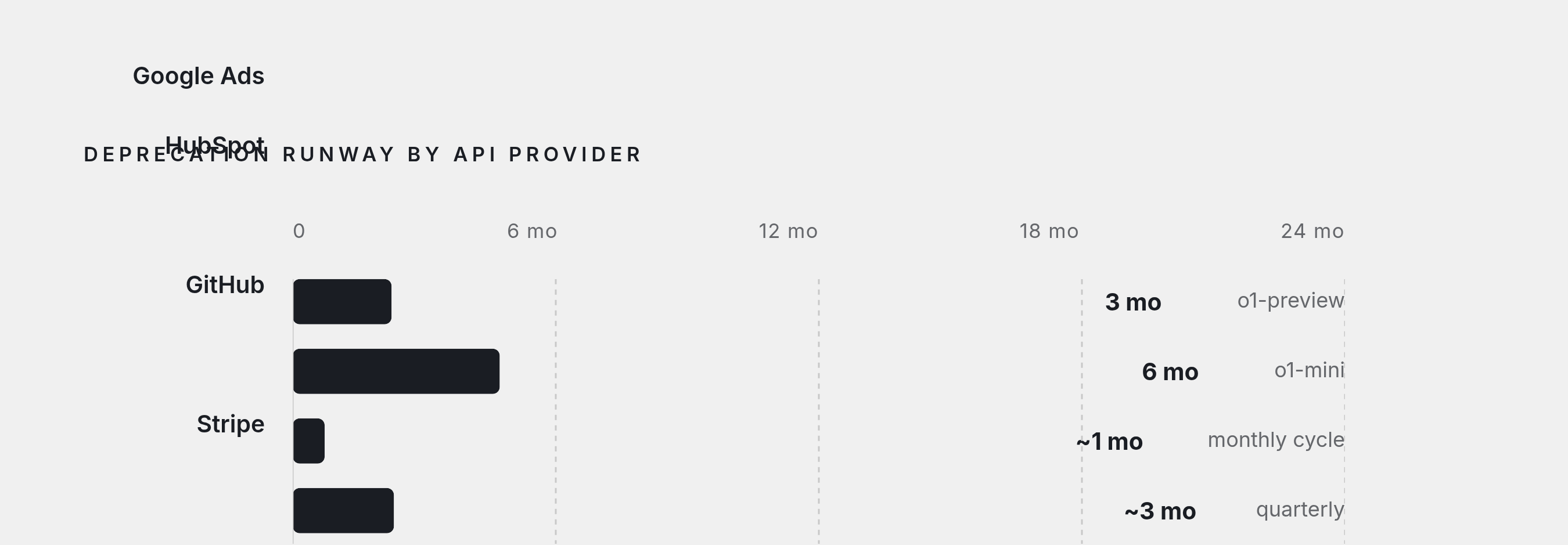
GitHub announces breaking changes roughly 12 months ahead, marks them in API schemas, emails OAuth app maintainers, and embeds Sunset headers in responses. Their 2020 GraphQL migration gave customers more than 24 months of runway. By the standards of this industry, that is exceptional.
OpenAI, between April and August 2025 alone, issued deprecation notices for o1-preview (three-month removal window), o1-mini (six-month window), and the entire Assistants API (one-year runway to August 2026). Three separate migration timelines in four months, none of which align with each other.
Google Ads API operates on a monthly release cycle with potential breaking changes. HubSpot uses date-based versioning on a roughly quarterly schedule. Meta's Graph API releases frequently, not all breaking, but the cadence demands constant attention. Stripe pins each API key to a version date and supports old versions indefinitely, which avoids forced migrations but lets multiple concurrent API versions accumulate in your codebase over time.
None of those approaches are wrong. But from the perspective of a team maintaining connections to all of them at once, the fragmentation is its own cost driver. A team connected to just ten providers must:
Monitor ten different communication channels for deprecation notices
Interpret ten different versioning conventions
Track ten independent deprecation timelines that share no common structure
There is no generalizable process that handles all of that cleanly. Each provider requires its own monitoring setup, and nobody is coming to fix that.
How the Sprint Tax Adds Up
The dramatic versioning events are easy to remember. The production outage from a missed deprecation. The emergency migration that ate two sprints. Those make it into post-mortems.
The quieter cost is bigger.
Every sprint carries an implicit tax line that nobody writes down: changelog reviews, rate-limit monitoring, error-handling patches, re-authentication flows after provider security changes. It's baked into velocity without being named, making everything feel slower and harder to finish in ways that are difficult to trace back to a source.
The 2024 Lunar.dev survey found that 40% of companies say they lack the time or resources to address rate-limit problems internally. Those teams end up writing middleware that keeps things running without fixing the underlying problem. That middleware becomes something else to maintain. The tax compounds on itself.
In the same survey, 47% agreed that better API management tooling significantly reduces overhead. The actual share experiencing the pain is higher; the other half just hasn't connected the symptoms to the cause yet.
The indirect costs are where the year really gets eaten:
A feature that should have shipped in Q2 slips to Q3 because a deprecation consumed two sprint days
Engineers context-switch mid-sprint to handle a production incident and carry the cognitive drag into their next task
On-call rotations absorb weekend hours when a deprecation deadline was quietly missed during a busy stretch
None of that appears as a single line in a budget. It dilutes velocity across dozens of sprints over the course of a year.
Integration Debt Gets Worse Over Time
Every deferred migration, every workaround written to keep an aging connector alive, every abstraction skipped because there wasn't bandwidth to do it right—these add to an integration debt balance that charges interest.
The Protiviti 2025 Global Technology Executive Survey found that organizations spend an average of 30% of IT budgets on technical debt management. For more than half of companies surveyed in a 2024 study, tech debt accounts for more than a quarter of total IT budget. Integration debt is a primary contributor to that category.
A reasonable rule of thumb: expect to allocate 15 to 25% of initial API development costs annually just for maintenance, before any version migration project or incident response gets added on top.
Teams carrying heavy integration debt typically report spending two to four hours on overhead for every ten hours of planned work. At a fully loaded cost of $150,000 per year per engineer, a 20-person team losing 25% of their time to this kind of overhead is looking at $750,000 per year in lost productivity. An MIT study found that complex, poorly designed software systems can incur up to 300% more maintenance costs than well-designed systems. The burden doesn't stay flat.
Adding your fifth integration doesn't cost five times what the first one cost. It costs more, because each new connector:
Interacts with existing connectors in ways the earlier ones didn't
Shares rate-limit budgets across services
Adds another deprecation timeline to track
Creates more surface area for cascading failures when something breaks
Pega's 2025 research puts average enterprise waste from technical debt at €370 million per year overall, with €134 million tied to legacy transformation. The cost curve steepens precisely when engineering capacity is most constrained, making the debt harder to address and easier to defer—and deferring it makes it worse.
What Your Team Actually Stops Building
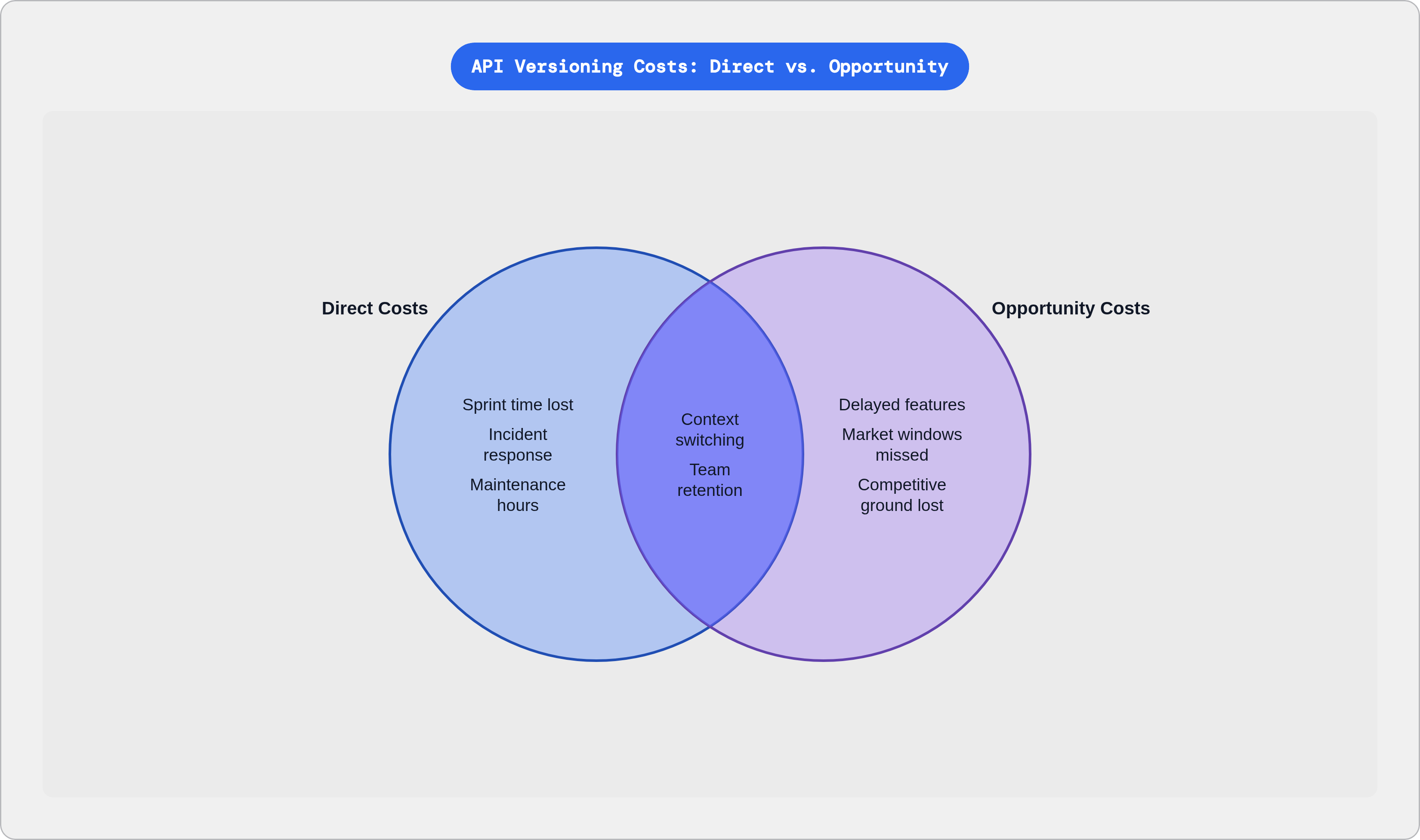
The direct cost of API maintenance is real but bounded. You can count the hours, multiply by the rate, and get a number.
The opportunity cost doesn't work that way. Features delayed by integration maintenance don't just cost the sprint time they consumed. They cost the market window, the customer conversations that didn't happen because the feature wasn't ready, and competitive ground ceded to a team that was shipping while yours was debugging a broken OAuth flow.
36% of companies in the Lunar.dev survey report spending more time troubleshooting APIs than building new features. For those teams, the ratio has structurally inverted. That's not a rough quarter. That's a broken operating model.
When a significant share of engineering time goes to integration upkeep, you have two options:
Hire to cover the maintenance load, making the cost explicit and immediate
Let feature velocity slow, making the cost implicit and spread across lost growth
Neither is neutral. Hiring specifically for maintenance work changes the composition of your engineering team over time—what engineers are recruited for, what they spend their careers working on, and how they feel about the job. That is a retention and culture issue sitting inside a cost issue.
The opportunity cost lands hardest at the early-growth stage, when headcount is small, every sprint matters, and the integration surface is expanding fast. That's when the sprint tax is most likely to determine whether you win or lose a market window, and also exactly when you're least equipped to absorb it.
Calculate Your Own Portfolio's Total Cost
Costs depend on your team size, your integration count, your providers' deprecation habits, and how mature your existing abstractions are. But the inputs are all named now, so you can run this yourself.
Count active third-party integrations in production—what's actively running and being maintained right now, not everything somewhere in the codebase.
Apply the 30% annual breaking-change estimate to project how many forced migrations you should realistically expect in the next 12 months.
Estimate weekly maintenance hours per engineer using the Lunar.dev range (one to two hours at the low end) as your floor.
Multiply by fully loaded hourly cost. Geomotiv puts the US benchmark range at $85 to $110 per hour as a useful reference point.
Add a multiplier for integration debt age. Systems that haven't been refactored carry the 15 to 25% annual maintenance premium on top of the base labor cost.
The output is almost always larger than teams expect—not because any single cost is dramatic, but because all of these costs run simultaneously across every integration in the portfolio, every week, all year.
The more useful question the exercise surfaces is this: how much of this cost is actually irreducible versus how much is a product of how your team has chosen to build and maintain its connectors? Provider fragmentation and deprecation churn are real, but a real share of the cost lives in the maintenance structure itself. Point-to-point integrations that live in your codebase mean every schema change, every auth update, and every deprecation event lands directly on your engineering team. Pre-built, managed connectors shift that burden to the infrastructure layer, where deprecation monitoring, schema updates, and re-authentication flows get handled without consuming sprint capacity.
The right comparison isn't build versus buy on any single integration. It's the total annual cost of your current approach, running across your entire integration portfolio, every year, growing with every connector you add.