How Often AI Models Actually Refresh What They Know About a Brand
Your brand's information in AI models lags years behind their stated cutoff dates.
Your brand's knowledge state inside an AI model runs older than the stated cutoff date, usually by a lot. Three separate delays stack on top of each other before your content ever shows up in a model's answer, and you probably have no idea any of this is happening. Understanding this pipeline matters because AI models are increasingly the first place buyers go to learn about products, compare options, and form opinions about companies. When those models carry outdated or missing information about your brand, the consequences show up in lost conversions and misaligned buyer expectations, not in error messages or flagged responses that anyone would notice and correct.
If ChatGPT says its cutoff is late 2025, you might assume your website's current state got baked in somewhere around that date. That's a misread of how the timeline actually works. There's a lag in when data gets collected, a lag between when training ends and the model ships, and a retraining cycle that leaves the model frozen until the next release. Stack those three and you're not looking at months of drift. You're looking at years. And, if your brand launched something new or changed pricing recently, there's a decent chance it's either invisible or just wrong in the model someone's consulting right now.
What a knowledge cutoff is and isn't
A cutoff is a hard stop, and past that date the model has zero training data. Nothing updates in the background, no live index refreshes itself. Training ends, and that's it until somebody builds a whole new model.
Here's where you might trip up. Data collection doesn't happen on one clean day; it stretches across months and tapers off near the end. Content published close to the actual cutoff is underrepresented, mostly because the internet hasn't caught up to it yet. The follow-up coverage and forum threads picking it apart haven't been written yet. That secondary layer of commentary and citation takes time to accumulate. Models rely on that secondary layer more than you might assume.
Common Crawl, one of the biggest sources of training data, runs on short fetch cycles. Miss one and your content waits for the next sweep. That alone can add two weeks of drift. Combine that with the tapering effect and you get a pattern researchers keep running into: effective cutoffs sit 3 to 6 months behind the stated ones. The gap is worse if you're not already a household name.
One more thing worth clarifying, because this confusion comes up constantly. The "updates" you read about, including safety tuning, interface tweaks, and general polish, don't move the knowledge cutoff at all. When OpenAI or Anthropic ships a refinement, the model isn't learning new facts about the world. It's getting better at following instructions and behaving more consistently in edge cases. The underlying knowledge base doesn't change.
So given that the cutoff sits somewhere other than where people assume, how old is the knowledge actually sitting inside the models everyone's using right now?
How stale are today's major models?
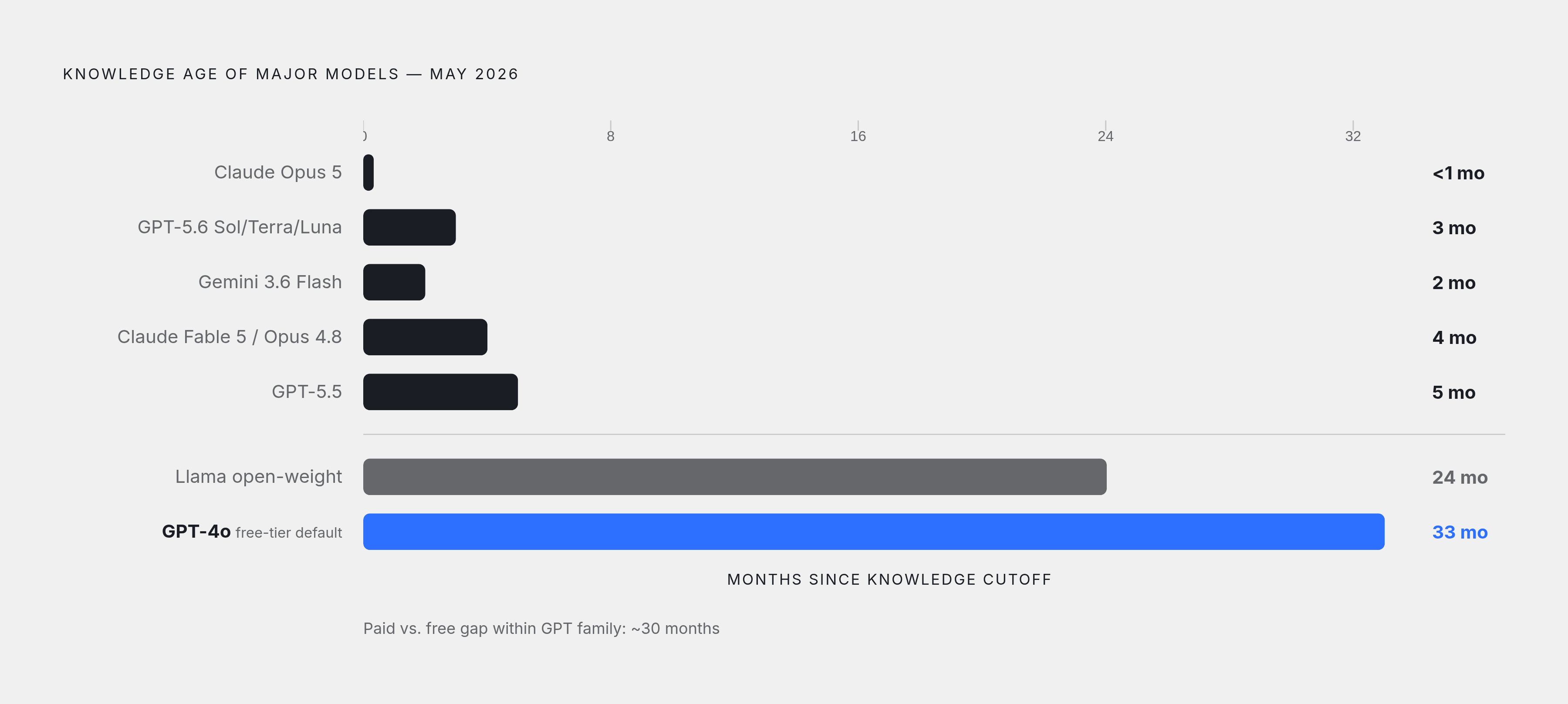
As of May 2026, every major production model in wide use is carrying knowledge somewhere between 12 and 30 months old, over a year in most cases, sometimes closer to three.
Walking through the actual lineup makes the spread clearer than any average would:
GPT-5.6 (Sol, Terra, Luna variants): cutoff of February 16, 2026, about as fresh as anything on the market
GPT-5.5: December 2025 cutoff
GPT-4o, still the free-tier default for most people: October 2023, a 33-month gap as of mid-2026
Claude Fable 5 and Opus 4.8: January 2026
Claude Opus 5: May 2026
Gemini 3.6 Flash: March 2026 baseline, with live Google Search bolted on top
Llama's open-weight line: stuck around mid-2024 after Meta's last open release in April 2025
DeepSeek: no officially published cutoff
The part that matters most for planning purposes: free ChatGPT users are on GPT-4o, that October 2023 snapshot, while you get GPT-5.5 or 5.6 as a paying subscriber, current within months. It's the same product family with a roughly two-year knowledge gap between the free tier and the paid one.
Most of the research floating around about AI citation behavior was built on GPT-4o, simply because it's the most widely used model. Which means a lot of the "here's how AI sees your brand" studies you've probably read were working from a knowledge base that was already significantly out of date on the day the research was published.
When somebody asks whether AI knows about their company, there's no single honest answer. It depends on the model, the tier, and the access method. Three people could ask the same question tonight and pull back three different eras of your company's history.
Why fresh training still ships stale
Training a large model burns an enormous amount of compute and takes weeks to months to run. The economics and infrastructure don't allow for frequent refreshes the way you'd refresh a webpage.
Even after training wraps, the model doesn't go straight to users. It runs through safety evaluation, fine-tuning passes, staged rollouts, and red-teaming. That gap between training completion and public availability has historically run 6 to 18 months, with most models landing somewhere in the 6 to 12 month range. A model is already behind the present moment the day it launches.
OpenAI has accelerated its release cadence to new versions every one to three months, which sounds fast until you notice that the underlying knowledge still jumps in discrete increments rather than climbing continuously. Each release represents a new snapshot, not a running update.
Put both delays together and the practical consequence looks like this: a brand that changes its pricing early in a given year may not show up correctly in a model for many months to over a year — assuming the data collection window even caught the change in the first place.
Brand knowledge inside AI moves in jumps, quarterly at best, annual more realistically. Continuous real-time updating is not how these systems are built.
The fast retrieval clock vs. slow training
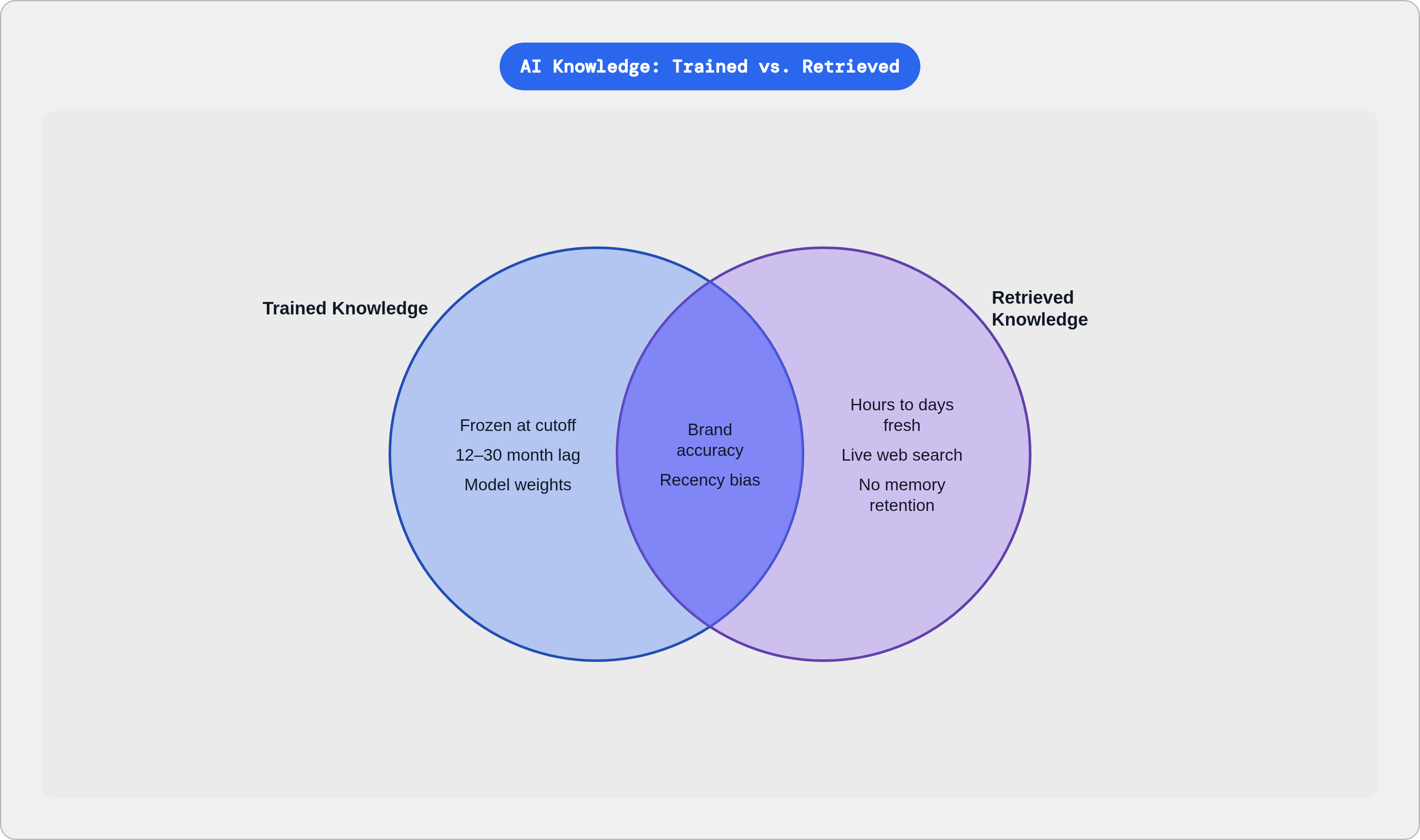
Two clocks run alongside each other in AI systems at very different speeds. Trained knowledge updates in those slow, discrete jumps described above, while retrieval can reflect a new article within hours of it getting indexed.
Not every product uses retrieval the same way:
Perplexity and Gemini search the web by default on every query
ChatGPT browses selectively, not automatically
Claude has web tools available but doesn't reach for them without being prompted
Retrieval does not update model weights; the model reads external content without absorbing it into its trained knowledge
That distinction matters more than it might seem. Internet access is not the same as knowledge. A model pulling from a live search often gives a more literal, occasionally less reliable answer than one drawing on its trained understanding, because it's working from retrieved text rather than internalized understanding. And in contexts where browsing isn't enabled at all, a brand is stuck waiting for the next model release whose training window happened to include the relevant information.
The market is investing heavily in retrieval-based approaches. Precedence Research put the global retrieval-augmented generation market at $1.85 billion in 2025, with projections landing at $67.42 billion by 2034, representing 48.9 percent annual growth. That scale of investment signals an industry reorganizing around the faster clock.
Practically, that means getting indexed and treated as authoritative on the open web is essential for retrieval visibility. But retrieval does nothing for the trained knowledge base. If a model isn't browsing, your current web presence may as well not exist to it.
What stale brand knowledge actually costs you
The failure modes here are not exotic. They're routine, which is exactly why they go unnoticed:
Old positioning or a discontinued product name repeated as accurate information
A product you retired a year ago still showing up as a live offering
Pricing or eligibility rules that changed, quoted to a buyer who then acts on the wrong number
A new product simply absent from the model's picture of the world
Most of this traces back to a stale source, not hallucination in the way people usually mean the word. A brand's own website accounts for only 5 to 10 percent of what a model reads about it according to McKinsey's 2025 research. This means that the wrong fact almost always lives somewhere you didn't think to check: an old press writeup, a marketplace listing nobody updated, a review site frozen in 2022. This problem bites hardest after rebrands, acquisitions, or category expansions — anywhere the public web moves slower than your business does.
Even retrieval-based accuracy decays faster than you'd hope. Content cited 82 percent of the time at the 30-day mark can fall to 37 percent by 180 days. Retrieval visibility doesn't hold its value indefinitely.
To understand how large an accuracy gap can get, consider an Oregon State University study on clinical guideline accuracy. It found that models with cutoffs predating updated guidelines, GPT-3.5-Turbo and Llama-2, scored 76.03% and 25.26% on benchmark questions, while models whose cutoffs came after the updated guidelines, GPT-4o and Llama 3.3, scored above 90%. The difference between a model that predates key information and one that includes it is not marginal.
Business leaders register this concern even when they can't always identify its source. Among large US companies, reputation ranks as the single most cited AI-related risk, named by 38% as their top concern according to The Conference Board and ESGAUGE in 2025, well ahead of cybersecurity at 20%.
The uncomfortable reality is that buyers almost never tell you the AI gave them wrong information. No complaint gets filed, no flag gets raised. They simply don't convert, or they arrive already holding incorrect expectations, and you never learn why. The damage is real; the attribution is nearly impossible unless someone is actively monitoring for it.
What content actually gets read by AI
Research into AI crawler behavior consistently shows a strong recency bias, with activity heavily concentrated on content published in the last few years and a steep drop-off beyond that window.
The implication that anyone sitting on well-sourced older content should draw is that quality alone doesn't guarantee inclusion. A well-researched page about your brand from 2021 can simply fall outside the training window for the next model, regardless of how accurate or thorough it is.
There's a second-order effect that compounds this problem. Low-authority scrapers holding onto old content can outrank newer, more accurate brand pages in terms of AI visibility, purely because they've existed longer and accumulated more inbound references over time. Age and link history still signal authority to these systems, even when the content itself is outdated.
Recency alone isn't sufficient, but it functions as a baseline requirement. Content needs to be both authoritative and recent to have a real chance at appearing in the training data and retrieval results that shape what a model says.
This is where independent, editorially credible publishing earns its value. A brand's own blog carries relatively weak trust signal as far as AI systems are concerned. Third-party publications with real editorial standing carry more weight, both for training data selection and for retrieval ranking. The stakes are higher than in the traditional search context, mainly because an AI model hands the user one answer instead of a page of ten links to evaluate independently.
Planning around the three-delay pipeline
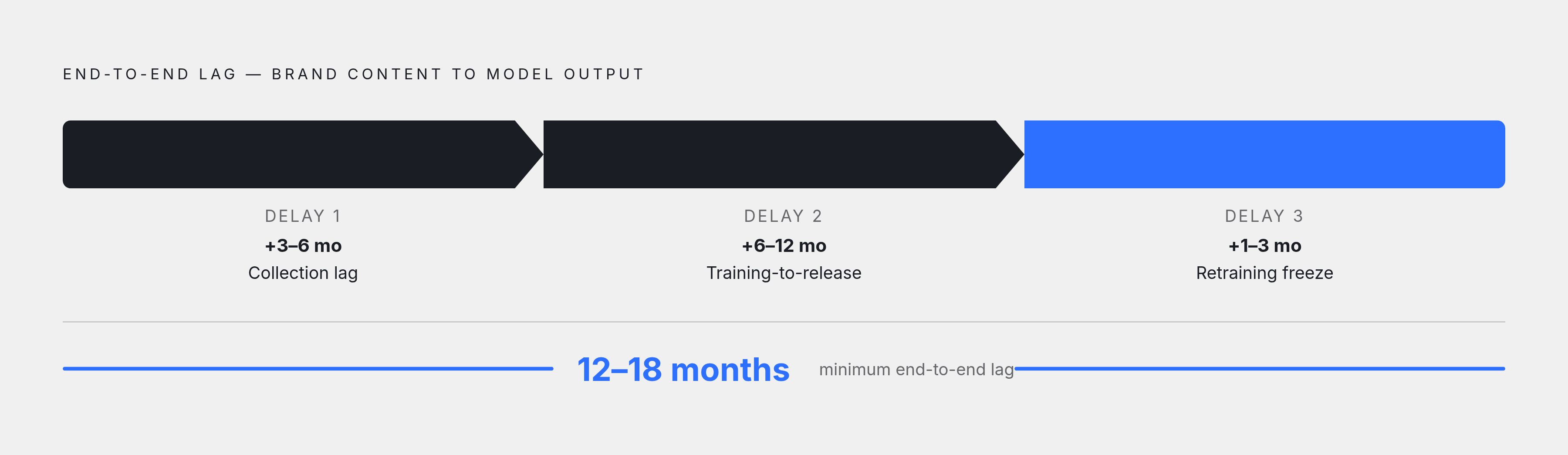
Treating the three delays as a planning framework rather than background trivia changes how you think about content timing and measurement. Here are the three delays, with what each one means for your content:
Delay 1: data collection: content near the crawl boundary can miss the current fetch window by up to two weeks, and effective coverage runs 3 to 6 months behind the stated cutoff for brands that aren't already widely referenced across the web
Delay 2: training-to-release: even once collection wraps, the model typically doesn't reach users for another 6 to 12 months
Delay 3: retraining cycle: once shipped, a model sits frozen until the next release. OpenAI has accelerated to every one to three months, but many providers move slower, and API deployments, including GPT-4o installations still on that October 2023 cutoff, often never get updated
Adding those up, the honest (but optimistic) planning estimate looks like this: content you publish today starts shaping trained-model answers 12 to 18 months out. The timeline extends further for slower providers and further still for anything baked into an API integration that nobody is actively maintaining.
Retrieval runs on a completely different timeline, hours to days, but only on surfaces that actually browse, and only if your content is indexed and treated as credible in the first place.
That distinction has direct consequences for measurement. Whether a model names your brand only means something once you know which model you tested, which tier, whether browsing was enabled, and how many queries you ran. A raw mention count with no context is not a reliable data point. A result of zero requires diagnosis before any conclusions are drawn: is this a genuine authority gap, or did you query a model whose training predates anything relevant about your company?
The strategy that follows from understanding this pipeline is not complicated, even if it's not fast. Publishing consistently on platforms with real third-party editorial credibility is the one approach that works on both timelines simultaneously. It improves retrieval visibility in the near term and seeds the training windows that future models will draw from later. Compressing these three delays to zero isn't possible given how these systems are built. Understanding the pipeline precisely is what separates a content strategy built for how AI actually works from one that's just publishing and hoping. Stop assuming your website feeds directly into the model's knowledge base.