AEO vs GEO — What the Difference Means for B2B Content Strategy
AI systems now judge brands on consistent visibility across the web, not just search rankings.
A B2B buyer today can form a complete opinion of a vendor without ever clicking through to that vendor's website. The research happens inside a chat window instead, and the vendor often has no idea it's being judged there.
How B2B Buyers Form Vendor Opinions
Picture a buyer typing "which vendors should I consider for content strategy" into ChatGPT instead of Google. A few years ago that question would have kicked off a dozen open tabs. Now it produces one answer, with a short list of names already baked in, and the buyer may never click past it. ChatGPT, Perplexity, Google AI Overviews, and Gemini have gone from curiosities to the first stop for research questions, and that shift changes who gets seen before a sales call ever gets booked.
It also breaks a rule that used to be reliable: rank first, get seen first. A page can be at the top of Google's organic results and still get skipped entirely by the AI answer sitting above it, because ranking and getting cited are now two separate contests with two separate scoreboards. A vendor can win one and lose the other without knowing it happened.
The downstream effect is a quieter, more decided kind of website visitor. Overall traffic drops as more questions get answered on the spot, with no click required. But the people who do eventually land on a vendor's site tend to arrive already holding a mental shortlist, built from an AI summary they read five minutes earlier. The first impression already happened somewhere else.
Why the terminology around this shift is still unsettled (and why the AEO/GEO distinction is worth making anyway)
The industry hasn't agreed on what to call any of this. Depending on which blog post lands in a marketer's inbox, the same work gets labeled AEO, GEO, AIEO, or AIO, and plenty of practitioners use these terms interchangeably without meaning to. That's a messy starting point, but the mess shouldn't be mistaken for emptiness. Two of these terms, AEO and GEO, point at genuinely different problems, and knowing which one a piece of content is solving changes what a content team actually builds.
Some of this confusion is fair, because the disciplines really do overlap at the foundation. Strong SEO authority helps both AEO and GEO. That objection isn't wrong about the foundation, but it stops looking one layer too early.
Where the terms split apart matters more for a B2B team than the shared foundation does. GEO, as a term, came out of academic research at Princeton, Georgia Tech, the Allen Institute for AI, and IIT Delhi, published at the 2024 KDD conference, and it's since been picked up in e-commerce for product discoverability (though even there, practice is still ad hoc and nobody fully understands the downstream effects yet). AEO, meanwhile, grew out of a narrower, older idea: winning the single best answer to a single specific question. But the levers a team pulls to win each game are different enough that treating AEO and GEO as one undifferentiated task leaves real opportunity sitting on the table. The rest of this piece makes the case for where that difference actually shows up, and what to do about it.
AEO's Target: The Source an AI Quotes for a Specific Question
AEO is a smaller, sharper target than most B2B teams assume. It's about winning one specific moment: a buyer asks a precise question, and an AI engine has to pick exactly one source to quote back. AEO is the fight for that single citation.
The prize is the sentence the AI delivers and the name it credits for that sentence, a single citation rather than a position in a results list or a broad halo of brand awareness. Winning that prize means writing in a way these systems can actually use. Answer engines favor content that states a clear answer early, backs it up with real evidence, and organizes itself so a model doesn't have to guess what the point is.
A few habits make content easier for these systems to lift and quote. Put the actual answer near the top of the page, not three paragraphs into a windup, because models tend to read and extract from what comes first. Back claims up with named sources, specific numbers, and real quotations, since content that looks and reads as citable gets cited more. Write in confident, direct language instead of hedging everything, because AI systems tend to pull sentences that sound certain, not sentences full of "it depends" and "generally speaking." Keeping the content current matters too: these engines penalize material that reads as stale, so a regular refresh schedule is part of staying visible.
Success here doesn't look like a ranking or a click count. It looks like how often a piece of content actually gets cited, how often it shows up in featured snippets across the exact questions a buyer would ask, how often it gets pulled into an AI Overview, and whether what gets quoted is even accurate to what was written. All of this ties back to the idea of E-E-A-T, which rewards content that visibly demonstrates expertise: author credentials attached to the piece, answers formatted tightly and authoritatively, sourcing that would hold up if someone checked it. Answer engines use exactly these signals to decide, passage by passage, which source in a sea of similar pages actually deserves the quote. Good AEO work also tends to help plain old SEO rankings, since the same clarity and sourcing that wins a citation tends to please a search algorithm too. But winning the citation is its own separate fight, and it's the one AEO is built to win.
GEO's Target: The Brand Story AI Tells Across Every Surface
GEO operates a level up from AEO. Instead of competing for one quoted sentence, it shapes the entire mental picture an AI system has assembled about a brand from everything it has ever encountered about that brand, pulled together into one answer. The target is the fuller company profile an AI gives back when a buyer asks something wide open, like "who are the leading content strategy firms for B2B SaaS?
This is the most counterintuitive part of this whole subject for teams used to thinking of GEO as a technical SEO checklist: brand consistency is the actual mechanism GEO runs on. It reflects the mess straight back to the buyer asking the question. No schema markup, no technical fix, no clever tag in the code can patch over a brand that's telling three different stories about itself across three different web pages. The fix for that problem lives in editorial discipline rather than a developer's to-do list.
GEO also quietly rewrites the old rulebook on authority. Traditional SEO ran on backlinks: the more sites that linked to a page, the more Google trusted it. GEO runs on something broader, a brand's presence and consistency across the whole web. That means keeping the same name, address, and phone number everywhere a brand appears, since AI systems use that consistency to verify a business actually is who it claims to be. It means showing up correctly in structured data and knowledge graphs, so a brand reads as a recognized entity and not just another domain name. It means earning real mentions in publications these AI systems treat as trustworthy sources. It means having an actual presence on third-party review sites and in communities like Reddit and LinkedIn, both of which these systems increasingly treat as evidence that a brand is real and reputable. And it means putting author names and credentials on content clearly and consistently, because GEO judges trust at the level of the whole entity, not just at the level of one isolated page.
Measuring any of this requires new yardsticks, since old ones don't translate. Teams running GEO programs are starting to track things like "share of AI voice" and "generative appearance score," replacing the ranking and impression numbers that used to tell the whole story.
AEO and GEO in the B2B Buying Cycle
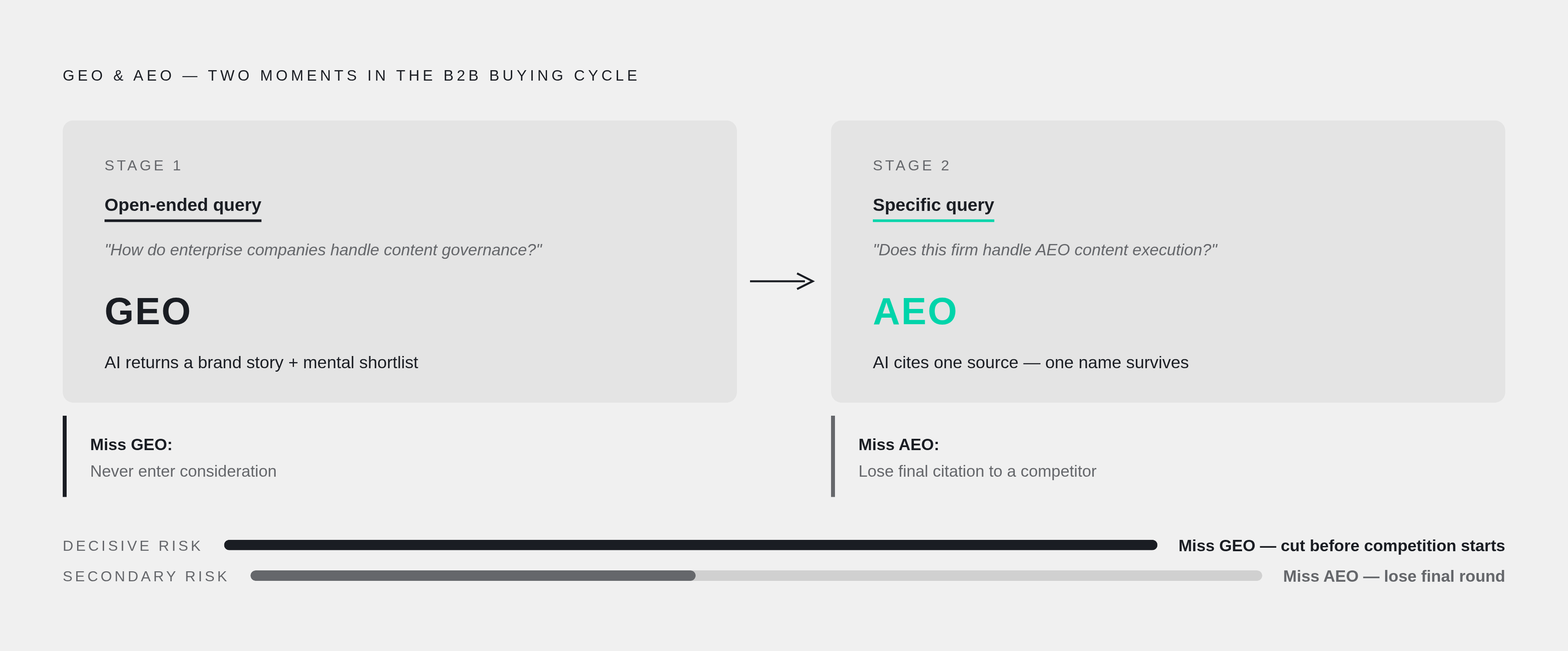
AEO and GEO aren't two names for the same job. They answer two different kinds of questions, asked at two different points in the buying process, and a content program that only builds for one of them is leaving the other stage of the funnel to chance.
Picture a VP of Marketing at a mid-market SaaS company who needs a content strategy partner. Early on, she doesn't know any vendor names yet. She asks something open-ended, like "how do enterprise companies handle content governance?" That's a GEO moment. Whatever names show up in that answer enter her mental shortlist before she's even started comparing anyone directly. A firm that's invisible in that answer may never get a second look because it was never entered into the competition.
Weeks later, her research narrows. She's down to two or three names and wants specifics: "what's the difference between Vendor A's approach and Vendor B's?" or "does this firm handle AEO content execution specifically?" That's an AEO moment, and whichever source gets quoted in that answer has real influence over which name survives to the shortlist's final round.
The asymmetry between these two moments is the whole argument. Missing the GEO moment can keep a brand out of consideration entirely; missing the AEO moment can cost an already-considered brand the final citation to a competitor at the exact point a decision gets made. Different failure, same outcome: a lost deal. And because AI answers only ever surface a small handful of cited sources per query, being absent at either stage costs a brand real visibility, not just a nice-to-have boost. It means being cut out of an earlier, increasingly decisive stretch of the buying cycle, one that a lot of sales teams don't even know is happening upstream of them.
A Single Content Program for AEO and GEO Together
None of this requires standing up two separate departments or tripling the content budget. AEO and GEO share enough of their underlying requirements that one well-built content program can serve both. What changes is emphasis and oversight, not headcount.
The shared foundation is the same quality signal both disciplines are built on: original research, named authors with real credentials, claims that can be checked, and genuine depth on a topic instead of a shallow pass. That one bundle of qualities satisfies AEO's need for citable, extractable answers and GEO's need for a brand that reads as a trustworthy, recognized entity, at the same time, from the same content. One more useful shared investment is an llms.txt file, an AI-facing index similar in spirit to a sitemap.xml, which supports both AEO's discoverability needs and GEO's entity-recognition needs in a single move.
From that shared base, the two disciplines split off into different kinds of work. AEO work happens mostly on the page: restructuring content so the direct answer sits up top, adding FAQ schema, building clean tables, and keeping citations and data current. GEO work happens mostly off the page, at the level of the whole brand: making sure the story a company tells is the same whether an AI reads the homepage, the blog, a review site, or a LinkedIn post.
A simple audit makes the gap between the two visible fast. Open ChatGPT, Perplexity, and Gemini, and see what each one knows about the company and its category. Any confusion, contradiction, or gap in those answers is the GEO to-do list. Any specific question the company should be winning but isn't cited on is the AEO to-do list. From there, both sides need their own tracking, since the old metrics don't cover either one: citation frequency and AI Overview inclusion for AEO, share of AI voice and generative appearance score for GEO.
What Phantom Farm does for this kind of integrated B2B content work
Brand governance, content architecture, and the editorial discipline to make sure an AI system represents a company accurately, both in a single cited answer and in the broader category story it tells, are the harder problem to solve. That's a harder problem to solve than adding a line of structured data to a web page, and it calls for a partner built to work both ends of it at once.
Phantom Farm is positioned as that kind of integrated B2B content partner, built to handle the strategic and governance work AEO and GEO both require rather than treating either one as a technical afterthought bolted onto existing content. In the buyer-journey terms laid out above, that means building programs that work on early-stage GEO brand presence and late-stage AEO citation at the same time, instead of treating one as a side project to the other. For a B2B team trying to show up correctly both in the open-ended question that builds the shortlist and the specific question that closes the deal, that combined focus is the actual job to be done.