Malformed API Response Handling Patterns for SaaS Teams
Three common response patterns silently break SaaS integrations without triggering alerts.
Most SaaS teams have their arms around API errors. An error shows up, the dashboard turns red, someone gets paged, someone fixes it. That part of the job is basically solved. The response comes back looking completely fine: status 200, valid JSON, every box checked, and still wrong underneath, and three failure modes cause this, all of which slip past the monitoring most teams already have.
The first is a status code that lies. Clients branch on status codes to decide what to do next, so a 200 OK wrapped around an error body breaks every automated system touching it. Getting 401 confused with 403, or 400 confused with 422, isn't a style question. A client that can't tell "you're not logged in" from "you're logged in but not allowed" literally doesn't know whether to refresh a token or give up.
The second is the silent failure riding inside a technically valid response. The API answers successfully. The payload is wrong, incomplete, or just empty. Nothing alerts on this, because nothing is technically broken. It gets found when a customer emails support, or when a report three systems downstream comes back looking strange.
The third is schema drift, the slow divorce between what a producer sends and what a consumer expects. The Fern API design guide and other sources point to undetected schema drift as a routine cause of broken integrations and bad production data. Drift runs both directions: code changes and nobody updates the spec, or the spec changes and the code never catches up. A pipeline built on n8n ran into exactly this. An external webhook kept returning a clean 200 OK, but the vendor changed its payload shape without warning. Downstream node mapping failed quietly, and because n8n never logged a system-level execution failure, the pipeline just sat there, not syncing data for days, looking fine from the outside the whole time.
Silent failure compounding across REST, GraphQL, and AI agent traffic
The same failure dresses differently depending on what's consuming it, and each costume is good at hiding from a different kind of monitoring.
REST is the simplest case and still trips people up constantly. Zuplo's error handling guide calls out the classic move: returning 200 OK with a body like {"error": "not found"} instead of an honest 404. The status code is supposed to be the contract. Stuffing the real answer into the body instead breaks every client that reads the status first and the body second, which is most of them. Layer onto that the fact that every API tends to invent its own error shape, and consumers end up writing custom parsing logic for each one. More formats to parse means more places for a new failure mode to go unnoticed.
GraphQL hides the same problem differently. A GraphQL server can return HTTP 200 on a request where a resolver quietly failed and nulled out a field the client actually needed. Standard monitoring sees a wall of green 200s and calls it a good day, while users are staring at broken pages. GraphQL does have an errors array built for exactly this, but it can sit right next to a populated data object. A client that checks for 200 and reads the data without checking the errors array processes corrupted data and never knows it.
AI agent traffic adds a third flavor. When a service built on a large language model starts degrading, it tends to keep returning success-shaped responses. The HTTP contract is satisfied. Latency might even look normal. The content is just semantically wrong, confidently wrong, in a way no status code was ever designed to flag. For agents acting on these responses without a human reading them first, that gap matters more than it would for a person who'd glance at the output and go "that's nonsense." Billing and financial SaaS products carry the sharpest version of this risk: a silent failure here doesn't mean a broken dashboard, it means a double charge, a missed payment, or a compliance problem nobody notices until an audit.
Three failure modes, three protocols, three different blind spots. That's the case for layering defenses instead of picking one fix and calling it done.
Standard HTTP status code discipline as the necessary first layer
Status codes are where defense starts, because status codes are where teams most often go wrong first, and that mistake poisons everything built on top of it.
Two distinctions cause most of the damage in practice. The first is 401 against 403. One says "we don't know who you are," the other says "we know exactly who you are and the answer is still no." A client that can't tell those apart doesn't know whether to prompt for a login or just stop asking. The second is 400 against 422. A 400 means the request itself is broken, bad JSON, missing field, malformed syntax. A 422 means the request was perfectly well-formed and still failed a business rule, like an order quantity of negative three. Collapsing both into one generic error response strips away the field-level detail a client needs to actually fix anything.
A 5xx is supposed to mean "try again, this might be temporary." A 4xx, with a couple of named exceptions like 429 and 408, is supposed to mean "don't bother retrying until you fix the request." Mark a non-retryable error as a 5xx by mistake, and clients start hammering a server with requests that were never going to succeed. Stacking three layers of an application that each retry three times multiplies the load downstream fast. That's a reliability incident whose root cause nobody will find until they trace it all the way back to one mislabeled status code.
The API7.ai error documentation guide states the rule directly: never use 200 OK to hide an error in the body. It breaks generic tooling and makes dashboards report failures as if everything's fine, which is arguably worse than no dashboard.
RFC 9457 as the structural answer to bespoke error format fragmentation
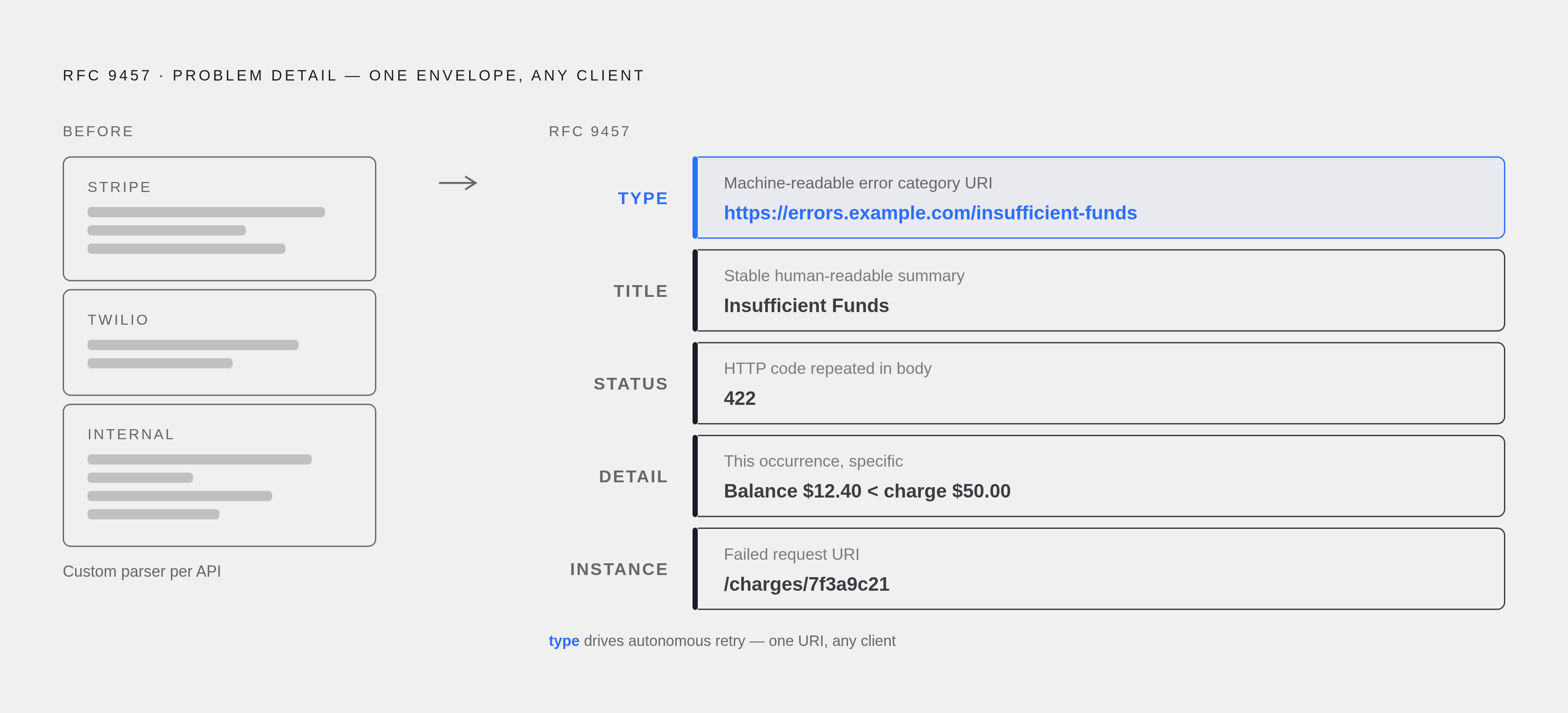
Getting the status code right solves half the problem. Most of the integration pain actually lives inside the response body. Every API inventing its own error shape forces every consumer to write custom parsing logic for every single integration, and that cost adds up fast across a stack with dozens of upstream services.
RFC 9457, published in July 2023, is the current standard answer, and it replaces the older RFC 7807 (anything already built to the old spec is already basically compliant with the new one). It defines a "problem detail" object with five fields:
{
  "type": ",
  "title": "Insufficient Funds",
  "status": 422,
  "detail": "Account balance of $12.40 is less than the requested charge of $50.00.",
  "instance": "/charges/7f3a9c21"
}
type is a URI identifying the category of error. title is a stable, human-readable summary. status repeats the HTTP code in the body for convenience. detail explains this specific occurrence. instance identifies the specific request that failed. Served with the content type application/problem+json, this response tells a client what happened without anyone writing custom parsing logic for it.
The format also supports extension members, so an errors array for field-level validation failures, or a requestId and traceId for log correlation, can be added alongside the five standard fields without breaking the spec. Spring Boot 3 and ASP.NET Core 7 both ship this natively, so for teams already on those stacks, adopting it costs close to nothing.
The real discipline the RFC enforces is that clients should branch on the stable type URI and the status code, never on the title or detail text. String-matching on a message is fragile. It breaks the moment someone fixes a typo or the app gets translated into another language. For AI agents specifically, this matters even more: a machine-parsable error code supports autonomous retry logic and lets an agent correct its own request, while a message meant only for human eyes gives it nothing to act on.
One more thing the format enforces, almost as a side effect: discipline about what gets shown. Full technical detail, stack traces, SQL, internal hostnames, library versions, stays in the server logs. The client gets a short requestId so support can trace the issue without the response doubling as a map of the company's internal infrastructure for anyone who wants to misuse it.
Schema validation as the layer that catches what status codes and error envelopes cannot
Status codes and error envelopes both depend on the API admitting something went wrong. The hardest failures occur when the response says 200 and the shape looks plausible, but the content underneath has quietly drifted away from what the consumer expects, so nothing admits anything is wrong. Catching that requires active schema validation, and it has to sit on the consumer side, at the point of ingestion, not just as a hope that the producer got it right.
A sufficient validation check confirms more than "is this JSON." It checks that required fields are actually present. It checks type correctness, so a field declared as an integer doesn't sneak in as a string. It checks enum constraints, so a value outside the declared set gets caught instead of passed along. It checks format rules, so a date field that isn't in ISO 8601 or an email that fails the declared pattern gets flagged before it reaches business logic. It checks numeric bounds, so a negative quantity on an order line doesn't slide through into a billing calculation.
A B2B payments platform with a large number of partner-facing endpoints logged multiple P1 incidents over six months, and the cause each time traced back to an interface regression: a renamed field, a tightened enum, a removed optional parameter. A schema validator sitting at ingestion would have caught every one of those before the bad data ever touched business logic. A separate global payments company, running many internal microservices, found that integration bugs made up nearly half of its production incidents in a single year. After the company moved to schema-first development with contract tests run at the pull request stage, that share dropped sharply over the following two quarters.
Contract testing discipline is rare. DORA research cited by Fern found that only a minority of organizations actually run contract testing, even though most claim to version their APIs. Critics point out that running a Pact broker and a full consumer-driven contract pipeline is a lot to ask of a small SaaS team. That criticism lands, but it doesn't let a team off the hook for validation. The old networking advice to "be liberal in what you accept" was never meant as a substitute for validation at the boundaries that matter. It's fine for an unknown extension field nobody's using yet. It is not fine for letting a null slide silently into a billing calculation. A team needs to answer which fields make up the actual behavioral contract and which ones are genuinely optional. On the producer side, automated breaking change detection at the pull request stage, comparing the new API definition against the old one before deployment, catches the renamed-field and removed-field class of drift before it reaches a consumer.
Idempotency and circuit breakers as the operational layer that makes retries safe
Catching a bad response is only half the job. What a system does next has to be safe even when the picture is still unclear, and that's where idempotency and circuit breakers come in.
Idempotency keys on POST and PATCH operations exist for exactly this moment: a request times out, the response is ambiguous, and the system doesn't know if the original request succeeded or not. Without an idempotency key, retrying that request can create a duplicate order, charge a card twice, or corrupt an inventory count. Lago's billing API guide treats idempotency as a cornerstone of reliable distributed systems. For billing and financial APIs specifically, a duplicate charge isn't a minor bug ticket: it is a compliance problem and a trust problem, the kind of thing that shows up in a customer complaint with a lawyer cc'd.
Retry policy needs the same discipline as status codes, because the two are directly connected. Retries are only safe for genuinely transient failures, things like a 5xx, a 429 with a Retry-After header, or a plain network timeout. Retrying a 4xx wastes effort on a request that was never going to succeed and can pile load onto a system that's already struggling, the same waste that follows when status codes get misclassified. Exponential backoff with some jitter mixed in is the standard way to keep retries from all stacking on top of each other at once.
Circuit breakers need an update for this environment too. A classic circuit breaker watches for HTTP failures and trips when there are too many. That's not enough for AI agent consumers or for services built on language models, because the circuit also needs to track quality failures: any output that breaks the expected schema, violates a rule the system is supposed to guarantee, or could trigger an unsafe action, even when the HTTP call itself came back as a clean 200. A degraded LLM-powered service tends to keep returning success-level responses right up until someone notices the output doesn't make sense. A circuit breaker watching only status codes stays closed the entire time, green across the board, while bad data keeps moving through the system underneath it.