When Search Traffic Is Up but AI Models Never Mention You
AI models cite brands differently than search engines rank them, rewarding mentions over backlinks.
Your search traffic is up. Your impressions are climbing. And when someone asks ChatGPT which vendor to consider in your category, your name never comes up. Two separate authority systems are at work here, each with its own rulebook, and you're winning one while getting completely ignored by the other. Your tracking isn't glitching.
Here's why that split happens, and what it actually takes to close it.
How zero-click behavior is making search success look better than it is
Impressions climbing while traffic sits flat isn't a mystery. It's math, and a fairly simple one at that. AI Overviews and instant answers now resolve a huge share of queries right there on the results page, before anyone clicks through to a website. Your listing can sit at the top of the page and still get a fraction of the clicks it used to earn from that spot, because Google already answered the question above it.
The Pew Research Center tracked this directly, watching real browser behavior across tens of thousands of actual Google searches rather than modeling it from a spreadsheet. The finding: when an AI Overview shows up, click-through on the organic results below it drops sharply, not gradually.
So picture the marketing team staring at a dashboard. Impressions up, they think, must be healthy. What the dashboard can't show is how many of those queries got fully answered without the brand's name ever appearing in the answer, and that's an invisible failure mode. It's a big one in B2B technology specifically, where AI Overviews now trigger on the vast majority of buyer queries. The category with the most money on the line is also the category where this problem has advanced the furthest.
There's a deeper cut here too. Zero-click search doesn't just reduce clicks, it severs the exact moment a brand used to insert itself into someone's consideration list. Gartner's 2025 research on B2B buying found that most purchases end up going to vendors buyers already had in mind before they searched at all. If the AI answer never puts you on that list, the click you lost was never really the point. The list was.
Why AI models build their answers from different signals than search engines do
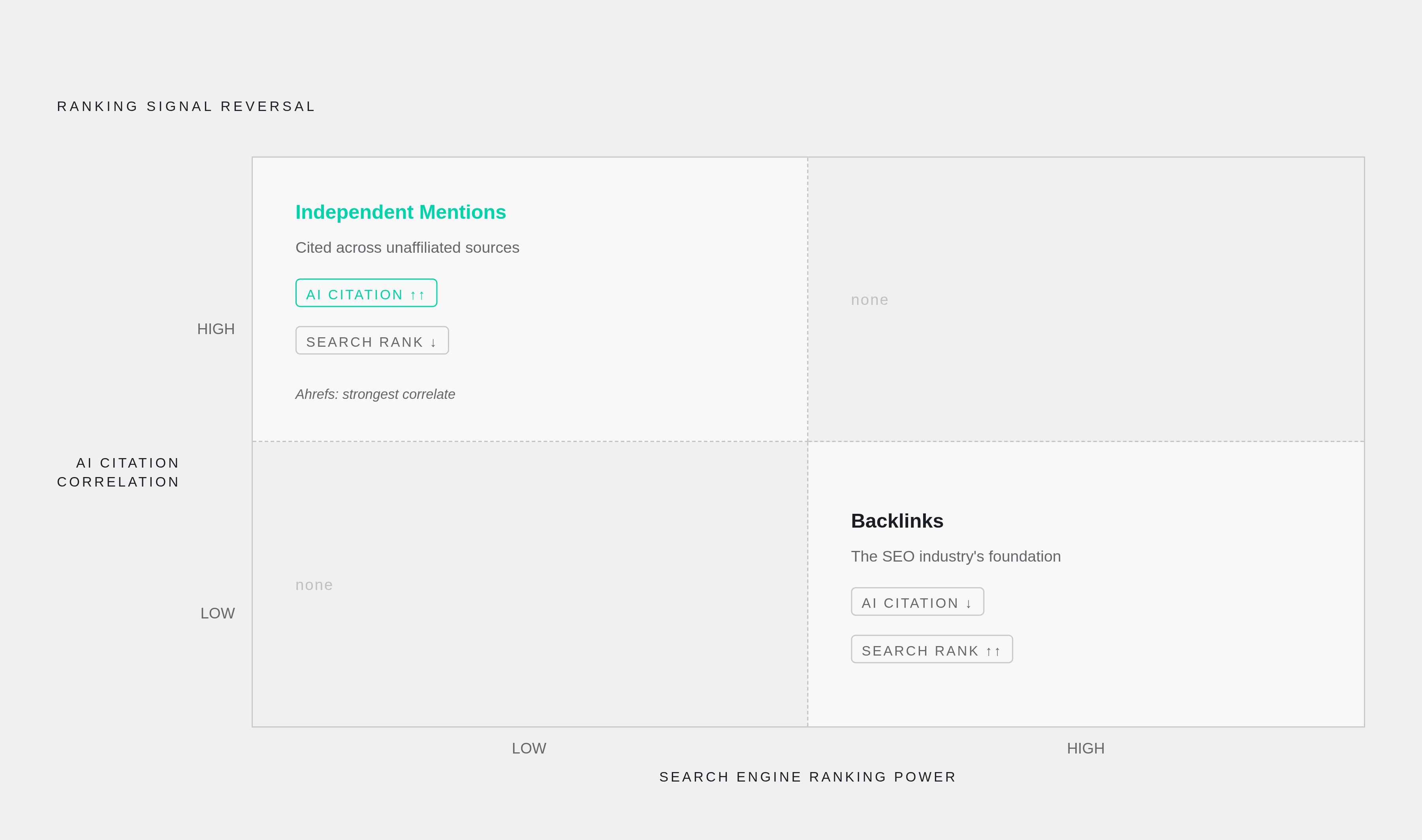
Search engines rank pages. AI models form impressions of entities: brands, categories, the relationships between them, all pieced together from everything they were trained on. That's a fundamentally different job, and it rewards a different kind of evidence.
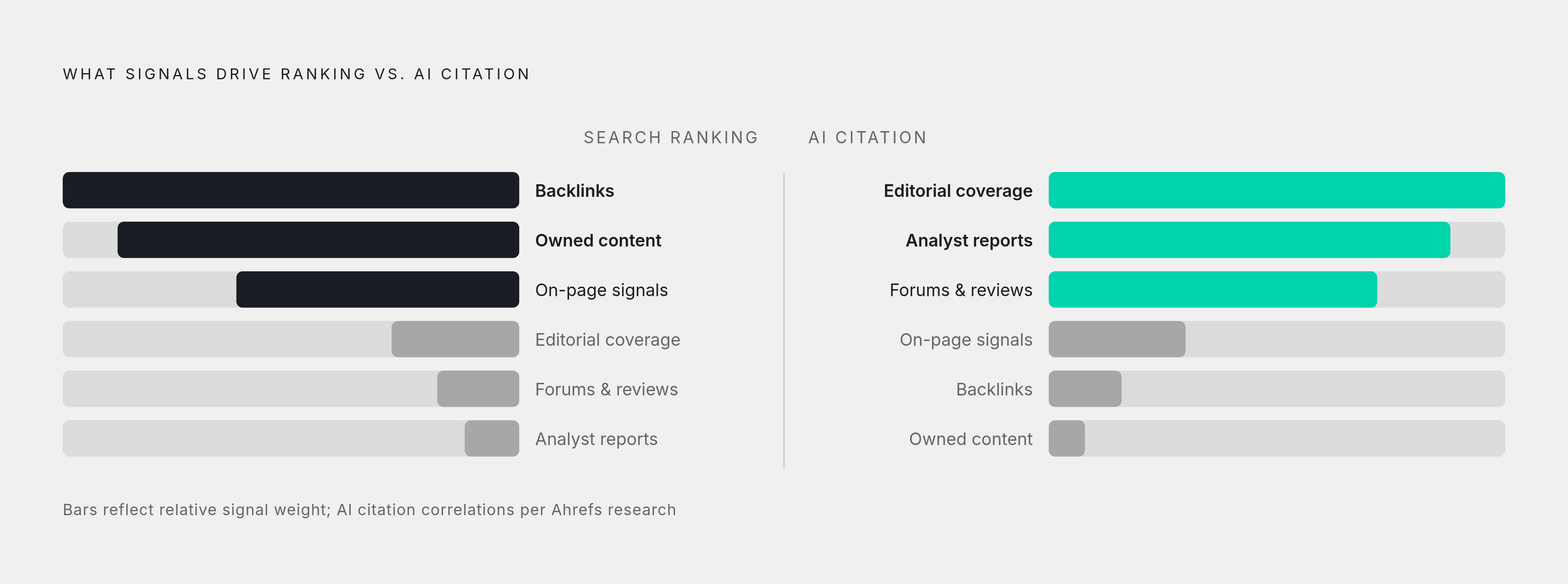
Here's the finding that should make every SEO team sit up: Ahrefs ran a large-scale study of brand visibility and found that mentions of a brand across independent sources correlate far more strongly with AI citation than backlinks do. Backlinks built the entire SEO industry, and they turn out to be largely irrelevant to whether ChatGPT will say your name.
Makes sense once you think about how these models actually learn, since they're trained on raw text, not a hyperlink graph. When independent editorial outlets, analyst reports, forums, and review sites keep discussing a brand in the same breath as its category, the model absorbs that as a fact about the world: this brand is real, credible, worth naming. Your own website, meanwhile, turns out to be the weakest citation source of all. Third-party sources dominate what AI models actually cite, which flips the old SEO instinct (build more owned content, always more owned content) on its head.
Diversity beats volume, and not by a little. Brands that show up in just one type of source get noticeably worse AI coverage than brands appearing across several source types, and each additional type you add seems to help more than the last one did. It's not additive, it's compounding.
One more wrinkle worth knowing: only a small slice of domains get cited by both ChatGPT and Google AI Overviews for the same query, which tells you these aren't the same test at all. And a meaningful chunk of AI Overview citations come from pages that rank nowhere near the top of traditional search results. The pages winning AI mentions are frequently not the pages winning rankings. Two scoreboards, two different leaderboards.
How unstable AI citation actually is, and what that means for measuring it
Here's the part that trips people up most: AI citation isn't just a different system, it's a genuinely unstable one. AirOps ran research across tens of thousands of citations and found that most brands appearing in an AI answer for a given query are gone if you run that same query again a short while later.
Why? The model rebuilds its answer from scratch every single time, since it's not pulling from a fixed leaderboard; it's rebalancing for freshness, diversity, coverage, on the fly. A brand that shows up today can vanish tomorrow with zero changes made to its content, because nobody touched anything at all. The model just decided to answer differently this time.
Platforms don't even behave the same way as each other. Some crawl new pages fast and show visibility shift in near real time, while others lean harder on training data baked in months ago, so their citation patterns move in bursts rather than smoothly. And the platform landscape itself keeps splitting further apart, with real ground being gained across multiple players; betting your whole approach on one AI platform is already a bet on the wrong number.
So what does this mean practically? Checking once in a while whether you show up is close to worthless, because the volatility swamps the signal. What you actually need is repeated, structured querying, run often enough that you can tell a real pattern from noise. A single appearance tells you nothing, and a rate — appearances out of a defined number of asks, run at real volume — is the only version of this that's honest.
Why most brands are flying blind on their AI presence right now
A GoodFirms study found that most brands already show up in AI search results in some form. That sounds encouraging, until you learn that only a small fraction of those same brands have built any actual system to track it.
Layer the attribution problem on top and it gets worse. When a buyer finds you through ChatGPT and visits your site later that day, that visit usually lands in analytics as plain direct traffic, with no referrer and no fingerprint tying it back to the AI model that said your name. The mention just disappears into the ether.
Put those two things together and you get teams with no feedback loop at all. They can't tell what's working, and they can't tell what's failing. And they genuinely cannot tell whether a zero in their AI visibility means "we have no authority here" or "our measurement is broken." That's not a small technical detail to wave away, either, since a team that can't tell a broken tracker from a real absence will spend months solving the wrong problem entirely.
Meanwhile the gap between brands that show up in AI answers regularly and brands that don't is already wide, and it's stretching further by the month. The ones building tracking and a real feedback loop now are compounding an advantage. Everyone else is signing up for a much steeper hill later.
What the traffic quality data suggests about why AI presence matters commercially
Here's the part that should get budget approved: visitors who arrive from AI platforms don't behave like typical organic search visitors. Multiple independent studies point the same direction: longer time on site, more pages viewed, and conversion rates that are meaningfully higher.
Seer Interactive ran a multi-vertical analysis and found conversion rates from ChatGPT referrals dramatically outpacing conversions from Google organic traffic. Gap that big changes the ROI math even if AI only accounts for a sliver of your total traffic. Ahrefs looked at their own numbers and found something similar: AI search made up a small share of total visits, but an outsized share of signups. In other words, people who click through from an AI answer have usually already decided you're worth checking out before they ever land on your page.
Adobe Analytics tracked a large retail panel and found something that should make everyone pay attention: AI-referred traffic went from converting worse than other channels to converting better, in about a year, as user behavior on these platforms matured. It's a trend line, and it's moving one direction.
Worth saying plainly: an AI citation works less like a cold impression and more like a warm referral, where somebody already vouched for you before the visitor showed up.
Now, the honest caveat. Most of this data comes from marketing and tech companies measuring their own audiences, which happen to be exactly the users most comfortable living inside AI tools already, so the conversion premium could easily be smaller in less AI-forward industries. And attribution fragmentation cuts both ways here too; some AI-sourced traffic is simply invisible in your analytics no matter how good your tracking gets. Take the trend seriously, but don't assume your numbers will match someone else's case study.
What it actually takes to build presence in AI answers
Don't start with content. Start with a question: what does the model currently think about your brand, right now, before you write a single new page? You find that out with structured, repeated querying, not guesswork.
Once you know where you stand, third-party editorial coverage is your highest-leverage move. Independent publications writing real, substantive pieces about your brand, your category, and your competitors, in ways that establish you as a known, credible name and not a footnote. Source diversity matters more than raw volume here; a mix of analyst coverage, editorial writeups, forum discussion, and review platforms builds a far richer signal than a mountain of blog posts all coming from your own domain.
Specificity wins too. Content built around original data, named statistics, and precise claims gets cited more often, because these models are literally extracting and repeating quotable facts. Vague narrative copy doesn't give them anything to grab onto.
Some services have emerged to address this gap directly, using networks of editorially independent publications to produce real content on a client's behalf, written specifically to be read and cited by AI models, with every structural decision reviewed by an actual person before it ships, and tracking search performance and AI performance as two separate, equally weighted outcomes rather than one main metric and an afterthought.
Your own website still matters, to be clear, but it just can't carry the whole strategy anymore. It needs to be accurate, specific, and full of real claims, but it's a supporting player now, not the lead. And one more thing worth flagging honestly: any mention of competitors in your content needs to be deliberate and tightly controlled. These models absorb competitive framing and will happily reproduce a comparison you never meant to make. That's not a "guidelines" problem, it needs actual enforcement.
How to tell whether your current content program is building AI presence or only search presence
Wrong first question: "are we showing up in AI answers?" Right first question: "do we have a system that can tell us that reliably, with enough repeated queries to produce a real rate instead of a lucky snapshot?"
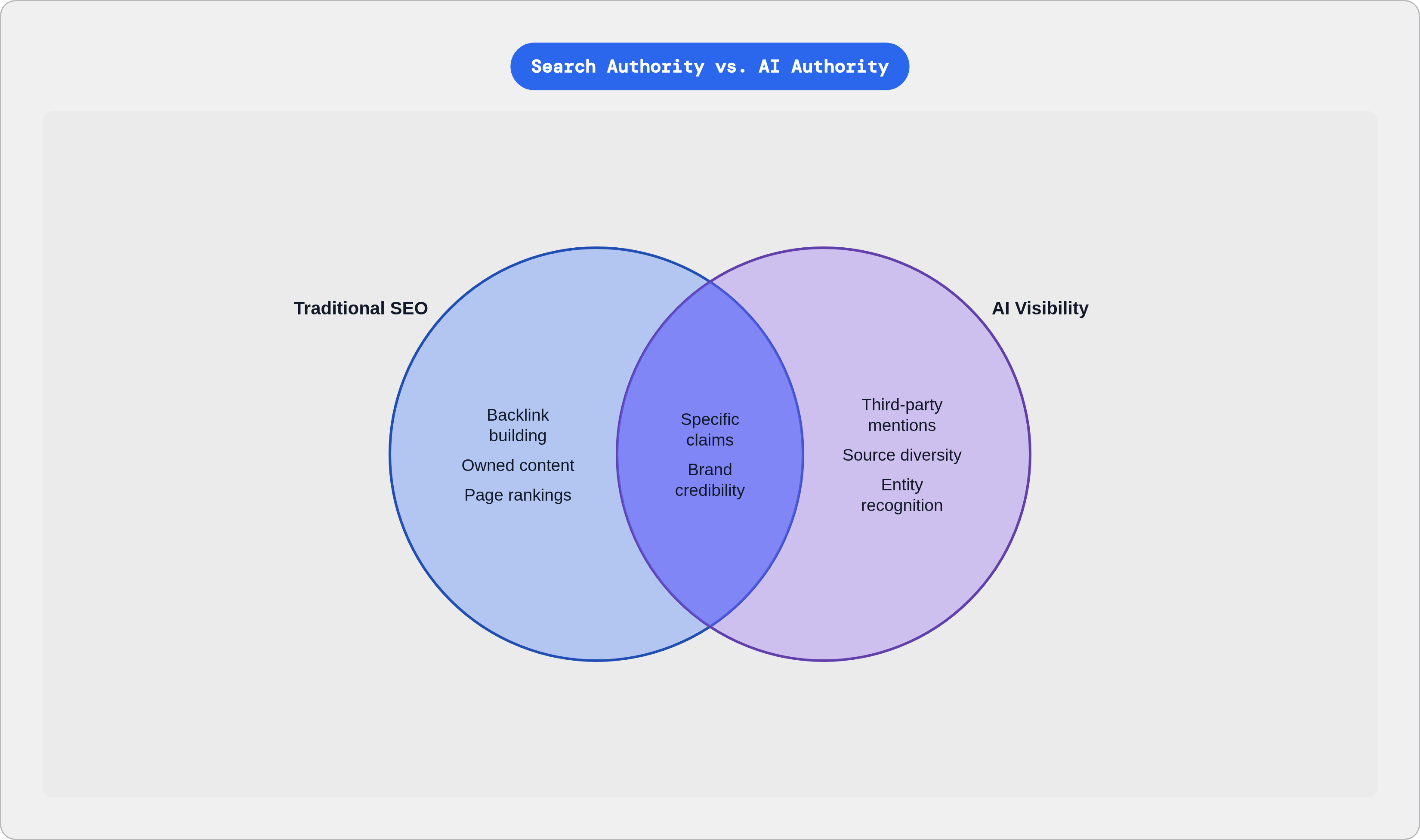
If your whole program is built around owned content and link acquisition, you've built search authority, and that's real, worth something. But it's the weaker predictor of AI citation, and no amount of doubling down on it closes this particular gap.
If you've got zero independent editorial coverage, no mentions in publications you don't control yourself, your program is structurally unlikely to build strong AI entity recognition, no matter how much content you crank out. Volume from a single source type is a weak signal, and it doesn't matter how much of it you have.
Run the audit. Map every source type where your brand currently shows up: owned site, press releases, review platforms, editorial coverage, analyst reports, forums. Count the source types, not the piece count, since moderate coverage spread across five source types beats a mountain of content from just one.
Then check your reporting. Does it separate search performance from AI performance as two distinct, tracked outcomes? If your dashboard only shows rankings and traffic, you literally cannot see the gap this whole piece has been describing.
None of this means abandon search. Rising search traffic is a real asset, and nobody's telling you to walk away from it. AI invisibility sitting right next to that traffic is a separate, real gap. Both things are true at once, and the fix isn't picking one. It's building the second system in parallel, without dropping the first.