Why Deleting a Page With Real Traffic Is the Wrong Default
Preserve years of link equity and organic authority instead of starting from zero.
Deleting a page that already gets traffic is one of the most common unforced errors in SEO. That page is proof someone typed a query into Google, clicked your result, and stuck around long enough to matter. Hit delete and you're setting fire to evidence.
Inside that page sits four things you can't rebuild on command: organic rankings, image search visibility, internal link equity, and backlinks other sites decided you deserved. All four took months, sometimes years, to build, and delete the page and they don't fade out politely — they die at once.
Here's a number that should slow you down before you touch that button: something like 95% of all pages on the internet have zero backlinks. If your page has three or four, it's already sitting in a small club most pages never get into. Kicking it out is a strange way to clean house, and I've watched teams do it over lunch without a second thought.
Why the impulse to delete is almost never data-driven
Ask someone why they want to delete a page and you'll get one of three answers: it feels old, the team's embarrassed by how it reads now, or traffic dipped last month and nobody wants to keep looking at the graph.
None of that is data. It's a mood.
Rankings move around constantly. Algorithm updates land unevenly across niches, and seasonality fools people every single year, including people who've been doing this for a decade. A traffic dip is a reason to go look under the hood, check whether the page still holds value first, and decide after, not before.
Impatience does about as much damage as panic does. A page that hasn't ranked after a few weeks online hasn't failed; it just hasn't had the runway to be judged fairly yet. Google does not answer to your quarterly deadline, and it never will, no matter how many Slack messages get sent about it.
So flip the question. Instead of "why should we keep this," ask "what proven value are we about to torch." That question puts the burden where it belongs, on whoever's finger is hovering over delete.
The backlink cost that deletion makes permanent
Backlinks decay on their own anyway. Sites lose somewhere between 7% and 20% of their backlinks every year just from link rot: sites shut down, pages move, editors clean up old posts. Deletion fast-forwards straight to that ending.
Ahrefs tracked this over nine years and found 66% of all links across the web had died by the end of it. Link decay is already winning, and deleting a page helps it win faster, which is an odd thing to volunteer for.
Once those links are gone, good luck reclaiming them. Reclaiming lost links after the fact works only a fraction of the time, by most industry benchmarks. Do the math and three out of four links you kill through deletion never come back, no matter how many polite outreach emails you send chasing them.
Put a dollar figure on it and the picture gets uncomfortable fast. Earning a single high-quality backlink through legitimate means often runs past $1,000 once you count the content, the outreach, the follow-ups nobody remembers sending. A page sitting on five earned backlinks is holding something like $5,000 of sunk cost, minimum. Delete it because it looked stale on a Tuesday afternoon, and that's what you burned.
Backlinks remain one of Google's top three ranking factors heading into 2025, and pages sitting at the number one spot carry roughly 3.8 times more backlinks than everything below them. A traffic-bearing page's link profile is frequently worth more than the rank it currently holds. You just can't see that value until it's gone.
What actually happens to crawl budget and internal equity when a page goes dark
Delete a page without a redirect and it returns a 404, simple enough on paper. Except search bots don't get the memo right away; they keep coming back, trying to crawl a URL that leads nowhere now, burning crawl budget on a page that doesn't exist anymore.
Semrush audited this in 2023 and found broken internal links and crawl errors on more than 42% of the sites it looked at. That's practically the default state of the internet, and unmanaged deletions feed it directly.
Sites with real crawl budget problems can end up with 30% to 50% of their important pages sitting unindexed. That's not hypothetical, and it doesn't stay contained to the page you deleted.
Here's the part almost everyone misses. Internal link equity moves quietly from page to page, the way water moves through pipes you never see until one bursts. If the deleted page was passing authority to five other pages, those five just lost support they didn't know they were leaning on. Rankings slip on pages nobody touched, and nobody traces it back to a deletion from two months ago. Everyone blames the algorithm instead.
How redirects preserve equity, and where they fall apart
Google has said plainly, through both Gary Illyes and John Mueller, that a properly set up 301 redirect passes PageRank without watering it down. Equity moves without evaporating, and that's the whole reason redirects exist as a tool.
There's a catch, and it's the one that trips up almost every team that tries this. The redirect has to land on a page actually about the same topic as the one you removed. Send it somewhere unrelated, and Google calls the whole thing a soft 404, and the equity transfer is cancelled.
A soft 404 is sneaky because it looks completely fine to a human. The browser loads a real page, no error, nothing visibly broken. Google, though, reads it as unhelpful or irrelevant, and it can quietly deindex the destination page too, even though the redirect works fine on a technical level.
The classic mistake is redirecting everything to the homepage. It feels tidy and almost guarantees soft 404 treatment, because a homepage rarely matches the specific topic of whatever you just deleted. It's asking for a science textbook and getting handed the phone book instead. Technically a book, but not what anyone needed.
Redirect to the most specific, most relevant page you've got, not some generic parent page three levels up the tree. And if there's genuinely no relevant destination anywhere on the site, that's your signal a 410 (Gone) beats a 404. Googlebot processes a 410 faster and drops it from the index sooner, while a plain 404 might get recrawled repeatedly before Google finally gives up. Treat a redirect like a precision tool, applied with care, and it works. Applied as a default setting, it just relocates the problem instead of solving it.
A decision framework that puts data before action
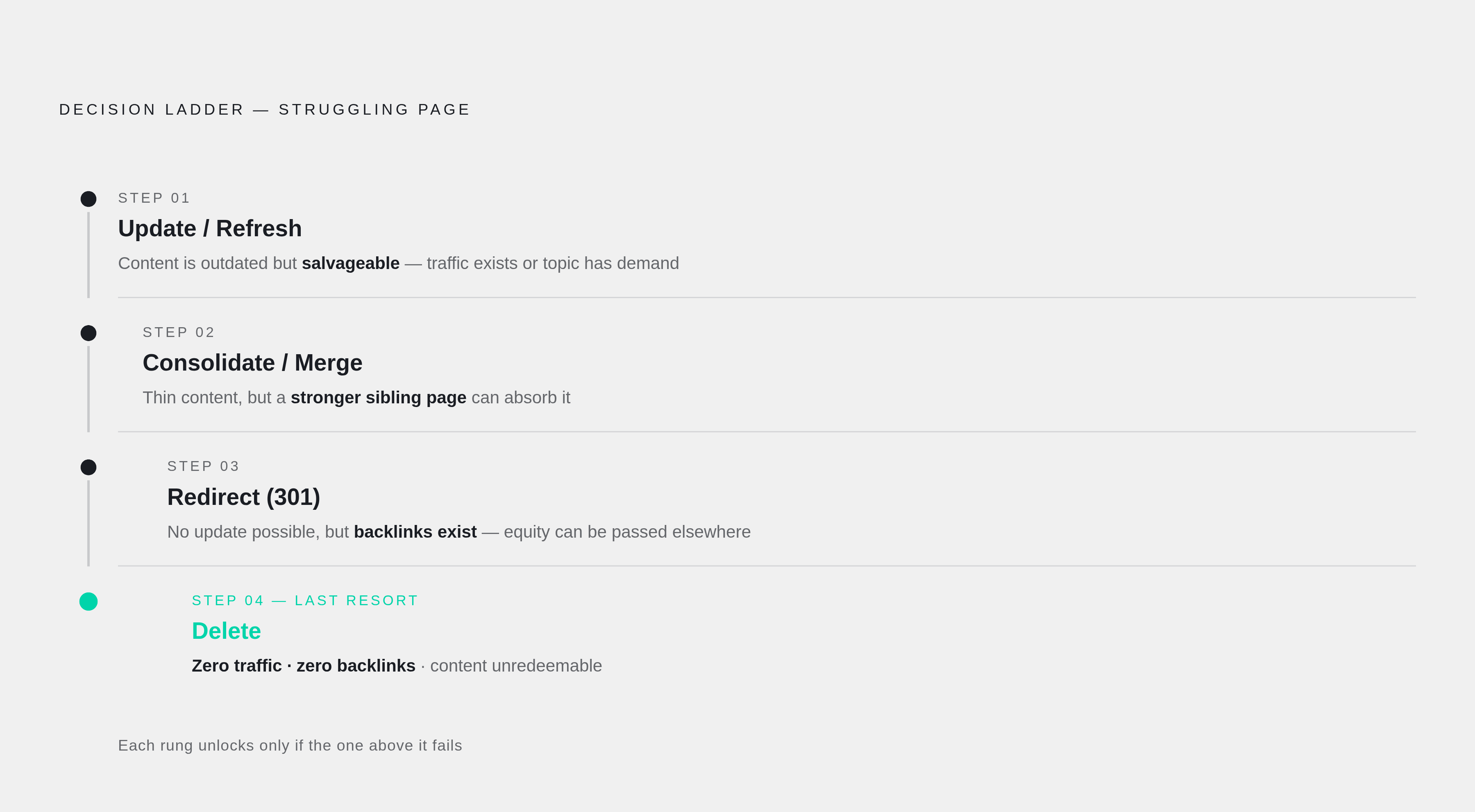
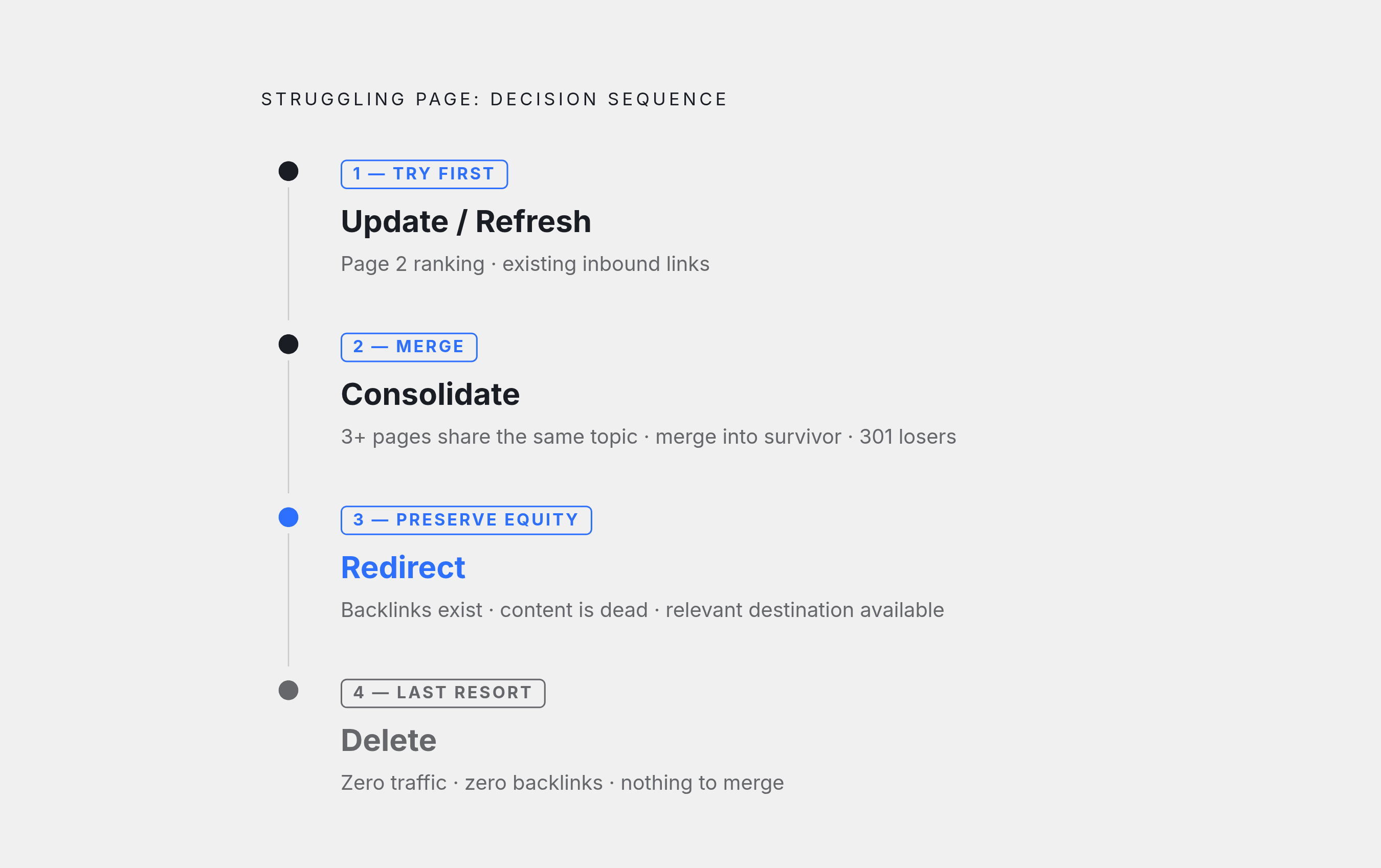
Four moves exist for a struggling page: update it, merge it, redirect it, delete it. Deletion sits at the back of that line on purpose, and it should stay there.
Update or refresh wins most often. A page already sitting on page two of Google carries history, existing links, a track record search engines can read. Sharpen the angle, swap in fresh numbers, fix the structure, and it frequently outpaces a brand new page built from scratch. One SaaS company I know of, whose blog drove 60% of its organic traffic, refreshed a stack of outdated posts with current data instead of trashing them. Organic traffic grew 25% in two months, with no new pages, just better versions of old ones.
Consolidation makes sense when three pages are circling the same topic and none of them wins on its own. Pick the strongest URL, pull the best material out of the weaker ones into it, then 301-redirect the losers into the survivor. Rankings and history transfer instead of vanishing into nothing.
Redirecting fits when a page has earned real backlinks but the content underneath is genuinely dead and can't be revived through an update. It only works if a topically relevant destination actually exists on your site already. If one doesn't, don't force a redirect just so it feels like you did something productive.
Deletion earns its spot only when a page has confirmed zero traffic, zero backlinks, and content too far gone to update or fold into anything else. Confirm all of that in Google Search Console (clicks, impressions, average position) and through a backlink audit in Ahrefs or SEMrush before anyone touches anything. Remember too: a page with a single backlink from a high-authority domain isn't a zero-value page, no matter how flat the traffic chart looks.
What the pre-deletion audit must actually check
Pull twelve months of Search Console data, not the last thirty days, including clicks, impressions, and average position, the whole set. Thirty days tells you what happened last month, while twelve months tells you the truth, and the difference between those two numbers has killed more good pages than it should have.
Seasonality wrecks more deletion calls than almost anything else. A page that looks dead in March might spike hard every November. Miss that pattern because you only looked at a short window, and you'll delete something that was simply waiting for its season to come back around.
Run the backlink audit next, Ahrefs or SEMrush, doesn't matter which. A page with barely any traffic might still hold one inbound link from a university, a major publisher, or an industry directory, the kind of link that took real outreach effort to land years ago. That link is the asset, and traffic was never the whole story on its own.
Check the internal link map too. Which pages point to this one, and would they lose meaningful authority if that link vanished? Then confirm the page is actually indexed in the first place. A stray noindex tag or a crawl error can suppress traffic that would otherwise show up fine, and deleting a page over a bug is its own special kind of embarrassing.
Only once all four checks come back clean, confirmed zero across the board, does deletion become the right answer. Even then, write down what you found and why you decided what you decided. Future you, six months from now, staring at a traffic dip somewhere else, will want that paper trail.
How long recovery takes when the wrong call has already been made
Recovering from a bad content decision usually takes three to nine months, depending on site size and how deep the damage went. It takes months, not days, and that's the part nobody wants to hear when they're standing over the delete button feeling decisive.
Algorithm-related dips need three to six months of steady, boring quality work before rankings settle back down, and that clock only starts once the fix actually goes live, not the moment someone notices there's a problem. Every week of delay pushes the finish line back further.
A deleted page with no redirect can't be patched, and there's no setting to flip. It has to be rebuilt from scratch or pulled from a backup, and even then, nothing guarantees the old rankings walk back in the door with it.
Compare that to a technical error, a stray noindex tag, a redirect pointed at the wrong URL. Those often clear up in days once Google recrawls, and a hard deletion doesn't offer that off-ramp.
The asymmetry here is almost funny, if it weren't so expensive: the wrong deletion takes thirty seconds to execute and months to undo, while the slow, careful approach costs nothing and keeps everything intact. That imbalance alone should be reason enough to sit on your hands for a week before deciding anything.
When pruning genuinely helps, and what separates it from deletion as a default
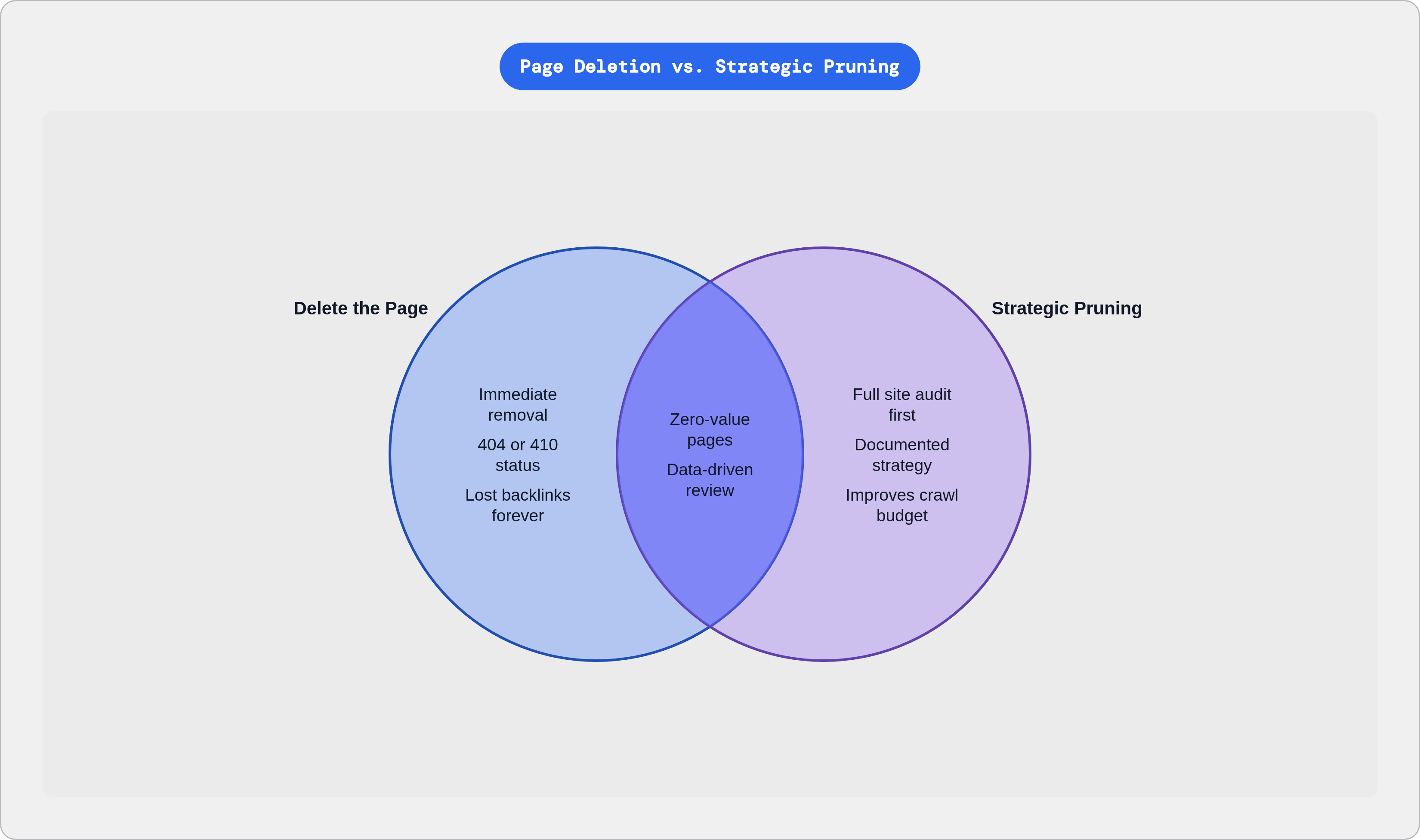
None of this means pruning is bad. Strategic pruning has a real use case. A site bloated with thin, duplicate, or genuinely irrelevant pages can drag down quality signals and waste crawl budget that should go toward pages actually worth crawling.
The difference is in how you get there. Pruning starts with a full site audit and removes pages confirmed, on purpose, as zero-value, as part of a documented strategy. Deletion-as-default starts with someone feeling weird about a page and hitting delete before lunch.
Done right, pruning follows the same order as everything else here: update first, consolidate second, redirect third, delete only what's left standing with nothing to show for it. Do it that way and you get a better user experience, sharper crawl budget allocation, and internal link equity sitting where it actually helps something.
Do it out of embarrassment or impatience instead, and you risk torching evidence your site spent years building. A page with real traffic already proved something, it earned its spot through actual searches from actual people looking for actual answers. Hold it to the standard sitting in the data in front of you, not to how the team happens to feel about it this particular week.