How a Human Approval Layer Changes What an Automated Content Pipeline Can Do
A human checkpoint in an automated pipeline unlocks riskier, higher-value work.
A human approval layer sits inside an automated content pipeline and does one job: it decides what the pipeline gets to try. Get that placement right, and the pipeline can attempt harder, riskier work than it could running solo. That's the whole argument, and everything below is just me explaining why I believe it after watching enough pipelines run without one.
AI content is common now. Most new web pages already contain some AI-generated text, and most marketers say they're leaning further into it next year. So why did MIT's NANDA group find that the overwhelming majority of enterprise generative-AI pilots show zero measurable financial return? Their own explanation, paraphrased: the pipelines don't remember anything. No feedback loop, no adjustment, no learning, just the same mistakes on a longer conveyor belt. That's a fixable problem, but only if you fix the right part.
Here's the part everyone gets wrong first. When a pipeline underperforms, the instinct is to automate harder, adding a step or removing a person. That's the wrong move, and it's a pattern that shows up repeatedly across teams that eventually reverse course. The real question isn't how good the model is at generating text. It's how much the operator trusts the system to act without someone checking its homework, and that trust lives or dies on one thing: is a human standing in the right spot to catch a mistake before it goes live?
What an automated content pipeline is actually doing at each stage
Strip the buzzwords out and a pipeline is five things happening in order: research and briefing, draft generation, metadata and SEO structuring, quality review, and publishing. Above all of it sits an orchestration layer, deciding when a draft is ready to move and when it needs a human hand on the brake.
Every pipeline built for actual production needs four working parts: an orchestration engine, a language model with API access, a content management layer, and quality control. People tend to treat that last piece like a single toll booth near the end, a final glance before the piece goes out the door. It doesn't work that way in practice. Quality control has to show up at multiple points, before generation starts, after a draft comes back, and again once the thing is live and out in the world doing its job.
Most decisions in that chain are low-stakes and forgettable, honestly kind of boring. But three decisions carry real weight: what to write next, how to describe the client or name a competitor, and whether to unpublish or rework something that's already live. Funny thing about those three: they're usually the ones pipelines hand to automation first, because on paper they look like routine content decisions. They're actually the spots where a tiny error sits quietly for months until someone finally notices the damage.
The specific failure modes that appear when no human approval exists
Language models don't look anything up. They predict the next plausible piece of text based on pattern, which means a confident, cleanly formatted, completely wrong statistic is just what the technology does sometimes, footnotes and all.
Run a pipeline unsupervised long enough and the same failures keep showing up. Made-up citations slip past internal review because they're formatted correctly and nobody thinks to double check a footnote that looks so sure of itself. Context drift creeps in over a long batch, so the system starts contradicting a claim it made three pages earlier, or promises something the business never agreed to deliver. Voice wanders from one run to the next, and competitor names show up where they shouldn't, through an accident of pattern-matching rather than any decision. That becomes a real liability once comparison content starts shipping at volume.
One B2B company found this out the expensive way. They published 47 AI-written comparison articles in a single month through programmatic SEO, and six months later, not one ranked above position 20. That tracks with what industry reporting keeps finding: AI content that skips human editing tends to underperform on engagement, and most marketers admit their AI drafts need heavy rework before they're usable. A lot of pipelines are shipping half-finished work and calling it finished.
There's a legal wrinkle here too, and it isn't going anywhere. The EU AI Act requires that a human be able to override or interrupt an automated system's output, full stop. A pipeline with no real approval step is walking into that requirement blind. Black-box systems are turning into a legal exposure now, alongside being an editorial embarrassment.
How a human approval layer changes what the pipeline is permitted to attempt
Turn the framing around. Approval works less like a speed bump and more like the thing that makes aggressive automation survivable.
Take strategy resets. A pipeline can watch ranking drops, traffic shifts, and gaps in how AI models cite a brand, then propose a new direction entirely on its own. Fine, but that proposal needs to land in front of an actual person before anything changes. No operator with functioning judgment lets an algorithm restructure a content program unattended, and honestly, they shouldn't want to.
Same logic covers competitor mentions. A system can write sharp, accurate, editorially sound comparisons at real scale, and it can do that well. But only if a person reviews each one before it ships, because getting this wrong at volume turns into a brand problem and, soon after, a legal one. That's the whole reason the capability stays locked without a review layer sitting in front of it.
Unpublishing works the same way, maybe more so. A page pulling real search traffic, or one that AI models are actually citing in live answers, should never disappear because an internal script decided it looked redundant. The approval layer lets the pipeline flag a page as a candidate for removal, but it never lets the pipeline pull the trigger itself.
One rule threads through all three examples: a pipeline earns the right to handle a consequential decision alone only once a human is positioned to catch the mistake before it matters. Skip that step and operators do the only sane thing available, which is shut the whole thing down. Kill the strategy queue, rip out the competitor logic, freeze every live page in place. That's the actual reason so many pipelines get stuck doing safe, forgettable, low-value work forever, and it has nothing to do with the model being weak.
Worth sitting with for a second: research looking across hundreds of thousands of pages found almost no relationship between AI authorship and ranking penalties. Google punishes bad content rather than AI-origin content specifically, and a lot of teams still conflate the two. A human layer that enforces quality removes the actual risk, and removing the actual risk is what frees the pipeline to publish more.
Designing the approval layer so it scales without becoming the bottleneck
Here's where a genuinely good idea turns into a bad rollout, and it's a recognizable pattern. Route every single output to one overworked reviewer with no sorting logic, and that reviewer becomes the slowest part of the whole operation. Congratulations, you've built a faster car with a smaller steering wheel.
Pipelines built for this kind of volume tend to publish somewhere between 30 and 100 pages a month, against maybe 4 to 12 through a traditional writing process. That gap means the pipeline has to move at the pace a senior editor can actually sustain, not the other way around. Otherwise you've automated a backlog, not a workflow.
The fix is triage by consequence, with sorting logic instead of one flat review lane for everything that comes through:
Routine drafts get an automated quality score and land with a junior editor. Strategy changes, competitor mentions, and unpublishing candidates go straight to a senior approver who already has full context on the account. Anything touching YMYL topics or a regulated industry hits a compliance check before an editor even opens the file.
Score drafts against a model trained on actual historical editor feedback, rather than a generic style guide pulled off the shelf, and revision cycles shrink meaningfully. The math on speed still favors the pipeline even with all this review layered in: a draft comes back from the model in a few minutes, full human review pushes total time to a couple hours, and that's still nowhere close to writing from a blank page. The quality gap holds up too, since sites pairing AI drafts with real human editors have seen bounce rates fall sharply.
One honest note buried in most of this research and worth repeating here: if a pipeline shaves its model costs but editorial review time climbs to compensate, nothing's actually been saved. The expense has just moved somewhere less visible. The number that matters is total cost per published piece, not the API bill sitting by itself looking impressive.
A few rules keep the approval queue from quietly rotting. Mandatory approval steps stay non-bypassable, period, not a suggestion someone waves off under deadline pressure. Every rejection gets logged with a reason and feeds back into how prompts get written, instead of vanishing into a folder nobody opens again. And the rejection rate itself becomes something worth watching as a pipeline health signal, not just a number the editorial team quietly tracks for its own curiosity.
How the approval layer makes the pipeline smarter over time
Back to that MIT finding: pipelines fail because they don't hold onto feedback or adapt to it. The approval layer is the piece that makes holding onto feedback possible at all, since without it, there's nothing to remember.
Here's the loop in practice, roughly how it plays out. An editor keeps making the same fix over and over, maybe a factual correction, maybe a tone adjustment, maybe pulling an unintended competitor mention. Once that same type of correction shows up three or more times, the system proposes an update to the instructions for whichever stage keeps causing it. A human looks at that proposed change and either approves it or kills it outright, and once approved, the fix applies going forward, automatically, no need to catch it by hand again.
The pipeline gets smarter for a specific, unglamorous reason: the approval layer keeps generating structured feedback that reshapes its own instructions, rather than sitting around waiting for the model's maker to ship an update. Over time the system starts attempting more ambitious work, sharper competitor framing, more precise positioning, because there's an actual track record proving it can handle that work now.
Compare that to what Gartner found in 2025: organizations spent an average of $1.9 million on GenAI initiatives the year before, and fewer than a third of CEOs said they were satisfied with the return. That gap between spend and satisfaction points to an architecture problem, and the missing piece is almost always the feedback loop.
This is also how a pipeline earns its way from tight human-in-the-loop review toward something lighter, human-on-the-loop monitoring. New deployments start with someone checking most outputs closely, no way around it. As the error rate on a given decision type drops and trust builds up over real cycles, that decision can shift toward spot-checking instead of full review every single time. That shift gets earned through a track record, and it doesn't get assumed on day one — any team that assumes it is asking for a bad quarter.
What this architecture looks like when it's built end to end
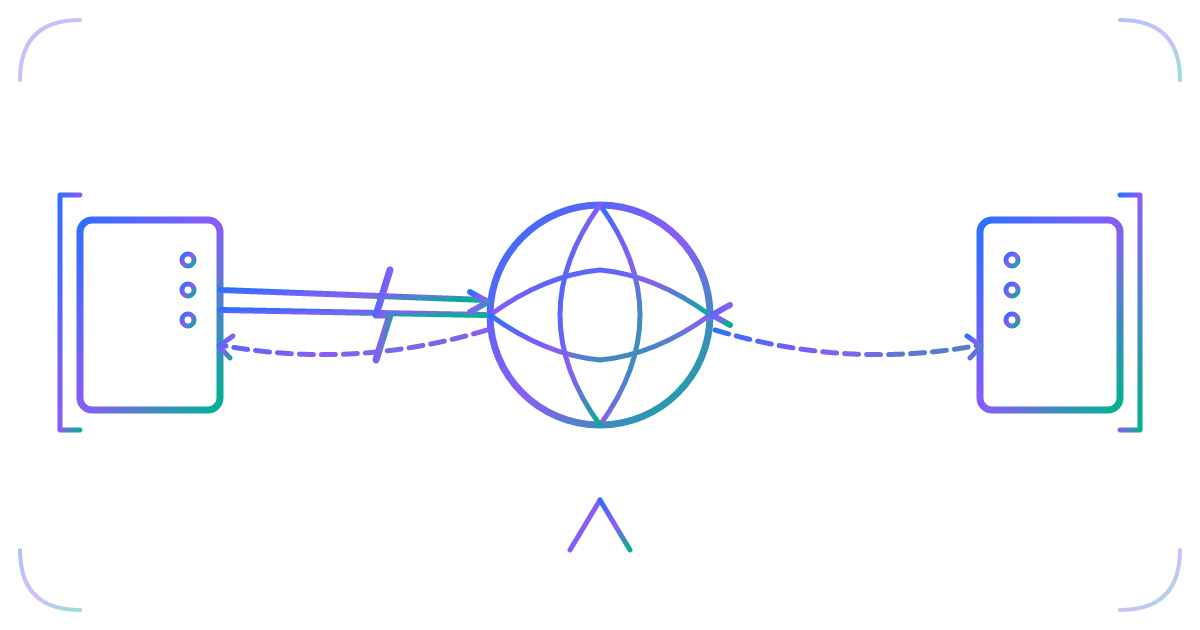
Put all of this together and a production-grade pipeline looks something like this. A strategy queue surfaces what to write next, and every recommendation sits open for review and edits before anything actually runs. Competitor mentions are governed by the system itself instead of left to whichever writer happens to be on shift that day, so every mention is deliberate, traceable, and consistent with how the client actually wants to be positioned. Pages already earning real traffic or genuine AI citations are protected by policy, meaning no internal signal, however confident it sounds, gets to unpublish them without a person saying yes first. Weekly reporting gives operators a real picture of both search performance and whether AI models are actually naming and citing the client, alongside clicks and impressions.
This is the architecture Letterbrace is built around: a pipeline that writes, measures, and proposes its own improvements, while every call that actually matters, strategy resets, competitor framing, page-level changes, sits in a queue waiting on a human before it ships.
One more thing worth mentioning here. Content that publishes through independent, editorially credible outlets, rather than pages that read like obvious client marketing, tends to build more search authority and more trust from the AI models crawling the web. That's a structural choice a team has to make on purpose, and sustaining it at scale takes actual human editorial judgment, alongside whatever workflow rules sit in a config file somewhere.
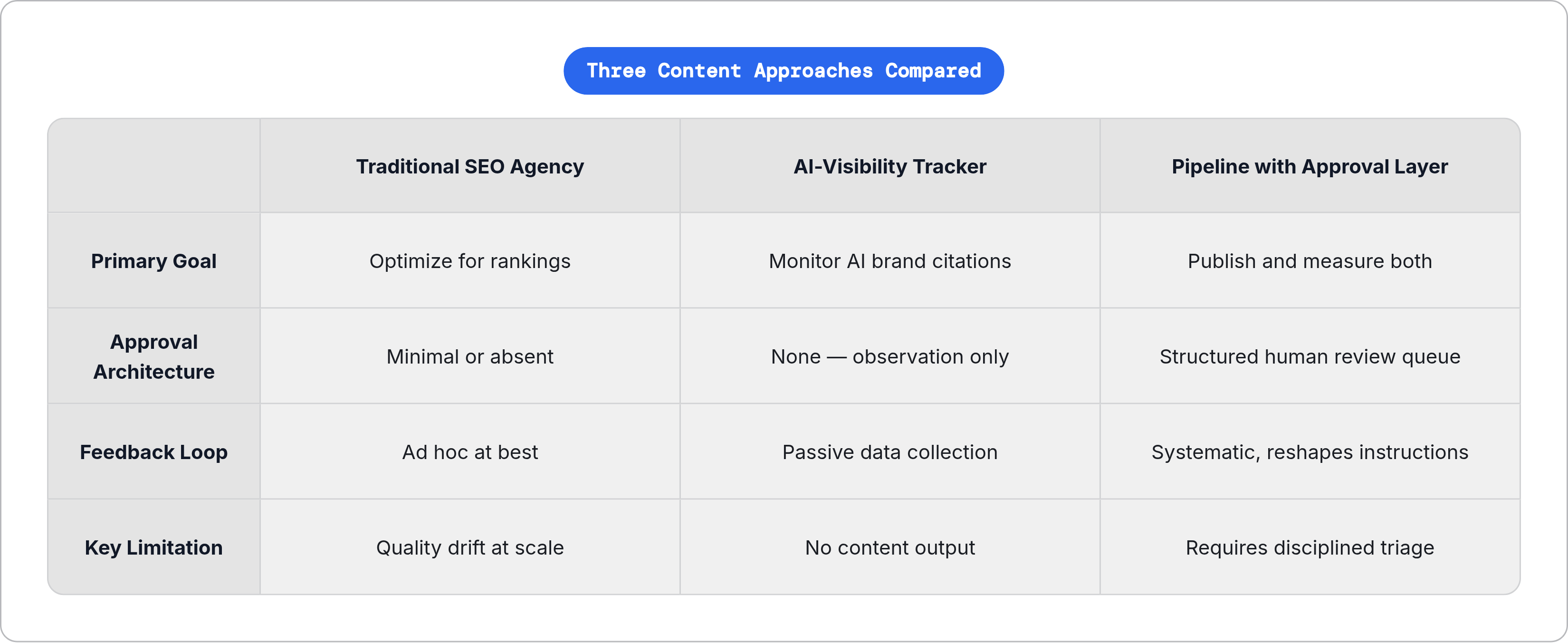
Three approaches, three different outcomes. Traditional SEO content agencies optimize for rankings and ship without much approval architecture behind any of it. AI-visibility trackers measure how models cite a brand but don't publish anything themselves, they just watch. A pipeline with a working approval layer does both at once, and the human layer is the reason doing both at once holds together instead of falling apart under its own weight.
Backlinko's research on ranking factors found that content showing clear expertise and real author credentials ranks meaningfully higher in competitive search results. That kind of expertise rarely comes from a system simply asserting it about itself. It comes from a human approval layer making sure the claim is true, defensible, and actually earned before it ever goes out the door.