Measuring AI Brand Citation Rate With Statistical Confidence
Brands need confidence intervals, not raw percentages, to measure AI citations reliably.
AI search has gotten so big that showing up inside a generated answer is now a real brand event. It is no longer a novelty or a curiosity on a quarterly slide. AI search visits grew substantially year over year, and by the first quarter of 2026 they crossed tens of billions of queries, so untracked citation performance has become a genuine blind spot for any content program.
The channel also behaves differently than a search results page. Generative answers typically cite only a handful of sources per response, and that compresses the competitive field far more tightly than a ranked list of ten blue links ever did. Being left out of an AI answer is closer to being invisible than to ranking on page two. And the stakes run deeper than visibility alone: these answers sit between most searchers and the open web right at the moment buyers build their shortlist, so a brand with no measurement in place is flying blind exactly when it matters most.
None of that is controversial. Most marketing teams already agree citation rate deserves tracking. The harder argument, and the one this piece makes, is that tracking it loosely produces a number that falls apart the moment anyone asks a hard question about it. Citation rate looks like simple math. Underneath, it is a statistical estimate, and most of the numbers currently circulating in board decks would not survive a second glance from a competent analyst.
What citation rate measures
Citation rate is a proportion estimate pulled from a sample, and that single fact carries more weight than most people give it credit for. The formula itself is almost insultingly simple: count how many responses cite your brand, divide by the total number of responses tested, multiply by 100. Simple arithmetic, though, does not guarantee a simple read. A proportion built from a sample always comes with uncertainty attached, whether or not anyone bothers to calculate it.
Part of the complexity is that citation rate is really two probabilities stacked on top of each other. First, there's the chance the engine runs a web search at all for a given prompt. Second, there's the chance it picks your domain once it searches. Each of those probabilities has its own variance, and when you multiply two uncertain things together, the result wobbles more than either piece did on its own. Think of it like stacking two wobbly ladders instead of one: the combined wobble is worse than either ladder alone, even though each ladder looks fine by itself.
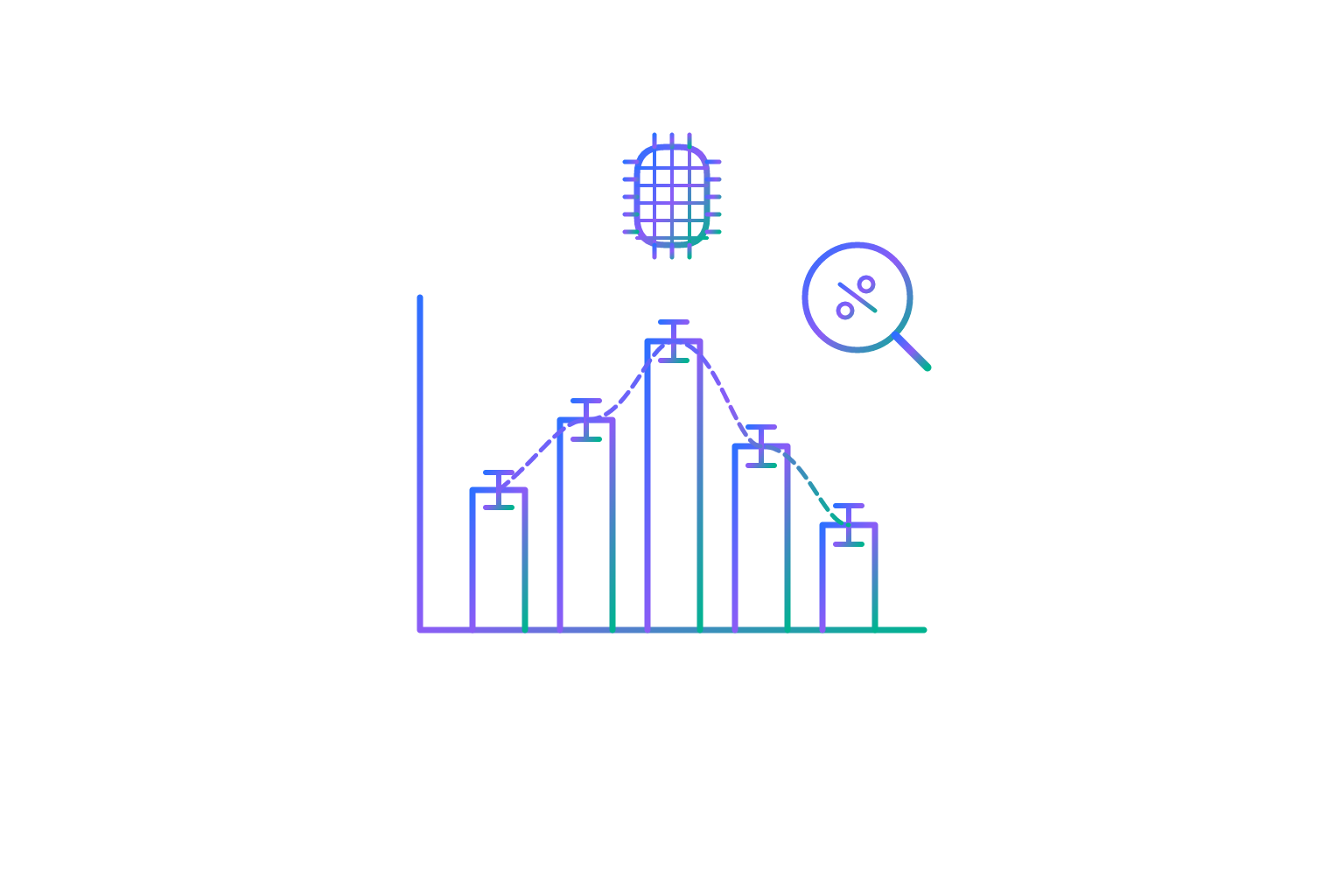
The standard confidence interval formula (SE = the square root of p times one minus p, divided by n) looks like intimidating algebra at first glance, but it is really just a tool for turning a raw percentage into a range you can defend in front of a skeptical executive. Report a citation rate with no interval attached, and anyone pressing on the number can poke a hole in it. If you report that citation rate, plus or minus a margin, built from a known sample size, the number suddenly has a spine.
That formula assumes something that rarely holds up in practice: independence between runs. The standard interval assumes each test run is a fresh, independent draw. But run the same prompt five times in the space of an hour, and those five runs tend to move together rather than independently, often because the engine caches recent context or because nothing about the underlying web results has changed yet. So the true confidence interval is wider than the textbook formula shows. A program that fires off a prompt a handful of times back to back and reports a clean, tidy citation rate has produced a number dressed up in more precision than it has actually earned.
How volatile AI citation is
AI citation bounces around far more from run to run than most teams expect, and that volatility is why small samples produce wide, shaky intervals that get mistaken for a stable signal. One finding puts a number on this directly: only a small fraction of cited URLs survive a repeat run of the exact same query. Brand-level presence holds up somewhat better than URL-level citation does, but neither is as stable as a single test run would suggest.
If a program runs only one test per prompt, or too few runs stacked together, it ends up with a confidence interval wide enough to swallow most of the possible outcome range. That kind of number cannot support a real decision. It is the statistical version of flipping a coin twice, getting heads both times, and then announcing that the coin always lands on heads.
Volatility also does not spread evenly across engines, which changes a brand's reported rate depending on which platform is queried. Superlines' analysis of 34,234 AI responses across 10 platforms found citation volumes for the same brand differing by a factor of up to 615 depending on which platform answered the question. Separate data from BrightEdge found a 16x gap between ChatGPT (a 99.3% eCommerce brand mention rate) and Google AI Overviews (6.2%) for comparable query types. That reflects a real structural difference in how each platform decides what counts as authoritative and which sources make the cut.
Foglift ran a Q2 2026 benchmark with 75 brand-neutral buyer questions across 25 verticals through five AI search engines, and it found a mean cross-engine Jaccard similarity score of just 0.18. In plain terms: any two engines, asked the exact same question, agree on less than one-fifth of the domains they cite. Blend all of that into a single aggregate citation rate and the number tells a story that does not match what's happening on any single platform. The practical implication is that measuring each engine on its own is a requirement, not a bonus feature of a good program. Averaging across engines that disagree this much just buries the real pattern under a false sense of consistency.
Why definition inconsistency across tools makes cross-tool comparison nearly impossible without a fixed methodology
Statistical noise is only half the problem. Different tracking tools do not even agree on what counts as a citation in the first place, and the gap this creates is large enough to change a brand's reported number by nearly a full order of magnitude. A controlled comparison of tracking tools, run against the same domain over 15 days, found a dramatic gap between the lowest and highest citation count that seven different tools reported. That gap comes directly from each tool building its own definition of what a "citation" even is.
You need to understand how those definitions vary before you can trust any single number. Otterly AI counts cited URLs with daily deduplication: it tracks distinct links to a domain once per 24-hour window rather than counting every individual mention as it occurs. Semrush's AI Toolkit, by contrast, measures two separate things side by side: "Citations" (how often AI platforms link out to a site) and "Mentions" (how often a brand's name shows up in an AI answer regardless of a link). Siftly tracks citations across ChatGPT, Perplexity, Google AI Overviews, Gemini, Claude, and other engines, layering in competitor citation share along with tools for content generation and citation outreach aimed at closing citation gaps.
None of these approaches is wrong. They are just different, built for different questions. Understanding what a tool counts, before trusting the number it hands back, is a basic requirement for using it well. Switch tools in the middle of a tracking program, or lay two tools' outputs side by side without checking their definitions first, and the resulting comparison means close to nothing. A team that doesn't know whether its tool counts unlinked brand mentions or only clickable links is comparing apples to a fruit basket.
Engine coverage choices add another layer to this same problem. Dropping a single engine from the sample can shift both the total citation count and the relative ranking of every tracked domain. That is because engines do not treat sources the same way. Foglift's research found that Perplexity cites YouTube in a large share of its responses, but ChatGPT and Claude cite YouTube in almost none of theirs. Leaving an engine out of a measurement program is never a neutral trimming of the data. It is a structural choice that reshapes the result, in the same way leaving one swing state out of a national poll would reshape the projected outcome.
ChatGPT does not cite sources on every query, because browsing has to be triggered first, whether automatically or by the user. A study of 30,002 hotel-related citations found that 37.3% of hotel questions never triggered a search, so only the searched share had any chance of producing a citation. A tool that doesn't account for that distinction will mix "no search happened" together with "search happened but we weren't cited," and those are two very different problems with two very different fixes.
The four methodological choices that determine whether a citation rate is defensible
If a citation rate is going to hold up under scrutiny, it needs four decisions made before data collection starts, not patched in afterward.
A fixed prompt set
You need to keep the prompt set frozen between one measurement cycle and the next. Swap prompts mid-program and period-over-period comparison stops meaning anything, because any change in the citation rate could just as easily reflect the new prompts as a real shift in brand performance. A solid working prompt set comes from real buyer language: definitions, head-to-head comparisons, "best tool for X" lists, how-to phrasing, grouped by where the buyer sits in the funnel. The set needs to be large enough to produce an interval narrow enough to act on, not just large enough to look thorough on a slide. New prompts need their own clearly labeled cohort, tracked on their own, because the original baseline has to stay intact for trend comparison. Every prompt and its intent should live somewhere any team member can find it, so they can rerun the exact same test. Reproducibility here is a requirement, not a nice-to-have extra.
Consistent engine sampling
Each engine needs its own reported rate. Never collapse engines into one blended aggregate number. Given how differently Perplexity, ChatGPT, Claude, Gemini, and Google AI Overviews behave, as the YouTube citation gap already showed, an aggregate hides more than it reveals. Which engines make the sample should be decided by where actual buyers go to ask their questions, not by which engine happens to be easiest to pull data from.
Enough volume for a narrow confidence interval
The confidence-interval formula (SE = the square root of p times one minus p, divided by n) lays out how sample size drives the width of the interval. At low sample sizes, the interval stretches so wide that a measured change could just be noise wearing a convincing disguise. Repeated runs of the same prompt need to be spaced out over time rather than bunched together, because bunching violates the independence assumption baked into the formula and makes the interval look tighter than it really is. You should report every citation rate with its confidence interval attached, not just the bare point estimate. A number without an interval is a guess wearing a lab coat.
Fixed cadence and a consistent definition
You need to run the full query set on a steady, repeatable schedule. How often depends on how fast the category moves, but once you pick a cadence, it needs to stay fixed for trend lines to mean anything. Alongside that, the working definition of "citation" (a linked URL only, versus a brand mention with no link, versus something else) needs to be written down and held constant. If that definition ever changes, the change needs to be marked explicitly in the time series, the same way an economist marks a break when a government agency redefines how it calculates inflation.
How to interpret a citation rate
A citation rate only becomes useful when you read it against the right comparison point. That means a prior period measured under the identical methodology, a competitor appearing in the same set of answers, or a breakdown by individual engine. It does not mean measuring against some industry benchmark that was built using an entirely different method, because that comparison is built on sand from the start.
The most reliable comparison is a brand's own prior period. If the rate moves outside its confidence interval, that is a real signal worth acting on. If it moves but stays inside the interval, that movement is noise, regardless of which direction it points. A citation rate that climbs a few points means very little if the interval on either number is wider than the gap between them. That's two numbers from the same noisy cloud, not a strategy win.
Share of voice adds a layer raw citation rate can't offer by itself: a brand's mentions measured as a proportion of all brand mentions appearing in the same set of answers, placing a number in competitive context. Where a citation lands inside an answer (first cited versus last cited) and whether it's linked or just mentioned both carry information the headline number flattens out. A brand cited first and linked is worth more than one buried at the bottom with no link attached, even if both count equally toward the same raw rate.
Content structure and where a brand's name shows up on third-party sites both shape citation share, so owned content alone can't fully control it, and any read of the data needs to account for that. Traditional search ranking plays a role here too. Pages near the top of Google's results account for most AI Overview citations, and the drop from the highest position down to lower ones is steep. Why definition inconsistency across tools undermines comparison