Custom API Integration Pricing and Cost Structures
Build costs are just the beginning—operational overhead and maintenance eat the real budget.
A custom API integration quote covers the build. It almost never covers what the integration costs over its lifetime, because build cost is one of three layers, and the other two (operational overhead and ongoing maintenance) show up later and cost more. Most companies budget for the layer they can see and get blindsided by the two they can't.
Here's how it usually plays out. The project lands on budget, everyone moves on, and three months later the support tickets start. A sync fails without telling anyone. There's a recurring maintenance workload nobody put in the plan. One team built a custom AI support bot on OpenAI's APIs for $42,000 and 14 weeks of work, a fair price on a fair timeline. Three months after launch, the bot needed substantial ongoing maintenance each month, and the lost productivity from that recurring load ate more value than the customer service savings the bot was supposed to generate in the first place. Nobody wrote bad code here. The quote's shape just didn't match the spend's shape, and the gap showed up as a monthly bill with no line item to hide behind.
What the initial build cost actually covers, and how complexity tiers move the number
Custom API integrations in the US run anywhere from $2,000 to well over $100,000. That range alone tells you almost nothing, because what matters is which tier a project sits in, and the tiers don't scale gently into each other. They jump.
Basic integrations (one-way sync, single endpoint, clean documentation) run $2,000 to $15,000. Moderate complexity (bi-directional sync, multi-step workflows, real data mapping) runs $15,000 to $40,000. Advanced work, heavy security requirements, legacy systems, large-scale data sync, lands between $50,000 and $150,000, sometimes higher. Specialized processing or serious regulatory work pushes that to $150,000 to $800,000.
In hours, the same story repeats. A small one-way connector takes 8 to 20 hours, so $400 to $1,000. A defined business workflow runs 30 to 80 hours, $1,500 to $4,000. Multi-system reconciliation runs 100 to 240 hours, $5,000 to $12,000. Enterprise builds with legacy systems in the mix run 300 to 800-plus hours, $15,000 to $40,000 and up.
A few anchors make this concrete. A Salesforce-to-HubSpot sync starts around $3,000. CRM-to-ERP work runs $10,000 to $25,000. Connecting an e-commerce platform to three separate downstream systems runs $15,000 to $30,000. A simple one-way sync sits at $1,500 to $5,000, a moderate one-way sync at $5,000 to $15,000, and a two-way sync with real edge cases climbs to $15,000 to $50,000 or more.
Europe runs differently: a modern SaaS API integration costs EUR 3,000 to 8,000, and enterprise-grade work runs EUR 8,000 to 15,000. Large consultancy quotes often sit well above those figures for comparable work, and that gap reflects something other than engineering hours doing extra work. It's project management and coordination overhead stacked on top, and clients rarely ask what they're actually paying for.
The factor that never shows up on a quote is team experience with the specific API, and it should. A team building against an unfamiliar enterprise API for the first time typically takes 1.5 to 3 times longer than a team that's done it before. Buried inside a labor estimate that pretends every hour costs the same, that's a real cost driver, not a rounding error.
The upfront number usually covers authentication flows, data mapping, error handling, testing. It usually skips edge cases, compliance controls, and the stuff that only shows up once real production data starts flowing through the pipe. Five things push a project up a tier: data direction (one-way is cheap, two-way isn't), documentation quality, endpoint count, security and auth strictness, and how deep the error handling needs to go.
Why enterprise integrations cost significantly more than the base build range suggests
Enterprise integrations aren't a different kind of API work. They're the same work done against older systems, stricter auth, messier data, and a much higher compliance bar, and that alone explains most of the price jump.
Legacy systems drive the first chunk of it. SAP ECC, older Oracle deployments, anything still running on-premise, these tend to have sparse documentation or pre-REST APIs, and that alone can add 30 to 50% to the base build cost depending on how bad the documentation actually is. Authentication drives the second chunk. OAuth 2.0 is an afternoon's work. SAML, mutual TLS, IP allowlisting, VPN tunnels, and waiting on a security team's provisioning queue, that's weeks, not hours.
Data normalization is its own cost center. Custom fields multiply across systems, field names collide between modules, and a real chunk of engineering time goes into reconciling data models before a single record actually syncs. Compliance requirements like SOC 2, GDPR, and HIPAA each demand their own controls (encrypted credential storage, audit logging, scoped permissions), and security implementation alone can add 20% or more to the initial build.
A useful benchmark: a single in-house integration done properly, with error handling, authentication, data mapping, and testing, typically takes several weeks of senior engineering time. At fully loaded engineering cost, that's $25,000 to $65,000 to build one integration, and that assumes access isn't a problem, which it often is. Teams frequently can't test against a customer's live ERP, so standing up a sandbox that actually resembles production becomes its own mini-project before the real work even starts.
Enterprise iPaaS platforms like MuleSoft offer an alternative, though their annual costs can reach well into the six-figure range. Worth knowing before anyone assumes build-vs-buy always favors buy, because sometimes it doesn't.
Accounting integrations show how messy this gets in practice. QuickBooks Online, Xero, and NetSuite each represent a chart of accounts differently under the hood; there's no shared model to code against. QuickBooks Desktop stores discount line items as separate records instead of properties on a line, so totals come out wrong if that quirk isn't handled explicitly. Tax handling differs by regional version of the same product. A QuickBooks integration that looks like three weeks of work on the proposal often turns, six months later, into a steady source of open support tickets, on-call incidents, and manual reruns somebody has to do by hand on a recurring basis.
The operational overhead that sits between the build and the maintenance bill
This layer never makes it into a proposal, which is the whole problem with it. Logging, monitoring, alerting, retry logic, tools for replaying failed jobs, systems for catching dead requests: all of it costs money to run and time to babysit, and none of it shows up as a line item because it's infrastructure, not a feature anyone can point to.
Third-party APIs change without asking permission. A field gets renamed. A response format shifts slightly. An endpoint gets deprecated. The integration keeps running right up until it silently stops syncing, and a customer usually notices before the team does.
QuickBooks Online's OAuth setup shows exactly how much operational tax hides inside something that sounds simple on paper. Access tokens expire every 60 minutes. Refresh tokens last 101 days but only work once. If two threads try to refresh the same token at the same time, one fails, which means the integration needs atomic token storage, concurrency locks, and a fallback UX for when re-authentication is unavoidable. None of that amounts to "build the integration." All of it is "keep the integration alive."
Rate limits work the same way: an ongoing cost, not a one-time fix. QuickBooks caps requests at 500 per minute per company, with a hard ceiling on concurrent requests. At real scale, that means per-company throttling, backoff logic, and queue management, none of which anyone asked for and all of which someone has to build anyway.
Then there's the 2 a.m. problem. When an integration breaks overnight, a senior engineer gets paged, and pulling that person out of deep work into firefighting is a real cost. It's just a cost that never made it onto the original invoice.
Vendor pricing changes land squarely in this layer too. In 2025, Intuit repriced its App Partner Program: GET operations are now metered, the free Builder tier caps out at 500,000 CorePlus read operations a month before requests get blocked outright, and paid tiers run $300 to $4,500 a month plus overage fees. Xero made a similar move around the same time, adding connection-based pricing tiers and putting key endpoints like Journals behind a premium gate. Two of the three most common accounting integration targets repriced within a year of each other. What used to be a fixed infrastructure cost turned into a variable one tied to how many customers a company signs up, not how much value the integration delivers.
Partial integration is its own trap, arguably the worst version of this tradeoff. Teams running half-connected systems still carry the full monitoring and on-call burden without getting the benefit of a fully connected system in return. Paying the overhead cost and never collecting the payoff.
How maintenance compounds over time and why the third year is often more expensive than the first
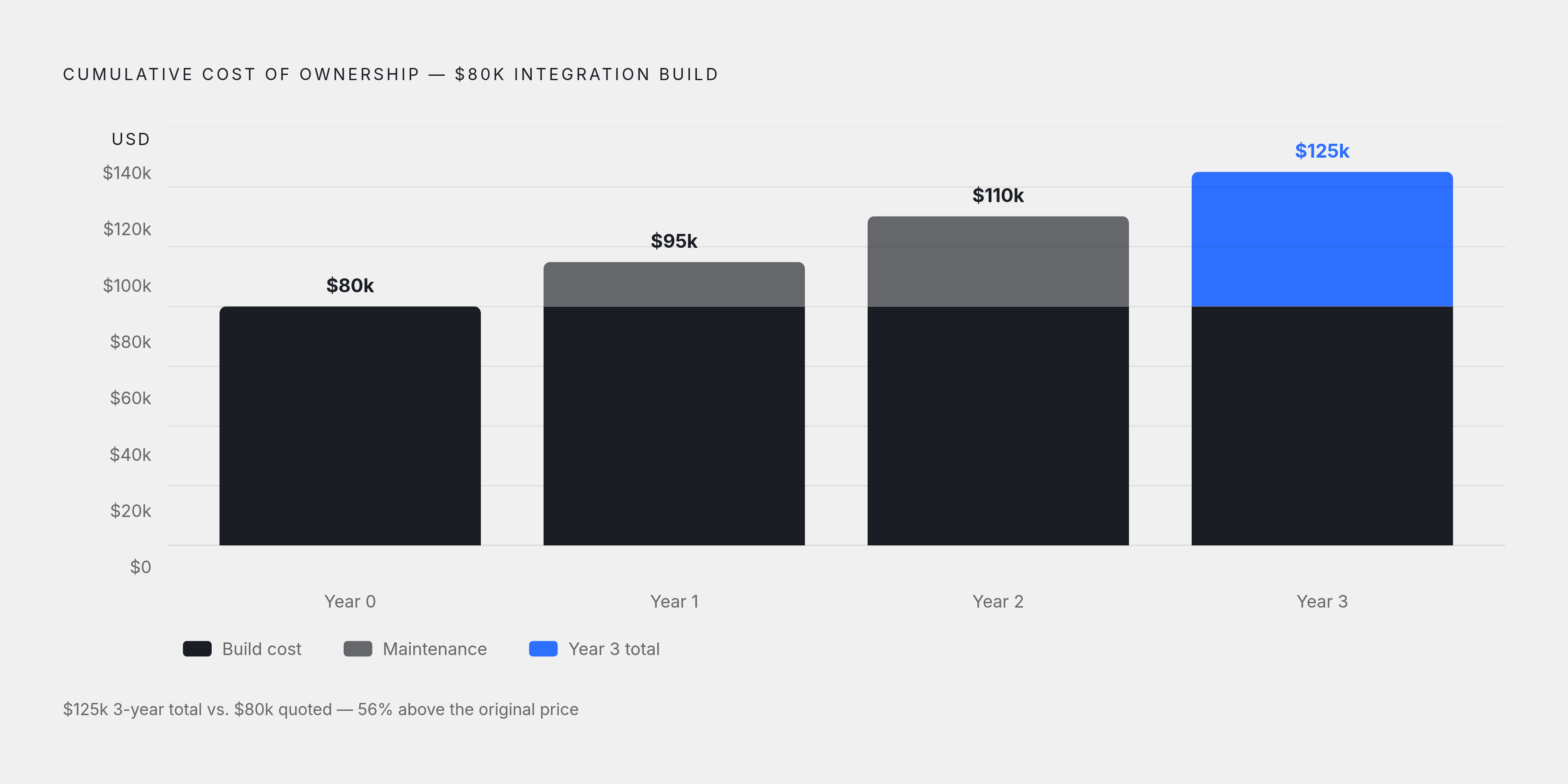
Industry figures put annual integration maintenance at 15 to 25% of the original build cost, repeating every year the integration stays alive. Run the math on an $80,000 build: $15,000 a year in support puts the three-year total cost of ownership closer to $125,000, not $80,000. Anyone budgeting for year one only is budgeting for a third of the real number.
Doing this in-house at scale gets expensive fast. Building and maintaining integrations internally at scale typically needs several engineers dedicated to the work full time, and the costs add up quickly. For an organization with a meaningful portfolio of integrations, $50,000 to $150,000 a year in staff and partnership fees is a figure cited in the literature, not a worst case.
That maintenance money pays for a specific list of recurring work: API version updates whenever an upstream provider deprecates an endpoint, security reviews and credential rotation, data model reconciliation as source systems change shape, edge cases that only ever show up under real production load, and technical debt from shortcuts taken under deadline pressure during the original build.
The second-integration problem kicks in next, and this is where most teams get the math wrong. The first integration takes several weeks. Within six to twelve months, customers start asking for Xero, then NetSuite, then Sage. Now the team maintains three separate integrations, each with its own token lifecycle, its own rate limit ceiling, its own data model quirks. Maintenance cost doesn't scale linearly with integration count. It multiplies.
The biggest hidden cost is opportunity cost, and nobody puts it in a spreadsheet because it doesn't generate an invoice. Every sprint spent on integration maintenance is a sprint not spent building product. Features that don't ship, deals that don't close, roadmap items that quietly slide, together these make up the real bill. Security debt compounds the problem on top of that: API-focused attacks jumped sharply in early 2023, and less than half of organizations run any kind of API security testing, so shortcuts taken at build time don't just sit there. They turn into liabilities with interest.
For teams weighing unified API platforms against building in-house, the break-even point tends to arrive relatively early in the integration portfolio, and past that point, every integration not built from scratch is straight savings. In-house builds can take a long time to fully stand up, so the break-even often arrives before the in-house path even finishes deploying. That timing gap is the strongest argument against defaulting to build.
How SaaS companies price integrations they offer customers, and why the model choice has its own cost logic
Most B2B SaaS companies don't charge directly for integrations. Integrations work as a lever instead: they drive upgrades, improve retention, raise how much a customer is willing to pay for the core product. The pricing decision is a growth decision wearing a cost-management costume.
Four models dominate, each with a different failure mode. Tiered gating locks integrations behind specific plans, pushing upgrades but choking adoption if the gate sits too high. À la carte pricing charges for integrations individually, predictable revenue per unit, but it adds friction right at the moment a customer decides whether to bother at all. Usage-based pricing charges per API call or data volume (Twilio is the textbook example), scaling cleanly with actual consumption but turning unpredictable for customers once volume climbs. Hybrid models combine a subscription base with usage charges on top, and they're winning: Chargebee's 2025 State of Subscriptions Report found 43% of companies already using hybrid pricing, with adoption projected to hit 61% by the end of 2026, and companies on hybrid models posting a median growth rate of 21%, ahead of both pure subscription and pure usage-based approaches.
Applied to integrations specifically, hybrid usually looks like this: gate which integrations are available by tier, bundle in a reasonable volume of syncs or API calls at that tier's price, then charge overage only once a customer blows past the included allocation by a wide margin. That gives the customer predictability and protects the vendor's margin at the same time, which is why it's pulling ahead of the alternatives.
Credit-based pricing is the newer pattern, and it's on track to become the default for AI-native products and agents heading into 2026. Credit wallets let a customer prepay a pool of credits usable across products, users, and agents, built for situations where usage is naturally irregular and a flat subscription or a strict per-call meter both feel like the wrong fit.
At the enterprise end, custom pricing is standard: multi-year contracts, volume commitments, negotiated discounts, and annual price increases baked in unless a customer locks a longer term. Buying committees walk in expecting to negotiate, and vendors price accordingly.
Price integrations too aggressively and adoption of the exact features that make a product sticky gets suppressed. Give integrations away free, and the engineering cost of maintaining every connector sits on the books without contributing a cent of revenue. Neither extreme works, which is exactly why hybrid keeps winning the argument.
How unified API platforms change the build-vs.-buy calculation at the integration layer
Unified API platforms (Merge, Apideck, Truto, Nango, Bindbee) exist specifically to absorb the operational overhead and maintenance layers described above. Instead of a company owning token refreshes, rate limit handling, and upstream API changes for every connector, the platform owns it, and the company pays a subscription instead of a headcount.
The pricing model each vendor picks matters more than it looks like it should. Merge prices per linked account, so every connection between a customer and an external system is its own billable unit, meaning cost scales with customer growth and with how many integrations each customer turns on. Apideck prices per consumer instead: cost scales with how many customers use integrations at all, not with how many each one adopts, so it doesn't punish a vendor for offering more connectors or for customers who plug into several at once.
That difference has a real structural consequence, the part of this whole calculation most teams get backwards. B2B SaaS runs on the assumption that adding one more customer costs close to nothing at the margin. Per-connection pricing breaks that assumption right at the integration layer, since every new connector a customer turns on becomes a new bill, and the vendor's incentives start pulling against the business's growth incentives. Account-based pricing treats a customer using more connectors as a cost problem. API-call pricing treats frequent syncing as a cost problem. Consumer-based pricing treats both as exactly what a healthy, well-used integration is supposed to look like, making it the model worth picking if the choice is on the table.
Set against the in-house path, significant time to build, substantial annual cost to run, and engineers tied up indefinitely, a unified API platform trades that capital and headcount commitment for a subscription with a cost structure that's at least knowable ahead of time. How build versus buy plays out depends on a specific, concrete context. It's what integration count the subscription starts winning at, and the break-even tends to arrive early in the integration portfolio for most teams. A team with one stable integration and requirements unlikely to shift might still come out ahead building it themselves. A team already running two or more integrations against APIs that change often should run the unified platform numbers explicitly instead of assuming the in-house path is cheaper by default, because past that point, it usually isn't.
Knowing which complexity tier a project actually falls into matters most at the estimation stage, since that's when scope creep is cheapest to catch. Letterbrace tracks how API integration costs move over time, initial build outcomes alongside the operational load that follows, which is often where the patterns behind a ballooning maintenance bill show up first, before they turn into a recurring line item nobody planned for.
The same build-vs-buy logic shows up outside pure integration work, too. A content marketing platform built around tracking whether AI models actually cite and name a given client faces an identical calculation: building that measurement infrastructure in-house compounds cost the same way integration maintenance does, and the same break-even math applies to deciding whether to build it or buy it.