RPC vs REST API Design for Internal Microservices
Internal microservices don't get seen by users, but they carry most of the request volume in any distributed system. And the choice between REST and RPC for those internal calls carries real weight. It's a decision about how a team thinks, how fast the system runs, and how much pain shows up later when someone tries to change a field name.
Microsoft's Azure Architecture Center splits APIs into two buckets: public-facing APIs (browsers, mobile apps, external consumers) and back-end interservice APIs (services talking to services you control completely). Public APIs get built for strangers. Internal APIs get built for people who already know each other's phone numbers. Different defaults apply, and mixing them up is where a lot of this goes sideways.
There's also a governance gap worth naming up front. Postman's 2025 State of the API Report, based on responses from more than 5,700 people, found 82% of organizations have adopted API-first practices at some level. Yet adoption of API-first practices does not automatically mean rigorous contract governance. That gap is widest exactly where internal services live, behind the curtain, where nobody's watching the API contracts as closely as they watch the ones customers see.
The mental model each approach imposes on the team that builds with it
REST thinks in nouns. Every resource gets a URL, and the verbs are fixed by the protocol: GET, POST, PUT, DELETE. You want an order? /orders/123. You want to cancel it? PUT a new status onto that same URL. The protocol hands you a grammar and you fill in the blanks.
RPC thinks in verbs. The call names the action directly: checkPermission(userId, resource), sendInvoice(invoiceId), calculateTax(amount, location). There's no URL to negotiate, no resource to model. You're not asking "what thing am I updating," you're saying "do this specific thing, now."
This sounds like a syntax preference. It isn't. It shapes how a team breaks up domain logic. REST's noun-first model fits naturally when the domain has clean, obvious resources: orders, users, products, invoices. RPC's verb-first model fits when the domain is full of actions that don't map cleanly to a "thing": validate, process, fan out, reconcile. Ask a team building a fraud-detection pipeline "what's the resource here?" and watch them stall. Ask them "what's the action?" and they'll answer in a second.
There's a practical cost buried in this, too. A REST client needs nothing but HTTP: curl it, browse it, done. An RPC client needs a generated stub, code built from a shared definition file. That's a real coupling between the caller and the callee's build process, and it matters more than it sounds like it should (more on that shortly).
gRPC is a widely adopted RPC framework for internal services, and it's worth separating what it inherited from what it invented. The action-oriented mental model comes straight from RPC, decades old. The speed comes from two key design choices: Protocol Buffers for serialization, and HTTP/2 for transport. Keep those two things separate in your head, because the tradeoffs attach to different parts of the stack.
What the performance gap between gRPC and REST actually looks like under load
Start with the payload, because that's the actual mechanism, not just a talking point. The same piece of data that takes 112 bytes as JSON can shrink to 28 bytes as a Protocol Buffer. That's a 75% reduction, and it's typical: binary serialization generally cuts payload size somewhere between 60% and 80% compared to JSON. Smaller payloads move faster. That's the whole trick, and everything downstream follows from it.
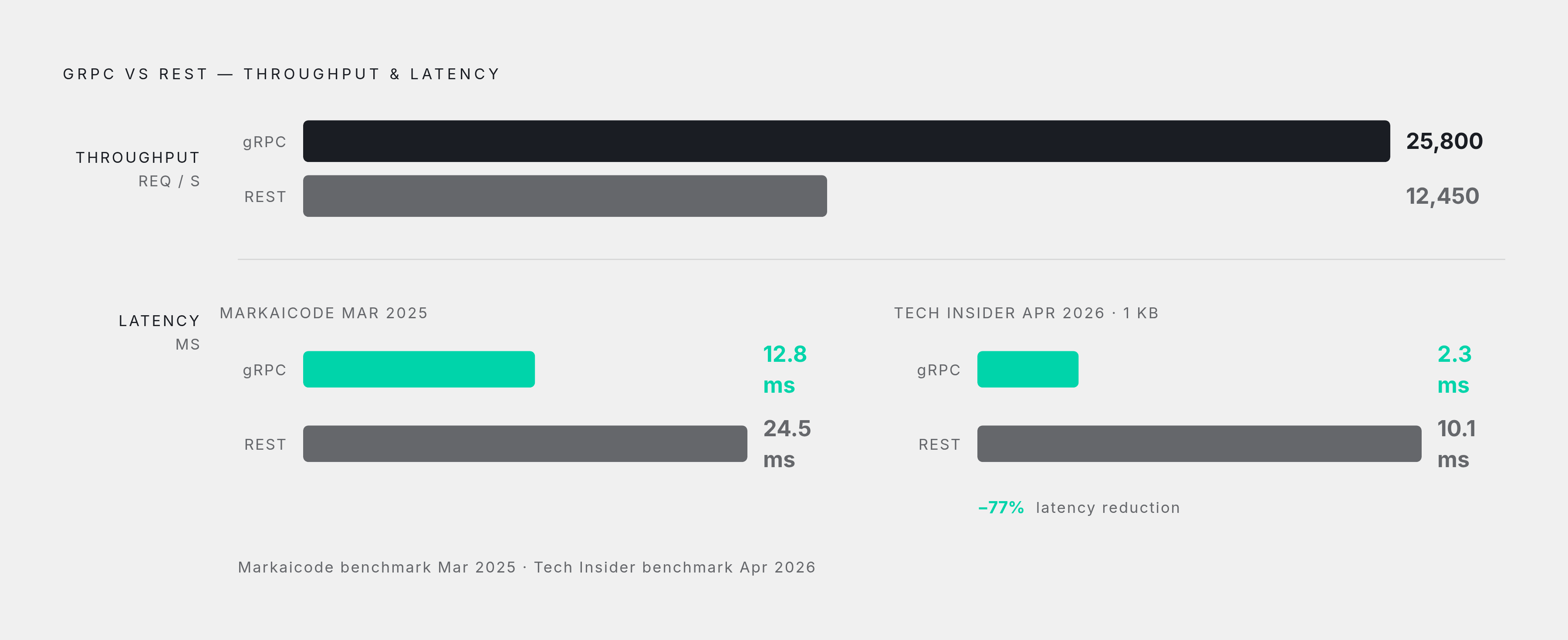
The benchmarks back it up. A microservice benchmark from Markaicode in March 2025 clocked gRPC at 25,800 requests per second with 12.8 millisecond latency, against REST at 12,450 requests per second and 24.5 milliseconds. Roughly double the throughput, roughly half the latency. A separate benchmark from Tech Insider in April 2026, using 1 KB payloads, found gRPC at 2.3 milliseconds median latency versus REST at 10.1 milliseconds, a 77% reduction. The reasons line up with what you'd expect: HTTP/2 multiplexing kills the repeated connection setup that HTTP/1.1 pays for on every request, HPACK header compression trims the fat off every call, and protobuf serialization runs somewhere around 6 to 10 times faster than parsing JSON.
Here's the nuance that benchmark headlines tend to skip: the advantage is payload-sensitive, not universal. On small payloads, REST can actually deliver lower latency; there's less serialization overhead to save on in the first place. As payload size and client load climb, gRPC pulls ahead, delivering something like 15% to 40% more throughput. Push into large payloads and gRPC's throughput can reach roughly 10 times what a REST server manages under the same load.
Real migrations show the same shape. One data pipeline, according to a writeup on the Boundev blog, moved from JSON-over-REST to Protobuf-over-gRPC and dropped its p99 latency from 340 milliseconds to 47 milliseconds. Seven times faster, with zero changes to business logic. Just a transport and serialization swap. Netflix started migrating hot internal paths from REST to gRPC back in 2018 and saw roughly a 50% improvement in p99 latency on the services doing the heaviest fan-out. The gains showed up internally, where the traffic patterns actually called for it.
All of this is real, but it's bounded. These numbers reflect high-volume, large-payload, tightly-controlled internal conditions. If your service handles a few hundred requests a minute with small JSON blobs, none of this moves the needle much, and you're solving a problem you don't have.
The real costs gRPC introduces that benchmark posts omit
Speed doesn't arrive free. gRPC requires a .proto file, a code-generation step, and ongoing stub management, and none of that is optional. Every service that talks gRPC needs its contract compiled into a stub before a single line of business logic gets written.
That has knock-on effects on debugging. A REST response is just JSON. Anyone can paste it into a text editor and read it. A gRPC message is a binary blob, opaque to curl, invisible to a browser without a gRPC-Web proxy sitting in front of it. Debugging goes from "read the response" to "regenerate the stub, decode the binary, hope the schema version matches." Somewhere, an engineer is quietly writing a debug script whose entire job is turning bytes back into words, and that engineer probably deserves a raise.
Schema maintenance compounds fast. Writing HTTP clients, syncing data-transfer-object schemas, and managing stub regeneration across a growing set of services carries a real and growing engineering cost, and that cost doesn't stay flat. It scales with every service added to the mesh. Add browser support to the list of headaches: gRPC has no native path into a browser, so gRPC-Web needs a proxy layer, commonly Envoy, sitting at the edge to translate. That's infrastructure complexity nobody budgeted for until it showed up.
Dropbox's migration to gRPC, through its internal Courier framework serving thousands of microservices, ran into a cost nobody predicted from a whiteboard diagram: TLS handshakes were burning a serious amount of CPU every time services restarted. The fix meant switching cryptographic algorithms, from RSA 2048 to ECDSA P-256, a change that required careful rollout across that scale. That's the pattern with gRPC's costs generally: they hide in operations, not in the code review.
The rough consensus across teams that have lived with both: REST wins on debuggability, testability, and documentation, gRPC wins on raw performance but loses ground on developer experience the moment an external consumer enters the picture. Microsoft's own architecture guidance puts it almost bluntly: use REST over HTTP unless there's a specific need for the performance benefits of a binary protocol. REST is the default. gRPC is the thing you have to argue for.
Where streaming and bidirectional communication change the equation
REST is built around one shape, in which a request goes out, a response comes back, and the client waits. That's the whole pattern, and it's a fine pattern for most things. It's just not the only pattern that internal services need.
gRPC supports multiple communication modes, including unary calls, server-streaming, client-streaming, and full bidirectional streaming, all native to the protocol. No polling loop bolted on as a workaround, no client hammering an endpoint every two seconds to ask "anything new yet?"
This matters for specific, real internal use cases: live telemetry pipelines, real-time fraud detection systems, event feeds that flow both directions between two services, IoT data ingestion at scale. A client can open a single server-streaming call and just sit there, receiving a continuous flow of events, with one persistent connection instead of a new one for every message. That kills the repeated connection-setup overhead that would otherwise pile up under a request-response model.
Dashboards, monitoring sidecars, and machine-learning inference pipelines all tend to fit the streaming model structurally better than request-response REST, and that's true regardless of payload size. This isn't a performance optimization in the way the benchmarks above are; it's a capability gap. REST can't do this without reaching for a separate protocol entirely, like WebSockets or server-sent events. If an internal service genuinely needs bidirectional streaming, the decision mostly makes itself.
How schema evolution and contract governance play out differently in each model
Protocol Buffers were designed with change in mind. Fields carry unique numeric tags, and new fields can get added without breaking any client still running the older schema. Deprecated fields get reserved rather than deleted, so nobody accidentally reuses a tag number and corrupts data for a service that hasn't updated yet.
Additive changes are safe. Removing or renumbering a field is not, and it'll break things immediately and loudly. That's the trade: the same discipline that makes Protobuf schemas safe to evolve also makes careless changes impossible to hide. There's no gray area where a sloppy edit slips through unnoticed.
REST, running over plain JSON, enforces no schema by default. OpenAPI (Swagger) can define one, and plenty of teams do write specs, but nothing forces a caller to actually honor that spec. It's documentation, not a contract. A .proto file, on the other hand, is a machine-readable definition that generates working stubs in whatever language a service happens to be written in, no manual honor system required.
That gap in enforcement is exactly where Postman's number from earlier lands hardest: Most REST-based internal services are running without the structural guardrails that gRPC bakes in by default. So the .proto maintenance burden described a section ago cuts both ways. It's overhead, yes, but it's also the mechanism that stops schema drift from turning into a 2 a.m. incident. Teams that find the discipline annoying are often, ironically, the teams that need it most.
The decision criteria that actually separate gRPC-appropriate from REST-appropriate internal services
Start with two numbers: how big is the payload, and how often does it move? Small, infrequent payloads favor REST, both because of its small-payload latency edge and because the tooling cost stays low. As volume and payload size climb, gRPC's throughput and bandwidth advantages start to compound, and the case flips.
Reach for gRPC when a handful of conditions line up. Services are tightly coupled and the consumer is always another service you control, never a browser, never a third party guessing at your API. The use case genuinely needs streaming or bidirectional communication that REST has no native way to express. The architecture spans multiple programming languages and a machine-readable, enforced contract between them carries real operational value. Or latency and throughput are the measurable bottleneck, not a guess, in something like real-time fraud detection, image processing, or high-frequency fan-out the way Netflix's hottest internal paths needed.
Reach for REST when service boundaries already map cleanly onto resources with CRUD semantics: create an order, read a user, update a product. Reach for it when developer experience, debuggability, and low onboarding friction matter more than shaving milliseconds off a call nobody's complained about. Reach for it when the team is small, call volume is moderate, and the tooling overhead of gRPC would eat time better spent elsewhere. Microsoft's guidance again: if REST already meets the network performance and payload requirements at hand, that's sufficient justification on its own. No further case needs making.
A quick filter, if none of the above settles it fast enough: does the API call read naturally as a verb phrase, like validatePermission or processPayment? Reach for RPC. Does it read as a noun phrase, like /orders/{id}? Reach for REST. It's not a perfect test, but it's a fast one.
None of this is permanent, either. gRPC came out of Google and got adopted early by Netflix and other large-scale companies, and mid-size companies are increasingly picking it up for their own internal services too. Adoption at scale by companies with Netflix's traffic doesn't mean adoption is correct for a team running a fraction of that volume. Scale is context.
Running both in the same system, where the boundary sits and how to maintain it
Microsoft, AWS, and Imaginary Cloud all land on roughly the same answer here: modern architectures often run both, REST facing the public internet, gRPC running inside the service mesh. This is deliberate. It's matching each protocol to the job it's actually good at.
The boundary isn't arbitrary. REST faces outward because it needs no client stub, works natively in any browser, and produces responses that are interoperable and cacheable by default, exactly what a stranger's client needs. gRPC faces inward because it can safely assume a known consumer, infrastructure you control, and a build process every team involved has already agreed to share.
Protocol translation happens at the edge. An API gateway, Envoy or Kong being common choices, handles the conversion so internal gRPC traffic never gets exposed directly to an external caller who has no idea what a .proto file is and shouldn't need to. Service mesh compatibility is worth checking before committing to a stack, too: Linkerd, for instance, has built-in support for HTTP, HTTP/2, and gRPC, but that kind of compatibility should get confirmed early, not discovered during an incident.
None of this means "use both everywhere and hope it works out." It's a disciplined boundary: public APIs default to REST, internal services earn gRPC when there's an actual case for it (payload size, streaming, polyglot contracts, measured latency pressure), and the gateway enforces the translation between the two so neither side has to know much about the other. Microsoft's architecture guidance adds one more practical instruction worth following literally: if REST is the choice for an internal path where load is still uncertain, run performance and load testing early, before the uncertainty turns into a production incident.
The real decision here was never about picking a favorite technology. It's about what a service is allowed to assume about whoever's calling it, how much that caller can be asked to build in order to talk to it, and what shape the actual conversation between the two needs to take. Get that boundary right, and the rest of the architecture tends to follow it without much of a fight.