How Third-Party API Rate Limits Become Your Product's Reliability Problem
When third-party APIs fail, your product pays the price, even when the problem isn't yours.
Rate limits cap how many requests you can make in a given time window. Per second, per minute, per day, per token. The exact shape depends on the provider and sometimes on your pricing tier.
The enforcement mechanisms vary:
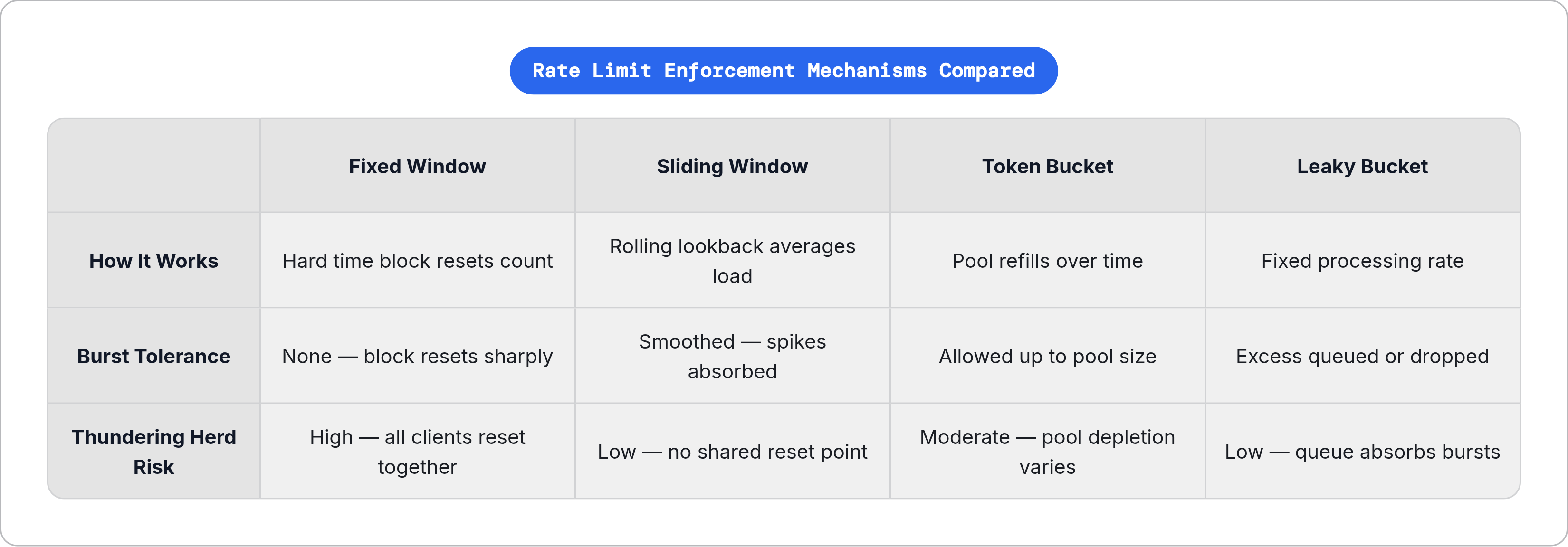
- Fixed window: requests are counted in a hard time block ("100 requests per minute")
- Sliding window: a rolling lookback that smooths out burst spikes
- Token bucket: a pool that refills over time; bursts are allowed up to the pool size
- Leaky bucket: requests are processed at a fixed rate, excess gets queued or dropped
Each of these produces different behavior when you hit the ceiling. The HTTP signal is a 429 Too Many Requests response. Sometimes you get a Retry-After header telling you when to try again. Often you don't.
Here's the part that still gets me: only about 15% of APIs use any documented form of rate limiting, per 2024 research. That doesn't mean the other 85% have no limits. It means their limits are undocumented, inconsistently enforced, or sitting quietly in production waiting for you to fall through the floor. Teams learn a limit exists when they hit it. The docs rarely say so in advance.
OpenAI, for example, applies separate token-per-minute and request-per-minute limits that can each be exhausted independently. You can be completely fine on one and completely stuck on the other at the same time. That kind of thing rarely makes it into documentation until enough people have already run into it. Which is, of course, how documentation gets written in this industry.
How a single 429 response can cascade into a user-facing outage
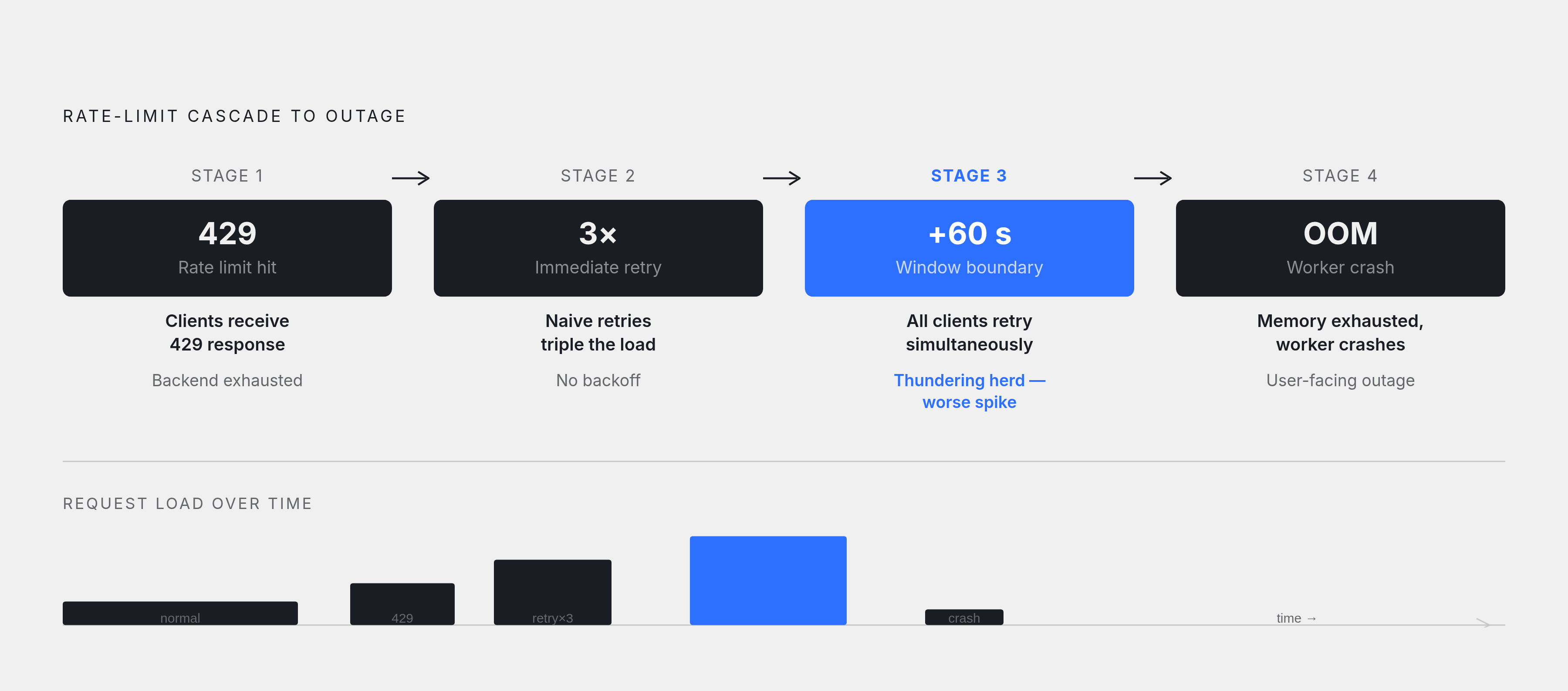
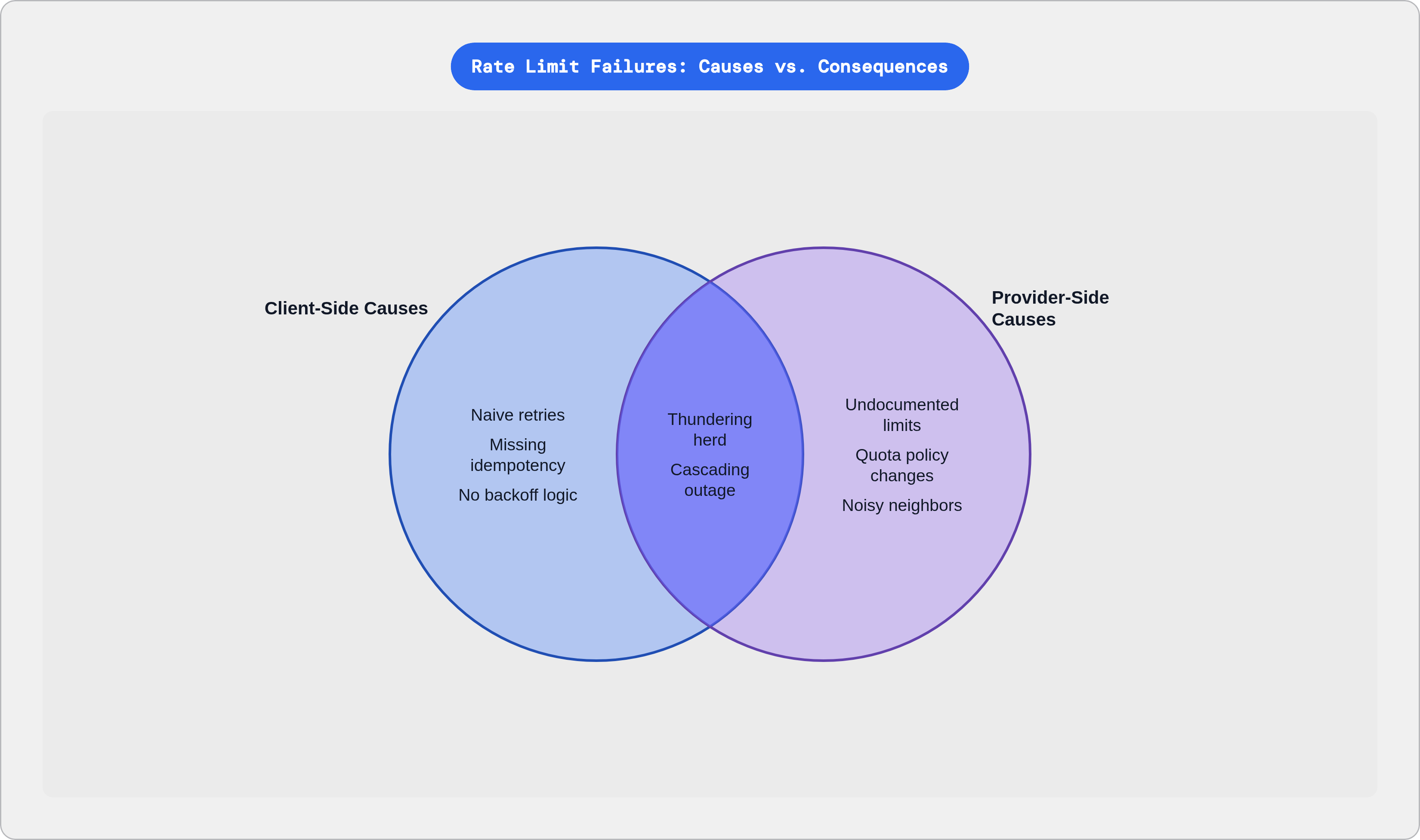
The first failure mode is the naive retry. "Retry three times immediately" sounds reasonable until you picture a thousand clients all doing it simultaneously against a backend that already couldn't handle the original load. You just tripled the problem. Teams still do this. It's like trying to cure a traffic jam by adding more cars.
What follows is the thundering herd. Clients that all hit their limit at the same moment retry at the start of the next time window, all at once, creating an artificial traffic spike that re-triggers the very limit they were waiting out. You didn't solve anything. You delayed the collision by 60 seconds.
The side effects compound from there. Retry loops hold open database connections. They consume CPU and exhaust memory. A background worker crash is entirely plausible from what started as an external quota error on a third-party API you don't even control. Idempotency makes it messier. Retrying a GET is safe. Retrying a POST that creates a record will produce duplicates if the server already processed the original before timing out. Now you have data integrity issues layered on top of the outage.
The Cloudflare dashboard outage in September 2025 is a clean illustration of this failure chain. A React bug misconfigured a dependency array, which triggered unnecessary repeated calls to the Tenant Service API. Those calls hit rate limiting. The dashboard went down. The upstream cause was a single misbehaving component. The downstream result was a product-wide outage.
From the user's perspective, there is no visible difference between "our product is broken" and "a third-party rate limit cascaded." The blame goes to the product they're paying for. Every time.
Rate limits that ended up on someone else's reliability record
These are real incidents. Not hypotheticals, not "imagine if." Things that actually happened, with documented impact.
GitHub Copilot, February 2026. An unexpected traffic surge exceeded an internal secondary rate limit. About 154,000 users got degraded availability. The trigger wasn't a bug. It was demand. The system did exactly what it was designed to do. It just couldn't handle the volume.
Atlassian Jira API, April 2026. Gateway-level rate limiting caused 429 errors for Forge apps for over 33 hours. Confluence APIs were unaffected the entire time. If you weren't watching the right status feed, you just knew your Forge app wasn't working, with no obvious reason why.
GitHub Search, also February 2026. A single customer operating hundreds of orchestrated accounts and issuing expensive queries concentrated load on one shard. That slowed lexical code search for everyone. Between 5 and 10% of queries timed out across the platform. One customer's behavior became the whole platform's problem.
Google Cloud quota system, June 2025. A bad automated update to the quota enforcement layer propagated globally. 76 services were affected for three hours. Compute, storage, and networking were fine. The quota layer was not. The abstraction meant to protect the system became its single point of failure.
OpenAI, November 2024. Routing layer nodes hit memory limits, failed readiness checks, and produced 502 and 503 errors across all models and all API endpoints for roughly 90 minutes.
The OpenAI reliability picture over a longer window is worth sitting with. One analysis tracked roughly 294 OpenAI outages since the start of 2025. Stripe, over the same period, ran at an estimated 99.99% uptime. OpenAI came in around 99.76% overall, with certain API components running lower over specific stretches. Both are real products used by real businesses. That gap is not small, and if your product depends on one of them, it becomes your gap too.
Twitter/X, 2023. The policy change eliminating free API access caused most unofficial clients and RSS aggregators to shut down overnight. Rate limits don't have to be technical to be catastrophic. A quota change enforced through pricing has the same practical effect as a hard 429. One Japanese disaster prevention account couldn't post critical updates after hitting the new API limit. Extreme case. But a clean illustration of what happens when your product's reliability is sitting on top of someone else's quota policy.
Why AI APIs are a special case for reliability planning
The reliability gap in AI APIs isn't negligence. It's structural. The demand curves for these services didn't exist two years ago. Providers are scaling, versioning, and demand-shaping simultaneously, in real time, against workloads they couldn't have modeled in advance. Nobody had solid historical data to plan from, because the history simply didn't exist yet.
Rate limits on AI APIs are also more complex than traditional REST APIs. Token-per-minute limits, request-per-minute limits, and model-specific quotas can each be exhausted independently. They interact in non-obvious ways. You can be fine on one dimension and completely stuck on another, and the error message won't always tell you which one.
There's a startup story circulating in developer communities, sourced from developer accounts and not officially confirmed, about a Y Combinator-backed startup that built on OpenAI's API, raised $2.3M, and signed enterprise contracts promising 99.9% uptime. OpenAI's API went down for six hours on Black Friday. The startup lost three enterprise contracts that week and shut down in January. The specific details are fuzzy. The pattern, though, is real. It shows up in documented incidents elsewhere, and the fact that people keep telling this particular story says something about how often they've seen some version of it play out.
The demo-day version is better documented. Three startups at a major accelerator had live demos fail when OpenAI's API went down during the event. The accelerator now advises all cohort companies to build offline demo modes that don't depend on live API calls. That's a policy change driven entirely by a rate limit problem.
The point isn't "don't use AI APIs." They're genuinely remarkable tools. The point is that any uptime promise you make to a customer is bounded by the weakest SLA in your dependency graph — your reliability is only as strong as its most fragile link. Right now, for most products, that weakest link is an AI API. Plan around that reality, not around the assumption that it'll hold.
The multi-tenant dimension: one customer's usage becoming everyone else's problem
In integration-heavy SaaS, API calls are made on behalf of many customer accounts, often against the same provider endpoint. The quota is shared even when the accounts aren't.
A single misbehaving sync job. An unusually large data export. A misconfigured automation. A bulk operation someone scheduled for 9 AM Monday morning. Any of these can exhaust the shared quota window for every customer using the same integration. The customer who did nothing unusual gets a degraded experience because another customer's usage pattern happened to concentrate load at exactly the wrong moment. It's a fairness problem as much as a reliability problem.
The GitHub Search incident from February 2026 is exactly this pattern at the provider level. One customer's query behavior degraded service for all users on the platform. The same dynamic plays out inside any SaaS product running shared integration infrastructure, just with your customers in the starring roles instead.
Most teams discover they have a noisy-neighbor problem the same way: retroactively, from a customer complaint, rather than from an alert.
One survey of software engineering decision-makers found that 88% of companies report third-party API issues requiring weekly attention. A third of those say it happens multiple times a week. In multi-tenant environments, the frequency and the blast radius compound each other in ways that aren't obvious until you're already in the middle of an incident.
The engineering overhead teams are absorbing right now
The numbers aren't abstract:
- 36% of companies spend more time troubleshooting APIs than building new features
- 60% reported spending too many weekly hours on third-party API issues
- 57% reported lacking the flexibility to scale API consumption as needed
- 40% acknowledge they lack the time or resources to build internal services to handle rate limit problems properly
They know what's needed. They can't get to it. Over half of teams are using some mix of ad hoc fixes, dedicated internal services, or one-off modifications to the originating code. None of these are systematic, and none of them hold up well when a provider has a rough week.
What makes this worse: most API problems originate on the client side. HTTP response code data shows client-related errors occur four times more often than server-related errors. A significant chunk of this troubleshooting burden is self-inflicted. It's the result of improvised handling that wasn't designed to hold under load.
And then there are the surprises. More than half of developers faced a production crash in 2024 due to an unannounced breaking change from a third-party vendor. Rate limit policy changes fall into that category. They arrive without warning and break things immediately. Every new integration multiplies the surface area for this class of problem, and the integrations that ship fastest are the least likely to have robust rate-limit handling underneath them. That's just the math.
What resilient rate limit handling actually requires teams to build
This is the actual work, not a shortcut list:
Exponential backoff with jitter. Retries need to increase wait time exponentially and add randomness. Jitter prevents synchronized retry storms. A fixed retry interval is what creates the thundering herd in the first place.
Respect Retry-After headers. When a provider tells you when to try again, believe them. When they omit that information, implement conservative defaults, not optimistic ones.
Idempotency keys on mutating requests. Before retrying any non-GET request, the system needs to determine whether the original was already processed. Blind retries on POST, PATCH, and DELETE create duplicate records or double-charges.
Per-tenant quota tracking. In multi-tenant systems, shared quota pools require per-account usage attribution. You need visibility into one customer's consumption before it exhausts the shared window. Not after.
Request queuing and prioritization. Not all requests are equal. A user-initiated action should not compete with a background sync job for the same quota bucket. Prioritization is a product decision, not just an infrastructure one.
Circuit breakers. When a provider is returning sustained 429s or 5xx errors, stop sending. A circuit breaker halts the retry storm and protects both sides. Without it, you're re-triggering the failure on a loop.
Observability at the integration layer. Visibility into rate limit consumption per provider, per customer account, and per endpoint. Without it, noisy-neighbor problems are invisible until someone files a support ticket.
Proactive quota monitoring with headroom alerts. An alert at 70 or 80% of a quota window gives you time to throttle before the limit fires. An alert at 100% is just a better-formatted incident notification.
Every one of these requires implementation, testing, and ongoing maintenance. And it has to be replicated across every provider integration in the product. That's the actual scope of the problem, and it's bigger than most teams budget for when they're moving fast on a new integration.
Why the integration layer is the right place to absorb this complexity, and what that implies for teams building on managed infrastructure
The pattern across every incident reviewed here is consistent. The teams that fared worst were the ones where rate limit handling was implemented differently across individual API integrations. Each one slightly different. None of them tested under real quota pressure, because who tests for that before a customer hits it?
Centralizing rate limit handling in a dedicated integration layer changes the math. Backoff logic, circuit breakers, quota tracking, retry queues all become consistent across every provider and every customer account. That consistency is what separates a team that weathers a bad week at OpenAI from one that's explaining contract losses in a postmortem.
The environment is also getting harder, not easier. Average API uptime fell from 99.66% in Q1 2024 to 99.46% in Q1 2025. That's roughly 55 minutes of downtime per week versus 34 minutes a year earlier. The infrastructure teams are building on is less stable than it was, and the number of integrations per product keeps growing.
Building and maintaining this layer in-house is the 40% problem from the survey data. Teams know it's needed. They can't prioritize it. So they ship integrations that will eventually fail under load, because that's what fits in the sprint.
Pre-built, managed connectors that handle rate limit behavior, including backoff, queuing, and per-tenant attribution, move that operational work off product engineering and onto infrastructure built specifically for it. That's a deliberate call about where complexity belongs, and acknowledging that rebuilding the same retry logic from scratch for every new integration is a poor use of anyone's time.
Third-party quota policies are an external variable your product cannot control. How your system responds is the only variable you own. That response logic shouldn't be re-implemented from scratch every time someone adds a new integration to the stack. Based on recent history, provider instability is happening more often than anyone planned for. The teams whose uptime commitments hold during those stretches are the ones who treated rate limit resilience as infrastructure, not an afterthought.