Schema Change Clauses in Third-Party API Contracts
Schema clauses protect structure, not the behavioral changes that actually break systems.
Publishing an API is a promise. Once other teams build against an endpoint, the provider can't rip it out without warning, since that breaks every system depending on it. Schema change clauses exist to manage that promise: they spell out how and when a provider gets to change the thing everyone else built on top of.
Most SaaS contracts bury this under a section like "Change Management & Feature Updates," covering deprecation, notice timing, and customer rights when something shifts underneath them. A pattern appears quickly across a handful of real contracts. Contract language from providers like Fourth, ESO, HotSchedules, and LINQ is roughly the same: the subscriber agrees data availability "may change at any time during the Term," with no refund owed and access cuttable whenever the provider decides. Some of that language is softer than others. LINQ's version, for instance, drops the "sole discretion" phrasing that Fourth's contract keeps. But the shape is the same across vendors, and it's the shape most buyers sign without ever pushing back on it.
None of this is hidden or sneaky. API terms of service let the provider modify or kill functionality without it counting as a breach, so long as they meet their own notice requirement. The provider keeps the right to change things, and the buyer gets a heads-up, asymmetric by design.
What a schema change clause covers
Even the well-written versions of these clauses cover a narrower slice of reality than most buyers assume. A tight schema change clause governs structural stuff (endpoint names, field names, data types, required-or-optional status), a boundary far smaller than what engineering teams actually rely on.
RoxyAPI's terms of service, section 4.1, show what a genuinely careful version of this looks like. Within a version, the API only adds things (endpoints, optional parameters, fields, enum values); it never removes or renames a field, changes a type, or kills an endpoint. Anything that would break a consumer ships under a new version prefix instead. Retirement is announced via changelog and email at least 90 days ahead, with the old endpoint live the whole notice period; the only escape hatch is an urgent security or legal issue.
That's about as rigorous as this kind of clause gets, and it's still only talking about structure. Compare it to GE's standard language, which commits only to "commercially reasonable efforts" to keep the previous API version running for 12 months, minus carve-outs for security or legal/technological requirements. "Commercially reasonable" is softer than RoxyAPI's hard 90-day floor, and the exceptions leave more daylight for the provider to walk away early.
An API contract is formally defined by endpoints, HTTP methods, request and response formats, data types, headers, status codes, and error responses. Every item on that list is something a schema validator can check automatically by feeding it a payload, which is both the point and the limit of the exercise.
The real breaking surface lives outside the schema
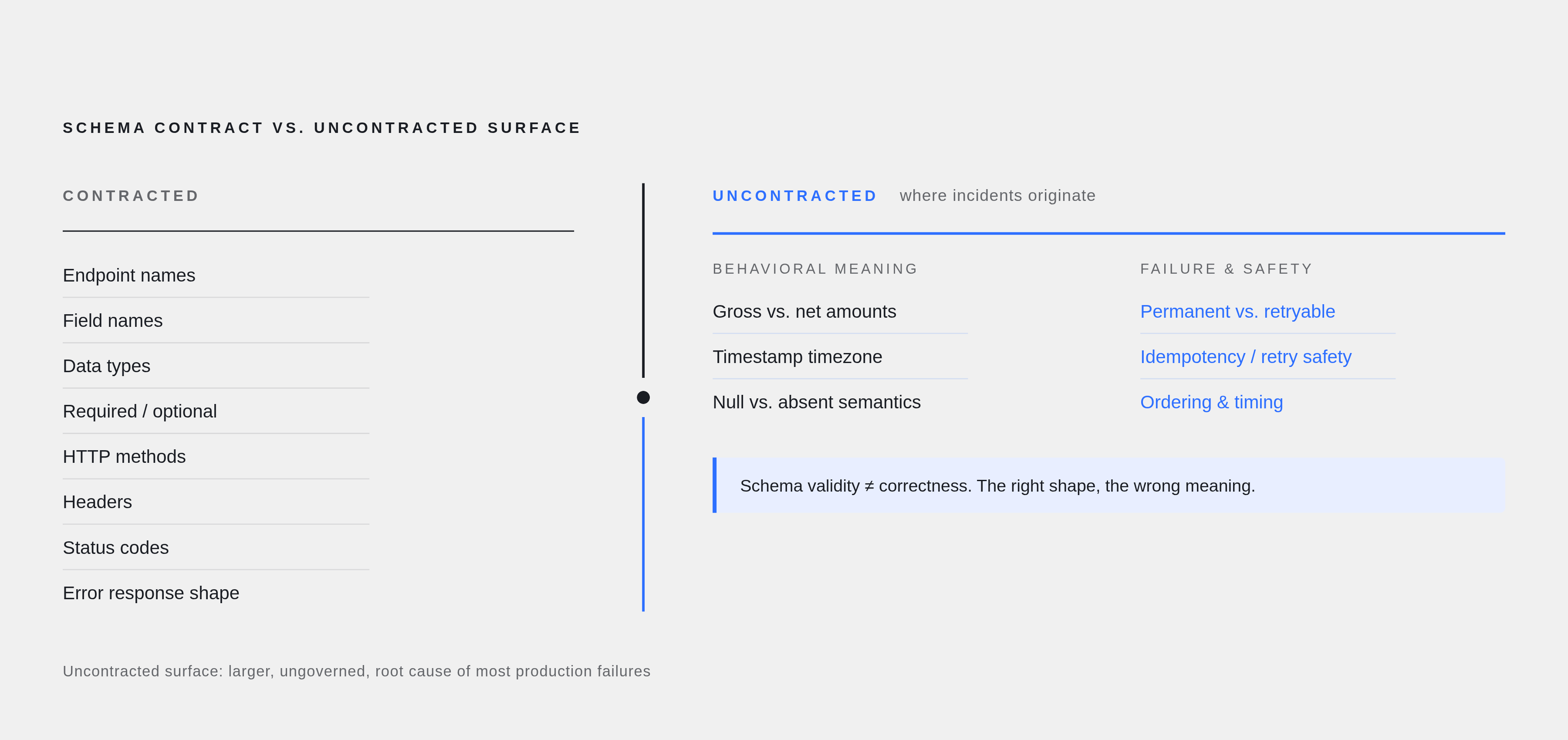
The contract governs the schema, but the failures that actually take down production systems happen in the territory the schema never touches: behavioral meaning, error semantics, retry safety.
An interface contract that actually protects both sides needs to cover at least four things beyond shape and data types. First, meaning: what a status value includes, whether an amount is gross or net, what timezone a timestamp uses, whether a returned list is complete or just one page. A schema validator has no opinion on any of that, and it's exactly where the worst incidents come from. Second, error behavior: which failures are permanent versus safe to retry, and how a client tells the difference. Consuming teams code against this distinction regardless of documentation. Third, retry safety, meaning whether hitting the same endpoint twice does anything harmful. One source calls this dimension "specific and widely ignored," since nobody writes it down until something breaks. Fourth, ordering and timing: does a response reflect a write the instant it happens, or is there lag.
The clearest illustration involves a field that quietly goes dark: a team stops populating a field nobody official thought anyone depended on. The schema still declares it. Responses still include it. It's just always null now. Three days later, two consumers break: one displaying the field on a dashboard, one using it to decide whether a failed call was safe to retry. The change sailed through review as routine cleanup, since no structural field was removed, renamed, or retyped.
That case reframes what "breaking" even means. Judgment sits with the consumer's code, not the provider's intent: a change is breaking if something that worked before stops working or quietly returns the wrong answer. Under that definition, a purely additive change, the kind every schema clause allows, can still be functionally breaking. Making an optional field required, narrowing accepted enum values, or tightening a validation rule all look additive on paper yet break real integrations.
A payment provider's routine deploy broke three downstream services silently
One documented case makes the abstract version concrete. A payment provider's routine Tuesday deploy added a single new field to its response payload. Nothing was removed, so by the schema's definition it wasn't flagged as breaking.
A team stopped populating a field nobody was "supposed" to depend on. Within three days, two consumers broke, one displaying it, one using it to decide whether to retry, despite the change passing review as cleanup. A reconciliation job started failing silently within two hours of the release. Nobody caught it internally; finance found the mismatch the next morning and traced it back to a deploy that, on paper, hadn't broken anything.
The gap between "passed every test" and "broke something real" shows what the structural definition of a schema change misses. Both sides thought they'd agreed on the interface, but they'd only agreed on its shape, not on what either side assumed the data meant.
This isn't a one-off horror story either. Undetected API schema drift is among the top three causes of production incidents across distributed systems, the World Quality Report 2025 found. And the underlying mechanic behind nearly every one of these incidents is the same: APIs rarely fail by simply stopping. They fail because one service quietly changes something another depends on without notice; a renamed field or altered data type can pass functional testing and still take down a downstream application an hour later.
Why AI vendor contracts compound the problem
AI vendor contracts inherit this exact structural mismatch and then make it worse. A model can change its output behavior, accuracy, or error patterns without a single line of the API schema changing. The endpoint looks identical, but what comes back no longer behaves as it did last month, something no clause built around field names and data types could catch.
Legal teams are largely improvising here. Most in-house counsel are building AI procurement processes from scratch, bolting new requirements onto SaaS templates never designed for a system that generates novel output and shifts behavior without permission. A model update changes the core functionality of what a buyer paid for, yet standard sub-processor notification clauses, built for swapping a cloud vendor or support tool, don't recognize it as needing disclosure.
Current guidance recommends 30–60 days' advance written notice before deploying a material model update affecting outputs, accuracy, or behavior, with "material" tied to the buyer's licensed use case. The EU has already moved on this. The EU Model Contractual Clauses for AI Procurement, published in 2025, include a full version aligned with high-risk AI Act requirements and a light version for non-high-risk systems, and are rapidly becoming the de facto standard template. Nobody has to adopt them wholesale to use them as a benchmark for what a serious behavior-change clause looks like.
What adequate notice and deprecation language requires
Good deprecation language does more than announce that change is coming someday. It specifies a notice period, classifies the change type, names carve-outs, and builds in a parallel-run window, parameters that should scale with the buyer's SLA tier.
That scaling principle matters more than any single number. A premium-SLA buyer has reason to demand a longer notice window and parallel-operation period than a standard-tier buyer, since its downstream systems tolerate surprise less. RoxyAPI's clause gives a workable floor: 90 days' minimum notice by email, with the old endpoint staying live throughout. The promise.legal guidance recommends a shorter notice period for material AI model updates, reflecting AI's faster release cadence rather than a lower standard of care.
A vague carve-out swallows the entire notice obligation the moment a provider decides to invoke it.
The strongest objection to long notice periods
Long notice periods conflict with security vulnerabilities that require an immediate fix. Rigid notice periods clash with security vulnerabilities requiring immediate breaking changes; buyers pushing long windows without carve-out design get a clause that breaks at the first CVE. That objection holds up: emergency security changes sometimes require breaking compatibility outright, and no governance process erases that risk.
Governance narrows that risk instead of eliminating it. What it does is make the risk visible, bounded, and something both sides can actually plan around. A well-built clause defines "emergency" tightly, requires documentation of the security basis, and obligates restoring compatibility or providing a migration path within a set window. That turns an open-ended escape hatch into a bounded one.
The harder objection to the emergency-change debate is that most contracts only govern structural compatibility, not semantic compatibility, and most contract clauses are worth little without covering both. Turning an absent field into an explicit null, reordering a list consumers read as chronological, or quietly making a field mandatory don't touch the endpoint name, yet can still break a client. Governance that only checks schema compatibility misses every one of these. Assessing semantic compatibility, what values mean, not just their shape, is the harder job most current contract language never attempts.
What contract testing does that contract language cannot
No clause enforces itself. A contract can promise 90 days' notice and a stable schema, but nothing about the paper catches a provider violating that promise in production. Catching that requires an automated check running continuously, independent of whatever the contract says on paper.
That's what contract testing is for. It verifies on every change that provider and consumer still agree on the interface: endpoints, request/response schemas, status codes, headers, authentication, data types. Run properly, it sits inside the pull request, catching breaking changes before they reach staging, let alone a customer.
There are two ways to build it. Schema-first testing treats the provider's own specification, usually an OpenAPI document, as the source of truth and checks the implementation against it. Consumer-driven testing, the Pact model, flips that: each consumer publishes a contract of what it needs, and the provider satisfies the union of all contracts.
Adoption of either approach is thin. Only a small minority of teams actually run contract testing, despite APIs changing constantly, which leaves most consuming teams with zero automated signal when a contractual promise gets broken. That gap worsens at scale: most organizations now run over 100 internal APIs, past which manually watching for schema drift stops being realistic. A schema change clause gives a buyer a legal remedy after something breaks. Contract testing gives a buyer a warning before it breaks. Neither one does the other's job, and skipping either leaves a real hole.
What buyers and integrators should negotiate before signing
Everything above only matters if it changes what gets asked for at the negotiating table. A handful of specific gaps appear in nearly every contract, all negotiable if raised before signing rather than after an incident.
On structural coverage, ask whether the clause commits to additive-only changes per version and requires a new version prefix for breaking changes, and ask how many days' notice precede endpoint retirement. Ninety days with the old endpoint staying live is a reasonable floor to ask for, not an aggressive one.
On behavioral coverage, ask whether the contract addresses semantic changes at all: field meaning, error classification, retry safety, ordering guarantees. Most providers will say no, which tells a buyer how much informal monitoring to build in-house to cover what the contract won't.
Ask for a defined notice period before material model updates, with "material" tied to the buyer's licensed use case rather than left to the vendor's discretion. Ask whether the vendor is obligated to flag changes that affect the buyer's own compliance posture; most standard templates skip that requirement.
On emergency carve-outs, ask for a narrow written definition of "emergency," a documentation requirement, and a firm window for restoring compatibility afterward.
Regardless of the contract, build contract testing into the integration: schema-first validation against the provider's OpenAPI spec, or a consumer-driven Pact contract. The clause is the legal backstop. The test suite is the early warning system. A buyer who negotiates hard on one and skips the other is still exposed, just on a delay.