Handling Integrations Scaling
Integration complexity grows exponentially, not linearly, multiplying maintenance burden fast.
Most teams don't plan to have thirty integrations. They plan to have three, maybe five. The logic feels sound at the time: build what customers are asking for, ship it, move on. Then a few enterprise deals close, a product manager reads a churn report, and suddenly there's a roadmap full of connector requests with no clear owner and no clear end in sight. Engineers who signed up to build product features find themselves debugging sync failures and chasing API deprecation notices. The integration list grows quietly, deal by deal, quarter by quarter, until the day someone counts and realizes the number has become a problem. Before long, you're a product team buried in integration work. The jump from three to thirty is a different problem entirely, and the teams that treat it like a linear expansion find out the hard way.
Integrations Multiply Complexity, Not Add It
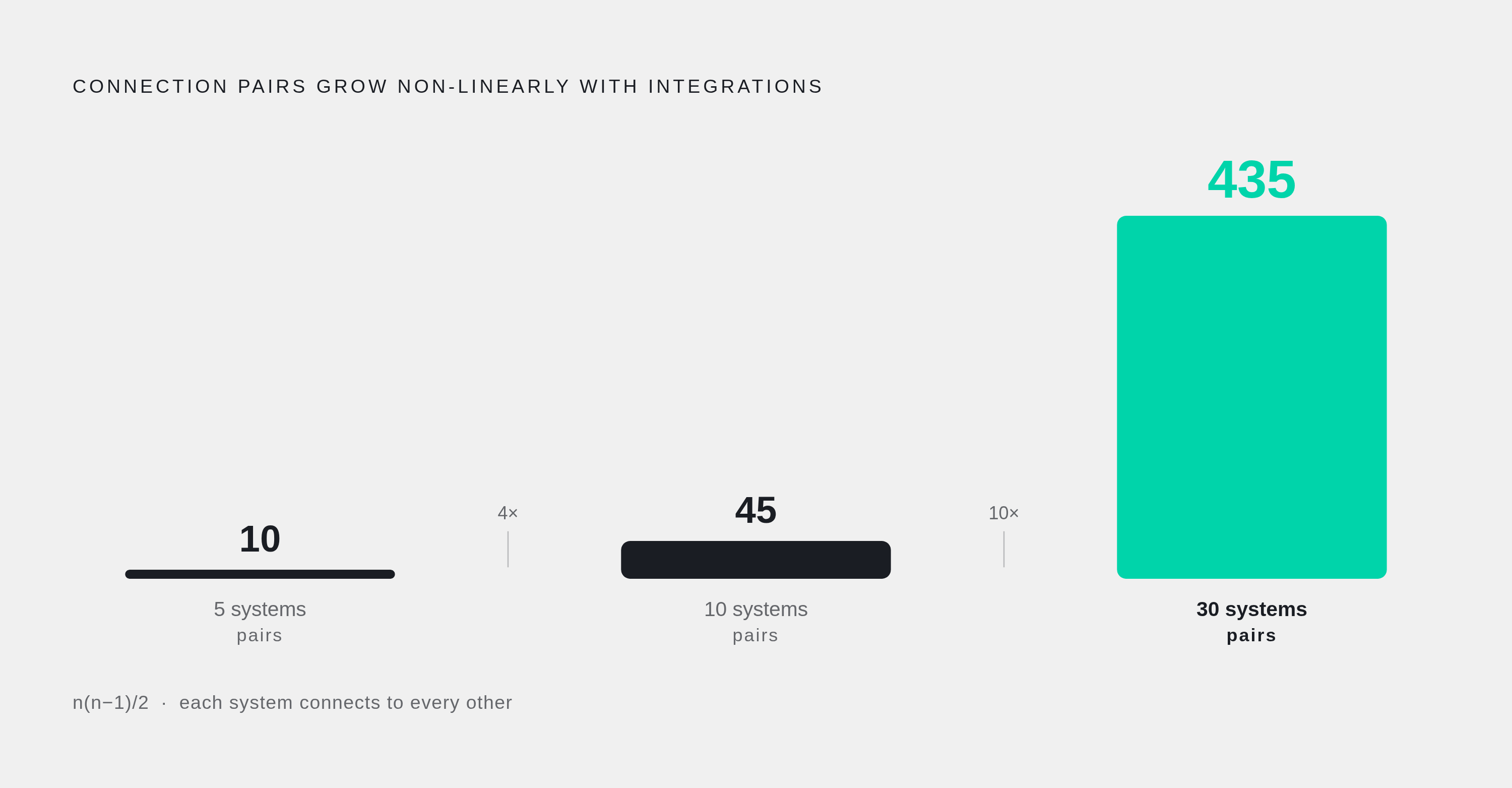
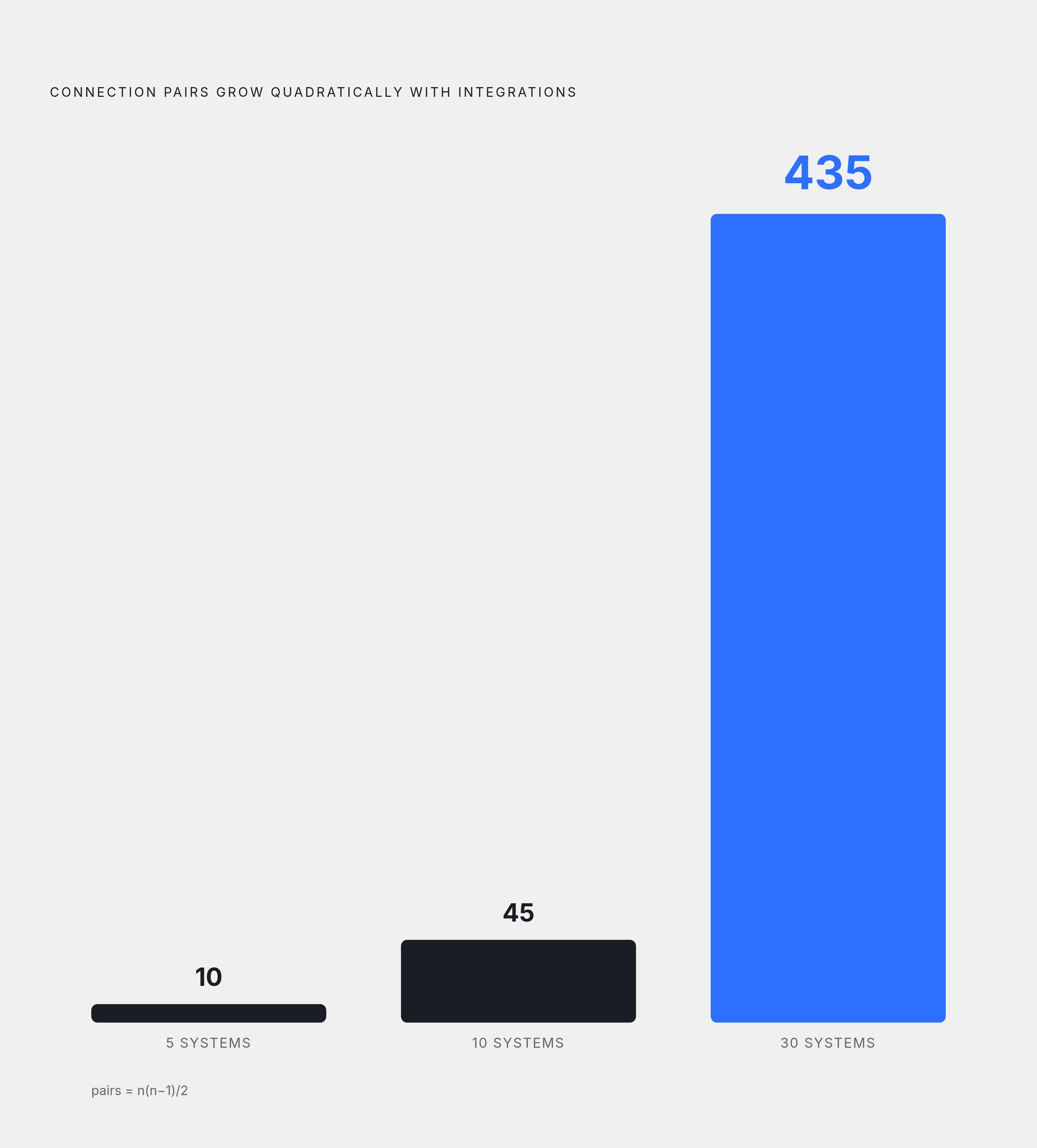
Here's something they don't tell you early enough: integrations don't add, they multiply.
When you add a feature, the complexity cost is roughly proportional. One more feature, a bit more code to maintain. But integrations connect systems to each other, and the number of potential connection pairs follows a specific formula. At five systems, you're managing 10 possible connections. At ten systems, 45. At thirty integrations, you're looking at 435 potential connection pairs.
That's not a scary number pulled from thin air. That's just math.
And behind each one of those connections is real engineering time. Rough practitioner estimates put initial integration builds at around 100 hours each, with annual maintenance running about 60 hours per connector on top of that. At thirty integrations, the annual maintenance load alone is substantial before a single line of new code gets written. Teams in this situation commonly report spending the majority of their data engineering capacity just keeping existing integrations alive. Debugging sync failures. Updating connectors when third-party APIs change. Optimizing performance. That's the job now.
At three integrations, maintenance is background noise. At 30, it becomes the loudest thing in the room.
The numbers on why this happens so fast are worth knowing. The average startup has around fifteen integrations. The average public SaaS company has around 350. That gap closes faster than most expect, because the pressure to close it is structural. Gartner's 2024 Global Software Buying Trends report found that the ability to support integrations is the number one sales-related factor in software purchasing decisions, with 44% of buyers citing it during vendor assessment. On the retention side, 92% of respondents in the 2024 State of SaaS Integrations report said customers with integrations are less likely to churn. Freshworks found customers with five or more integrations are up to 80% less likely to churn. Businesses with five integrations are willing to pay 20% more for the same core product.
So yes, you're going to build more integrations. The question is what happens when you do.
Your Architecture Breaks Before You Expect It
Point-to-point is the default. Every team starts there. And honestly, it makes sense at small scale. It's fast to implement, easy to reason about, and gets the job done when you're managing a handful of connections.
What it becomes at scale is a different story.
Each system connects directly to every other system it needs to talk to. That's fine until one team changes a schema, and suddenly three other integrations break simultaneously. The codebase becomes what engineers lovingly call spaghetti: a web of interdependencies where no single person can hold the full picture in their head. When something breaks at 2 a.m., nobody really knows where to start.
Hub-and-spoke architecture is the common answer. Instead of systems talking directly to each other, everything routes through a central hub. This collapses the connection count from that n(n-1)/2 curve back down to just n. At ten systems, that's ten connections instead of 45. That's a real improvement. But it trades one set of problems for another. The hub becomes a single point of failure. It becomes a scaling bottleneck. And maintaining the hub becomes its own full-time engineering concern.
The microservices approach splits integrations into independently deployable services, which lets you scale specific high-demand connections without dragging everything else along. But that flexibility costs coordination overhead. More services means more teams, more handoffs, more places for things to fall through the cracks.
Here's the honest version: there is no architecture that makes thirty integrations feel like three. The question is which failure modes your team is equipped to manage.
Integration Debt Grows Faster Than Code Debt
Most engineers understand code debt. It's the shortcuts taken under deadline pressure, the functions that need refactoring, the tests that never got written. It's visible. It lives inside your system. You can audit it, prioritize it, budget for it.
Integration debt lives in the connections between systems, and that distinction matters more than it sounds.
When a third-party API changes, the break propagates. Silently, often. Every downstream integration connected to that API is now at risk. The failure doesn't surface in your application logs. It doesn't trigger a standard alert. A customer notices first, files a ticket, and now you're in reactive mode trying to trace something that has no obvious home in your codebase.
Nearly half of organizations have replaced their primary integration tools in the past three to five years. But the old tools don't disappear when the new ones arrive. They stay in production. The new layer goes on top of the old one. This is how integration debt compounds. It doesn't get resolved during migrations. It accumulates.
The deeper problem is visibility. Integrations connect systems, but typically no one owns or monitors the full dependency graph. It's fragmented across teams, spread across tools, documented in wikis that haven't been updated since the person who wrote them left the company. When fewer than 60% of active integrations are visible to central monitoring, integration debt has already crossed from maintenance inconvenience into governance risk. You're operating infrastructure you can't fully see, and falling behind on upkeep at the same time.
Every New Integration Expands Your Attack Surface
Here's a statistic that should give any technical leader pause: organizations have, on average, 10 to 20 percent more active APIs than they are aware of, according to a 2025 Imperva report. APIs they built, connected, and then lost track of. Still running. Still exposed.
The breach data reflects this. According to Salt Security's 2025 Global State of API Security survey, 57% of organizations suffered an API-related data breach in the past two years. Over 63% experienced security incidents due to unmonitored or inadequately secured APIs. API vulnerabilities cost organizations $2.5 billion in remediation, fines, and lost revenue in 2024 alone.
And the attacks are getting smarter. In 2024, 27% of API attacks targeted business logic vulnerabilities, a 10-point increase from the year before. These exploits understand how your system is supposed to work and abuse it. Account takeover attacks on API endpoints jumped from 35% in 2022 to 46% in 2024. The surface is growing and being targeted more specifically.
Shadow IT makes this worse in ways that are hard to control. About 55% of employees are already adopting SaaS tools without security's involvement. One in three data breaches now involves shadow IT. The average breach cost in that category is $4.88 million, per IBM's 2024 report. And AI-generated code is accelerating the problem. Veracode's 2025 GenAI Code Security Report found that 45% of AI-generated code introduces vulnerabilities detected in audits. Engineers using AI tooling can now build integrations faster than security teams can review them.
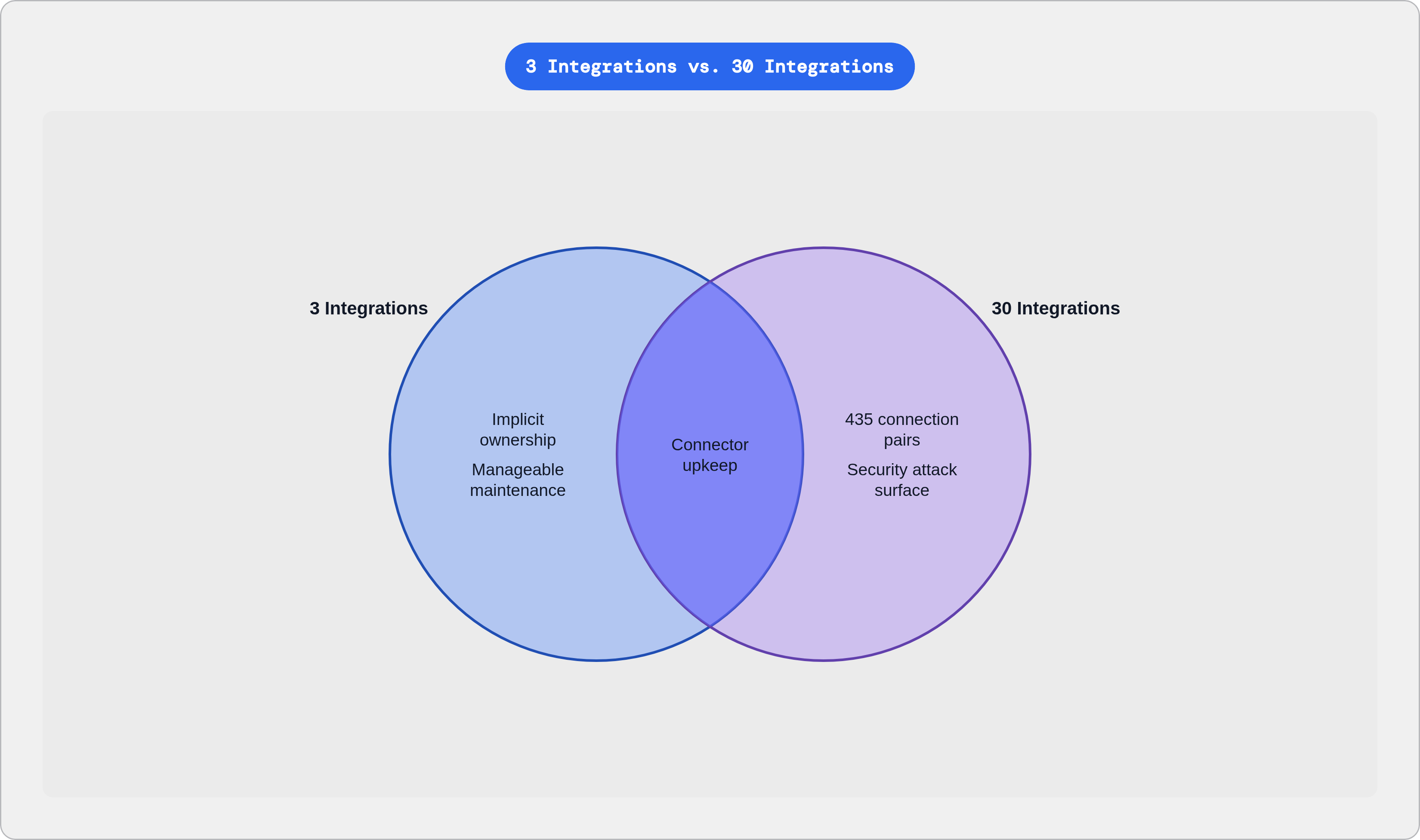
Then there's compliance. Every integration that touches customer data is a new audit trail. GDPR, CCPA, HIPAA, depending on your market. At 30 integrations, the compliance surface requiring coverage is an order of magnitude larger than at 3. That math is unforgiving and doesn't care how fast you shipped the connector.
Tribal Knowledge Stops Working at Scale
At three integrations, ownership is implicit. One engineer wrote it, one engineer knows it, issues get caught informally. This works fine. It feels efficient, even.
The problem is that it keeps working, right up until it doesn't.
At thirty integrations, "the person who wrote it" is no longer a complete answer to the question of who owns something. People leave. Teams restructure. The original context disappears. And when an integration fails at 2 AM, the question of who is responsible needs an answer that doesn't involve digging through Git history or Slack messages from 18 months ago. Clear ownership is what allows engineers to determine accountability quickly, enforce governance, and close security gaps. Diffuse ownership means none of those things happen reliably.
The observability gap is closely related. As integration count grows, failure modes multiply in ways that don't show up in standard monitoring. Expired API keys. Silent sync failures where data stops flowing but no error is thrown. Partial data delivery where records arrive but fields are missing. None of these surface in application logs. None of them trigger your usual alerts. You find out when a customer complains or when a report looks wrong and someone decides to investigate.
The response to this in practitioner circles has been a shift toward "shift left" observability. The idea is simple: monitoring architecture decisions should happen at design time, before the first production failure. This norm exists precisely because reactive monitoring doesn't work at scale. You can't patch your way out of a visibility problem.
Only a minority of enterprise applications are integrated, per a Salesforce survey, even as the average enterprise app stack has grown considerably. Most organizations are already operating with a governance model that hasn't caught up to the scale they're actually managing.
What an Operational Model at Thirty Looks Like
There are three distinct problems here, and they require three distinct answers. Conflating them produces partial solutions that feel like progress but leave one of the problems unaddressed.
The architectural problem: Move off point-to-point before the dependency graph becomes unresolvable. This means making a deliberate architectural choice early, before the spaghetti has already set.
The security problem: API inventory and access governance need to be ongoing processes, rather than one-time audits. If you don't know what APIs are active, you can't protect them.
The operational problem: Explicit ownership, documented runbooks, and observability coverage for every integration. Including the ones built two years ago by someone who no longer works there.
The build-versus-manage question sits at the center of all three. At three integrations, building custom connectors is completely reasonable. You understand the system, you own the code, the maintenance load is manageable. At thirty, that 60 hours of annual maintenance per connector becomes the deciding factor. Building and owning thirty connectors internally means owning every API deprecation, every auth change, every schema migration across all of them. That's a significant engineering commitment before any product work gets done.
Pre-built, managed integration platforms shift that burden. Unified authentication, pre-built connectors, managed update cycles. The maintenance load gets absorbed by the infrastructure layer rather than sitting on your product team. Integrations that previously took months to ship can ship in days. Engineering focus stays on core product work rather than connector upkeep. The real value proposition at scale is the ongoing operational cost that compounds across thirty connectors over years, not just the initial build time.
The governance principle that ties all of this together is simple. The teams most likely to scale integrations successfully are the ones who decide, before they hit thirty, that integration infrastructure is a category requiring dedicated investment. A real investment, with ownership, tooling, and process to match — not a side task distributed across whoever wrote the original connector, and not something deferred to next quarter.
The teams that wait to make that decision don't get to make it cleanly. They make it in the middle of a production incident, or during a security audit, or when an enterprise customer asks who owns their data pipeline and nobody has a confident answer.