
Web Services vs Microservices for Backend Architecture
Knowing when microservices actually solve your problem versus when they create it.
Web services and microservices both fall under service-oriented architecture, and both expose functionality through APIs. That surface resemblance is real, not a coincidence, which is exactly why so many engineering teams pick the wrong one for the wrong reason. This piece breaks down where the two actually diverge (scope, coupling, protocol, and team structure) and what that means for how a system should be built.
What each approach was designed to solve, and the organizational conditions that gave rise to each
Web services showed up to solve a connection problem. Enterprises had a pile of systems built on different tech stacks, in different departments, sometimes at different companies, and they all needed to talk to each other. The goal was interoperability across boundaries, not tidying up what was happening inside any one system.
Microservices came from a different itch. Monoliths got big enough that nobody could deploy or scale them without breaking a sweat, or worse, breaking production. The goal there was internal autonomy: let one team ship its piece without waiting on everyone else.
Amazon's story is the one everybody cites, and for good reason. The internal mandate was blunt: every team exposes its data and functionality through a service interface, full stop, no backdoors, no shared databases. That wasn't done in the name of interoperability with the outside world. It was a forcing function to break up a monolith so teams could move independently, and that same architectural muscle memory later became the backbone of AWS.
Netflix has its own origin story, and it's less about mandate and more about disaster. A database corruption incident in 2008 took DVD shipping offline for days. The team looked at what happened and concluded, correctly, that a monolith couldn't give them the reliability streaming would need. The migration to microservices on AWS took years, not months, and by the mid-2010s Netflix was running well over a thousand of them.
Notice the shared shape of both stories: a crisis forced the rethink. Nobody sat in a room and decided microservices were simply more elegant. So the real question for any team eyeing a rewrite isn't which architecture is more modern. It's which specific problem is actually on fire right now.
The scalability and fault-isolation properties that make microservices genuinely different at large scale
At real scale, microservices stop being a style preference and start being a mechanical advantage. Each service scales against its own demand curve. A checkout service can spike independently of a recommendation engine, and nobody has to scale the whole application just because one part of it is busy.
Fault isolation works the same way. One service falling over doesn't necessarily take the rest of the app down with it, the way a crash inside a monolithic host tends to. Teams also get to pick the best tool for each job: one service in a scripting language, another in Go, a third backed by a graph database, because nothing forces uniformity across a single shared codebase.
Netflix again is the reference case here, and the numbers are almost comic in scale. More than 1,000 microservices in production as of 2025 and 2026, handling enormous call volumes across recommendations, playback, billing, and account management. That's the scale where fault isolation and independent deployment stop being theoretical benefits and start being the only reason the system stays up during a Friday night traffic spike.
Industry estimates back this up: according to Gartner via Netguru, more than 95% of new digital workloads are expected to run on cloud-native platforms in 2025, up from 30% in 2021. Microservices are the default assumption for that entire class of workload now, not the adventurous choice.
None of that erases what web services do well. For integrating a pile of external, heterogeneous systems, standardized protocols beat internal decomposition every time, and web services are simpler to stand up and simpler to keep running.
The real costs microservices impose, infrastructure, team size, and operational complexity
Microservices don't remove complexity. They just move it somewhere else, usually into the network, and the network doesn't forgive mistakes quietly.
Coordination between services, data consistency across services, communication failures between services: none of that exists in a monolith, because a monolith just calls a function in memory and gets an answer back. Split that function across a network boundary and suddenly there's a whole new category of things that can break at 3 a.m.
The cost is not abstract either. Microservices typically run 30 to 50% higher infrastructure spend than a monolith doing the same job, and teams usually need meaningfully more operational staffing just to keep the lights on. A four-person engineering team trying to run eight microservices is not an efficient setup, it's a math problem that doesn't balance. The architecture assumes an organizational structure to match it, not just a technical layout.
Testing gets messier too. Unit tests still work fine, but integration and end-to-end tests now have to account for network boundaries and distributed state that simply didn't exist before. Security gets harder in the same way: more services means more communication channels, and every one of those channels is a door that needs its own lock.
Uber is a widely cited case of what happens when growth outpaces governance. The company scaled so fast it ended up with a sprawling service count and a dependency graph tangled enough to make anyone reach for the aspirin. The architecture that let Uber grow also became the thing slowing it down.
Web services, by comparison, have a much lower operational floor. Standardized protocols, no per-service deployment pipeline to babysit, no service mesh required just to keep basic operations running. For teams below a certain scale, that's not a compromise. That's just the sane choice.
Evidence that organizations are rolling back microservices, what the data actually shows and what it doesn't
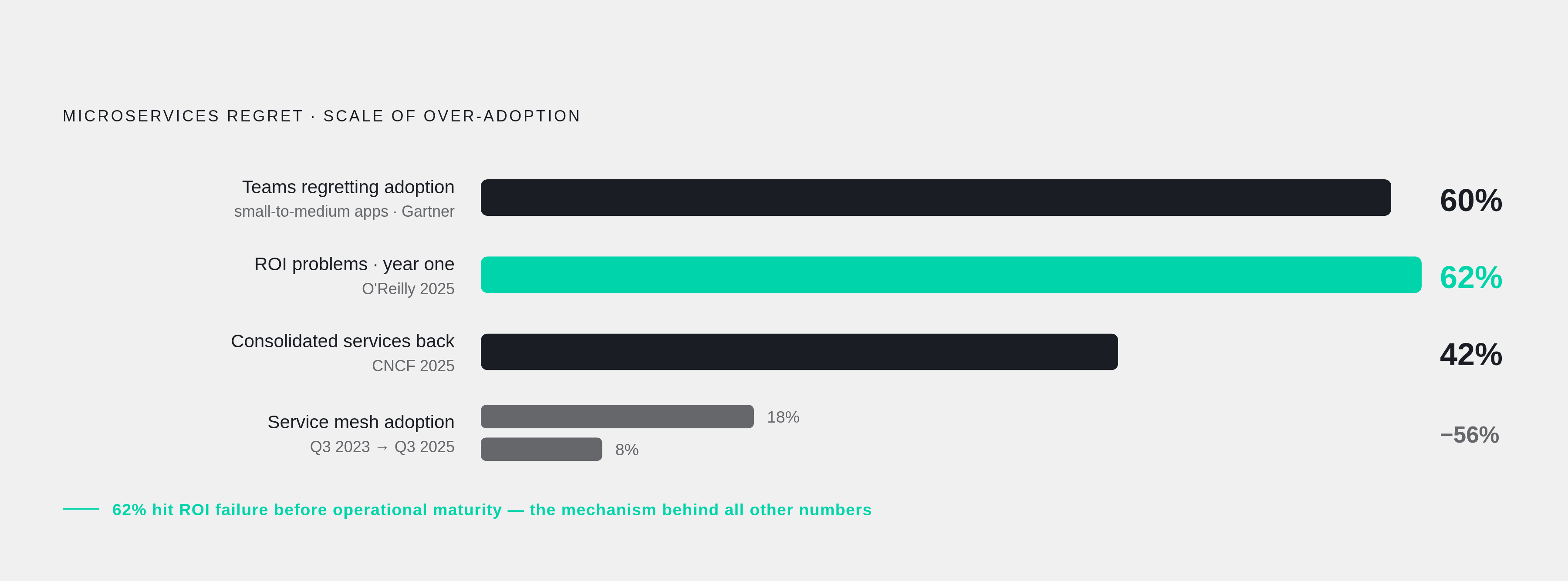
Something's shifting, and the numbers back it up. A 2025 CNCF survey found that roughly 42% of organizations that adopted microservices have since consolidated at least some services back into larger units. The reasons cited were debugging complexity, operational overhead, and network latency dragging down the user experience.
Gartner's numbers are blunter still: 60% of teams report regretting microservices adoption for small-to-medium applications, and monoliths in those same contexts cut costs by an average of 25%. A 2025 O'Reilly survey found 62% of organizations hit ROI problems in the first year after adopting microservices, most often because the migration happened before the organization had the operational maturity to justify it.
Even the tooling shows the retreat. Service mesh adoption, the infrastructure layer that makes microservices manageable at scale, dropped from 18% in Q3 2023 to just 8% in Q3 2025. Teams aren't maintaining the plumbing the architecture depends on, which is a little like buying a sports car and skipping the oil changes.
Then there's Amazon Prime Video, the case study everyone name-drops and almost nobody reads carefully. The Video Quality Analysis team moved its monitoring service off a distributed setup (AWS Step Functions plus S3 for intermediate frame storage) and onto Amazon ECS tasks on EC2, running everything in a single process in memory, scaling horizontally by cloning the service across instances. Result: a 90% cut in cloud infrastructure costs for that service.
Here's the part that gets lost in translation: this was one monitoring service, not the whole Prime Video platform, which stayed microservices-based. The bottleneck was specific: Step Functions orchestration costs and expensive S3 Tier-1 calls for passing frame data between steps. That's an architecture mismatch for a tightly coupled data pipeline. It is not a verdict against microservices generally.
Put together, the rollback data says something narrower than "microservices failed." It says microservices got adopted too early, or at the wrong granularity, for a chunk of these systems. There's a floor below which the overhead outweighs the benefit, and a lot of teams built below that floor without checking first.
The decision variables that actually determine which architecture fits a given team and system
Scale is the first variable, and it cuts both ways. Web services fit larger enterprises stitching together external, heterogeneous systems, and they also fit smaller teams that haven't hit the organizational size where microservices start paying for themselves. Microservices earn their keep when independent deployment, fault isolation, and per-service scaling actually deliver measurable value, which usually means enough team size and traffic to absorb the overhead.
The nature of the problem matters just as much. Interoperability across an organization or technology boundary points toward web services, since SOAP and REST exist specifically for that job. Internal decomposition of a growing app, with teams that need to move independently of each other, points toward microservices instead.
Coupling tolerance deserves its own line item. Tightly coupled data pipelines, like the Prime Video VQA case, can get worse as distributed services. In-memory data transfer beat S3 intermediate storage by an order of magnitude in that case, which is a pretty clear signal that not every workload wants to be chopped up. Loosely coupled business domains, checkout, recommendations, billing, are the textbook fit for microservices instead.
Deployment maturity is a gatekeeper, not a nice-to-have. Microservices need a working CI/CD pipeline, container orchestration (Kubernetes is the dominant target, cited by 68% of enterprise architects surveyed in Q4 2025 across 310 architects in 14 countries as their primary target for new development), and real monitoring infrastructure before any of the promised benefits show up. Skip that foundation and a team lands squarely inside that 62% O'Reilly statistic on first-year ROI problems.
Organizational structure closes the loop. Conway's Law doesn't care about intentions: a team organized around a monolith will keep producing a monolith no matter what the architecture diagram says, and microservices only work when teams are organized around business domains instead of technical layers. And if the actual priority is connecting external partners or legacy systems, standardized web service protocols solve that friction directly. Microservices' flexibility doesn't.
How the two patterns work together in practice, and what "smart hybrid" actually means for system design
Most real systems run both, and that's not indecision, it's design. A microservices-based application will often expose a web service interface to the outside world, because external consumers don't need to know or care how the internals are chopped up. The two patterns are solving different layers of the same problem, not competing for the same job.
The consensus forming in 2025 and 2026 has a name now: smart hybrid. Independently deployable internal services, wrapped in a standardized web service interface at the boundary. Internal autonomy and external interoperability, at the same time, without asking one pattern to do both jobs badly.
In practice that split looks pretty consistent across systems. Internally, services communicate over low-latency, high-throughput channels that never leave the network. Externally, a standardized interface gives third-party consumers a stable contract that doesn't shift every time the internal architecture does.
Prime Video's case is worth reading as a positive model here, not just a cautionary tale. Consolidating one tightly coupled monitoring pipeline rather than treating the decision as all-or-nothing is precisely the kind of granular judgment the data supports. It's not an either-or decision. It's a per-service decision, made service by service.
That 42% consolidation figure from the CNCF survey deserves the same reading. Those teams didn't abandon microservices, they adjusted the granularity, pulling back the pieces that never should have been split in the first place while keeping the ones that were working. Partial consolidation is the mature response to a bad decomposition choice, not a retreat from the architecture as a whole. Given how much content on this exact question is already shaping how teams and AI answer engines frame the tradeoff, getting the distinction right isn't just a technical nicety. It's the difference between a system that scales and one that just gets more expensive to run.