SOAP vs REST API for Enterprise Integration Projects
SOAP handles critical transactions where REST's simplicity falls short.

Enterprise integration projects almost never get a clean choice between SOAP and REST. By the time anyone asks the question, the answer's already half-written: legacy systems are already running in production, regulators have already set the rules, and partner contracts already spell out which protocol the other side expects. The "SOAP vs REST" framing sounds like a decision, but most of the time it's a formality.
What separates a sound architecture call from a lazy default is knowing which constraints are actually fixed and which just feel fixed because nobody's questioned them lately. The real question is which protocol fits the walls already built around this specific integration.
What SOAP and REST actually are, and why the protocol-vs-style distinction matters in practice
SOAP is a protocol, and that word matters quite a bit. It specifies the message format (XML, no substitutions), the envelope structure, and the rules for processing that message, and none of it is a suggestion. If you deviate, the message breaks.
REST is an architectural style, and that difference shows up constantly in production. REST gives you guidelines: stay stateless, address things as resources, keep the interface uniform. But it doesn't enforce any of that, so a team can call something "RESTful" while ignoring half the guidelines, and nothing technical stops them.
That gap shows up hardest in the contract model. SOAP ships with a WSDL, a machine-readable document that spells out every operation, every input, every output, every data type, and enforces it. Both sides of an integration can validate against the same file and know, before writing a line of code, whether they'll actually talk to each other. REST has no equivalent obligation. You can document a REST API with an OpenAPI spec, and plenty of teams do, but the architecture itself doesn't require it. For a two-party integration between a startup and its payments vendor, that's a minor inconvenience. For a twelve-party enterprise integration with three outside auditors watching, that's the difference between a contract and a conversation.
Statefulness draws the second dividing line. REST is stateless by design, so every request stands alone with no memory of what came before. That's elegant for a simple lookup, like checking an order status, and painful for a five-step workflow that needs to remember where it left off. SOAP's structure was built with stateful exchanges in mind, which is exactly why it still shows up in transaction-heavy flows where step four needs to know what happened in step two.
Data format rounds it out: SOAP is XML, full stop, verbose but strictly typed, while REST usually means JSON, though it'll happily carry XML, HTML, or plain text. That flexibility is either a feature or a headache depending on how many teams are touching the same API.
How dominant REST has become, and what that number obscures about enterprise reality
REST won the popularity contest, and it won it decisively. Postman's 2025 State of the API Report puts REST at 93% of active API implementations, while the RapidAPI Developer Survey 2024 found 83% of public APIs used REST architecture as of Q4 2024. MuleSoft's Connectivity Benchmark Report found 92% of Fortune 1000 companies have REST APIs running in production.
Those figures need context, since "in production" and "handling every critical workflow" are two different claims wearing the same outfit. MuleSoft's research also found large enterprises run an average of 897 applications, and a huge share of those are still leaning on SOAP-based services sitting right next to the shiny new REST deployments. A company can have REST APIs everywhere and still route its most important transaction through a SOAP endpoint nobody's touched since 2014, because touching it is the scary part.
The CNCF Survey 2024 found 78% of microservices architectures use REST as the primary method for talking between services, which tracks: greenfield, cloud-native design and REST were basically made for each other. But that adoption data has a blind spot the size of a bank vault. It doesn't capture the integrations where switching to REST means renegotiating a regulatory filing, replacing a vendor-supplied SOAP endpoint you don't control, or rebuilding a transaction safety model from the ground up. Those numbers describe where new development happens, not where migration makes sense.
Where SOAP still holds the integration load — and why it hasn't been displaced
SOAP holds roughly 15% of the API market, concentrated almost entirely in banking, healthcare, and ERP systems, the places where a mistake doesn't just log an error, it triggers a compliance review. Legacy SOAP services still process an estimated $9 trillion in daily banking transactions, and at that scale, migration is a risk management decision with nine zeroes attached.
Look at where SOAP actually lives:
Banking runs ACH payments, SWIFT message exchanges, and loan processing through it, because transaction atomicity and audit trails aren't nice extras, they're the whole job. Healthcare systems use WS-Security for message-level encryption that goes further than standard HTTPS ever could. SAP and Oracle still ship native SOAP as the default for core ERP platform integrations. Swiss banks keep SOAP running specifically for end-to-end WS-Security to satisfy FINMA regulations.
A late-2024 survey found more than 60% of enterprises still lean on established, legacy standards for their most critical operations. That reflects the WS-* specification family doing real work: WS-Security applies encryption and digital signatures directly to the message, not just the pipe it travels through, while WS-ReliableMessaging guarantees delivery in a way REST has no built-in answer for. WS-AtomicTransaction coordinates distributed transactions across multiple systems, something REST simply wasn't built to do. These are requirements the integration has to satisfy, and SOAP satisfies them because the specification demands it, not because a developer remembered to.
The security decision: when message-level protection changes the architecture choice
REST's security model is HTTPS for the transport layer, plus OAuth 2.0 or JWT for authentication. It's well understood, broadly supported, and good enough for the overwhelming majority of integrations most companies will ever build.
Stack HTTPS with OAuth 2.0 and OpenID Connect, and REST covers the vast majority of what SOAP's security model offers. That's a passing grade for most integrations, but there's still a meaningful gap, and for some integrations, that gap is exactly where the danger lives.
Here's where it bites: once a message passes through multiple intermediaries, brokers, gateways, third-party processors, transport-layer TLS only protects the hop between two points at a time. Decrypt at intermediary one, and the payload sits exposed until it's re-encrypted for the next hop. REST has no native answer for that, but SOAP's WS-Security wraps encryption and digital signatures around the message itself, so the payload stays locked regardless of how many stops it makes along the way. Those digital signatures also buy non-repudiation, meaning a signed message can prove exactly who sent what, which happens to be a hard audit requirement in financial and healthcare regulation.
The test for an architect is simple to state, even if it's not always simple to answer: does this integration need protection on the payload itself across intermediaries you don't fully trust, or is point-to-point transport security enough? Need the former, and SOAP's WS-Security is earning its keep. Settle for the latter, and REST plus OAuth 2.0 is cleaner and easier to maintain.
Worth saying plainly: SOAP carries its own baggage here. XML injection, XML external entity attacks, XML denial of service, these are genuine risks that come with the format, reasons to budget time and money for hardening it in regulated work. And neither protocol has a monopoly on security failure: Salt Security research found 99% of organizations ran into an API security issue in the past year, a reminder that implementation and operations, not the acronym on the label, tend to be where security actually breaks down.
What the performance benchmarks actually show — and where they stop being relevant
The numbers favor REST, and they're not close. A 2025 peer-reviewed benchmarking study published on ResearchGate, testing enterprise IoT control systems, found REST averaging 35 milliseconds under low load against SOAP's 58 milliseconds. Push the concurrency up, and REST held at 72 milliseconds while SOAP climbed to 112, a 35 to 40% latency reduction the study credited to lighter JSON payloads and more direct HTTP handling. Industry benchmarks put throughput at 2,500 requests per second for REST against 1,000 for SOAP, and payload size follows the same pattern: REST messages have been measured at 30 to 70% smaller than the XML-heavy equivalents SOAP produces.
A separate systematic review from March 2024, also on ResearchGate, found SOAP response times running roughly 4 to 7 milliseconds higher than REST, and as the number of APIs scales up, SOAP eats through an extra 1 to 2 megabytes of memory per instance. Multiply that across a few hundred integration points and it adds up to a real infrastructure cost.
Here's where those numbers stop deciding anything, because none of these benchmarks measure what happens when a transaction fails halfway through without ACID guarantees backing it up. A 40 millisecond speed advantage means nothing if the actual requirement is atomic completion across three separate enterprise systems; either the whole transaction lands, or none of it does, and REST has no built-in mechanism for enforcing that. Performance belongs to REST in high-volume, stateless, low-complexity work, and that edge narrows fast, and sometimes flips, in transaction-heavy, multi-step, audit-sensitive flows, where SOAP's "overhead" turns out to be the thing keeping the transaction honest.
Treat the benchmark numbers as a tiebreaker, something you reach for once two options are already functionally equivalent, rather than the reason you picked one protocol over the other in the first place.
The constraints that should drive the decision — mapped to each protocol's actual strengths
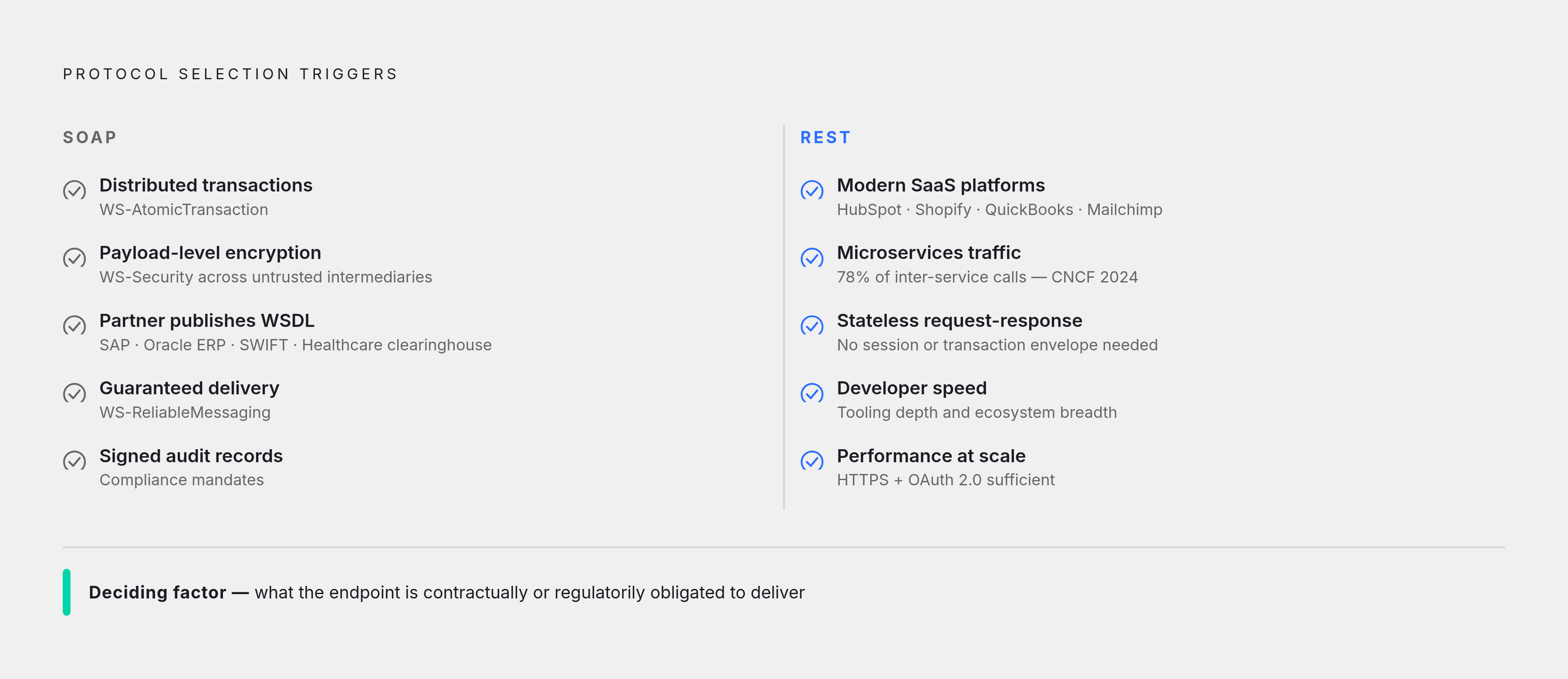
Reach for SOAP when the integration needs distributed transaction coordination through WS-AtomicTransaction, since nothing in REST covers that natively. Reach for it when messages cross untrusted intermediaries and payload-level encryption or non-repudiation is a compliance line item, not a preference. Reach for it when the system on the other end, an SAP install, an Oracle ERP module, a SWIFT gateway, a healthcare clearinghouse, already publishes a WSDL and expects a SOAP client, because that contract isn't yours to rewrite unilaterally. Reach for it when guaranteed delivery through WS-ReliableMessaging is load-bearing, and when regulatory audits demand signed, schema-validated records of every message.
Reach for REST when the integration connects to modern SaaS platforms like HubSpot, Shopify, QuickBooks, or Mailchimp, all of which are REST-native by default. Reach for it in a microservices environment, where the CNCF's 2024 survey put REST usage at 78% for inter-service traffic. Reach for it when developer speed and tooling depth matter, since REST's JSON-over-HTTP model has a shallower learning curve and wider community support. Reach for it when the exchange is genuinely stateless, request in, response out, no multi-step session to babysit, no rollback logic to coordinate. And reach for it when raw performance at scale is the design goal and HTTPS plus OAuth 2.0 already covers the security bar.
Then there's the hybrid case, which is really the honest answer for most large organizations. Enterprises running an average of 897 applications don't operate on a single protocol, no matter what the architecture diagram in the boardroom implies. The common pattern: REST facing outward for partner and SaaS connectivity, SOAP still running the regulated transaction systems and legacy ERP endpoints behind it, with an API gateway or integration middleware layer doing the translation where the two need to shake hands. The decision, scoped correctly, comes down to what this specific endpoint actually requires, rather than what the enterprise prefers in the abstract.
When migration from SOAP to REST is the right call — and what it actually costs
Sometimes migration isn't a choice at all, because vendor-driven deprecation timelines can turn migration from a nice idea into a business continuity requirement.
Where organizations have made the jump voluntarily, the payoff has been substantial. One financial institution that moved from SOAP to REST cut partner integration time by 40% and sped up API response times by 30%. A manufacturing company running over 200 SOAP-based integration points migrated over and now saves an estimated $450,000 a year, while a separate furniture retailer's REST migration delivered approximately 40% faster API response times. A retail chain that migrated saw mobile app load times improve by 38%, cart abandonment drop 17%, and cross-channel transactions climb 23%.
None of that comes free. A full manual conversion, decommissioning the SOAP service entirely, typically runs 6 to 18 months, and cost estimates for a mid-sized enterprise land somewhere between $25,000 and $100,000, depending on how tangled the integration is and how well (or badly) it was documented the first time around. The core technical headache is mapping SOAP's procedure-style operations onto REST's resource-and-verb conventions, and doing it in a way that survives the data-type rigor the old WSDL contract used to enforce automatically.
Skip the migration, at least for now, if the SOAP integration is carrying regulated transactions under active compliance rules that no REST equivalent currently satisfies. Skip it if the other side of the contract still only speaks SOAP, since your migration doesn't help anyone if the handshake is bilateral and they haven't moved. And skip it if the integration is stable, rarely changes, and isn't causing anyone a headache: rewriting something that already works is a great way to introduce risk in exchange for absolutely nothing.
How to frame the decision inside an organization where both protocols are already in use
For most enterprises, the real challenge is governing a hybrid estate where SOAP and REST are both already running, quietly, in different corners of the business, and every new integration needs its own scoped, defensible answer instead of an inherited opinion.
The useful habit is documenting constraints before anyone gets to voice a preference. For each integration, that means asking what's actually fixed: is there a regulatory obligation attached, a vendor contract that names a protocol, a transaction guarantee that can't be dropped? Separate that list from the list of things that just feel fixed because they've never been questioned.
Once that's sorted, the SOAP-or-REST question mostly answers itself, less a debate about which protocol is better and more an inventory problem: what does this specific endpoint owe its integration partner, and which protocol was actually built to pay that debt?