WebSocket vs WebRTC for Real-Time Data Channels
WebSocket guarantees ordering but sacrifices freshness; DataChannel trades reliability for speed.
Picture the moment three weeks before launch when the voice feature keeps stuttering, and nobody can figure out why. The team built the whole real-time layer on WebSocket because it was familiar, fast to set up, and worked great in testing. Then real users on real networks started talking over each other in half-second delays, and the fix turned out to require ripping out the transport layer, not patching a bug. That scenario repeats across engineering teams because of one wrong assumption: that WebSocket and WebRTC DataChannel are two brands of the same product, like picking between two coffee makers that both make coffee, and they are not. They solve different problems, and picking one means picking a topology, a delivery contract, and a cost structure, all before a single feature gets built. This piece lays out what each technology actually commits an application to, so engineers can choose topology, delivery guarantees, and cost structure on purpose.
What WebSocket commits you to at the transport level
WebSocket is a message protocol that rides on a single, persistent TCP connection, and TCP's core promise, that every byte arrives in order and arrives completely, is both the best thing about it and the ceiling on how fast it can ever be. The connection starts with an HTTP upgrade handshake. After that handshake, the connection just stays open, acting like a dedicated pipe that delivers messages as a strict, ordered, reliable stream running between client and server.
That ordering guarantee is where the trouble starts. TCP will not hand message N+1 to the application until message N has fully arrived, no exceptions. Drop one packet and everything behind it sits in a queue, waiting, a problem engineers call head-of-line blocking. It does not matter if message N+1 is wildly time-sensitive. It waits anyway. On top of that, every WebSocket connection runs over a single TCP stream with one shared congestion window, so a burst of large messages (a file upload, a big state dump) can delay small, urgent messages stuck behind them in line.
WebSocket also has no idea what audio, video, codecs, or jitter are. It moves bytes from one place to another and nothing more. Send audio through a WebSocket and the application has to handle every media concern itself: timestamping chunks, detecting gaps, deciding what to discard. The transport will faithfully deliver a stale audio chunk with the same confidence it delivers a fresh one, because freshness is not something TCP tracks.
The same goes for anything a transport protocol cannot infer on its own. Whether a message got processed, how to backfill a gap after a reconnect, whether retrying a command risks running it twice, how to pick up cleanly after an outage, none of that comes free. Message IDs, acknowledgements, idempotency rules, replay logic: all of that lives in the application, not the protocol. And security is not automatic either. WebSocket needs an explicit TLS setup, the WSS scheme, to get encryption; the base protocol does not require it.
What WebRTC DataChannel commits you to at the transport level
WebRTC DataChannel runs on a very different foundation, and the gap starts with what WebRTC even is. It is a suite of browser APIs and network protocols working together, with getUserMedia(), RTCPeerConnection, and RTCDataChannel as the main interfaces a developer touches. Choosing WebRTC commits an application to a peer-to-peer topology and a delivery model that can be tuned, and both of those choices impose operational weight that a feature comparison chart never captures.
The DataChannel itself sits on SCTP, running over DTLS, running over UDP. That stack lets a developer configure delivery as ordered or unordered, with or without retransmissions. That configurability is the entire reason DataChannel exists as a separate option: it lets an application choose between guaranteed completeness and raw freshness, a choice TCP never offers.
Encryption is not optional anywhere in the stack. Audio and video run through DTLS-SRTP, with DTLS handling key exchange and SRTP handling the actual media encryption, and the data channel runs SCTP over DTLS. There is no setting to turn any of this off. Security is baked into the design, not bolted on as a configuration step like WSS is for WebSocket.
WebRTC also ships with a full media pipeline that WebSocket simply does not have: codec negotiation, bandwidth adaptation that responds to changing network conditions, jitter management, connection statistics, and, depending on the implementation, echo cancellation. None of that is something a WebSocket-based app gets without building it by hand.
None of this comes free of setup cost. Before any data moves, two peers need a way to exchange session descriptions and ICE candidates, a process called signaling, and WebRTC does not supply that channel itself. Teams build it on WebSocket, HTTP, SIP, or whatever fits. Then there is NAT traversal: ICE, STUN, and TURN have to do their work before a single packet of real data flows. Doing peer-to-peer over the public internet carries the actual price of this complexity, since most devices sit behind routers that were never designed to let strangers connect to them directly.
Some WebRTC DataChannel implementations have historically left the SCTP window size at its default setting rather than tuning it, and that produces real performance problems the moment network latency drifts away from ideal lab conditions. UDP under the hood does not automatically mean fast in practice; it means configurable, and configuration left untouched can quietly cost performance later.
The topology commitment in production
Client-server versus peer-to-peer is the fork in the road that determines everything about how a system scales and what it costs to run, and the two paths diverge in ways no side-by-side feature table captures.
Scaling means load balancing, clustering, and connection management, all living at the application layer, because the server sees and handles every single message from every single client. That is a real, ongoing operational cost, but it is a predictable one: more users means more connections means more server capacity, in a straight line a team can plan around.
WebRTC's peer-to-peer model looks, at first glance, like it skips that cost entirely. Once signaling wraps up, the server goes quiet. It never touches the media. The signaling server only ever handles small JSON messages, not the actual audio, video, or game state flowing between peers; that is why WebRTC gets described as easy on server load.
NAT traversal is where the catch appears. Enterprise users sitting behind corporate firewalls need TURN relay servers at a much higher rate than ordinary consumer traffic, because corporate networks tend to block the direct peer-to-peer connections ICE normally finds. TURN relays packets rather than just routing them, so the "server never sees the media" promise quietly breaks down for a meaningful slice of enterprise users. At real scale, a large share of concurrent connections routed through TURN adds up to hundreds of megabits of bidirectional bandwidth that someone has to provision and pay for. Running WebRTC for any audience that includes corporate network traffic carries this as a standard cost, and it needs to be budgeted from day one, not discovered during a billing review.
Peer-to-peer also has a ceiling on group size. Direct P2P connections handle small matches fine, but push past a handful of simultaneous participants and the mesh of direct connections between every pair of peers grows too complex to manage; larger multiplayer games move to server-based frameworks instead. A server-based setup can hold far more concurrent connections on a single instance than a mesh of direct peer links ever could.
Neither model is cheaper across the board. Each one has a cost structure shaped differently, and the honest version of this decision means going in with eyes open: TURN provisioning on the WebRTC side, connection infrastructure on the WebSocket side. Phantom Farm's own real-time infrastructure treats this as the first budgeting question on any project, not an afterthought discovered after the TURN bill arrives.
Delivery guarantees as the decision signal most teams overlook
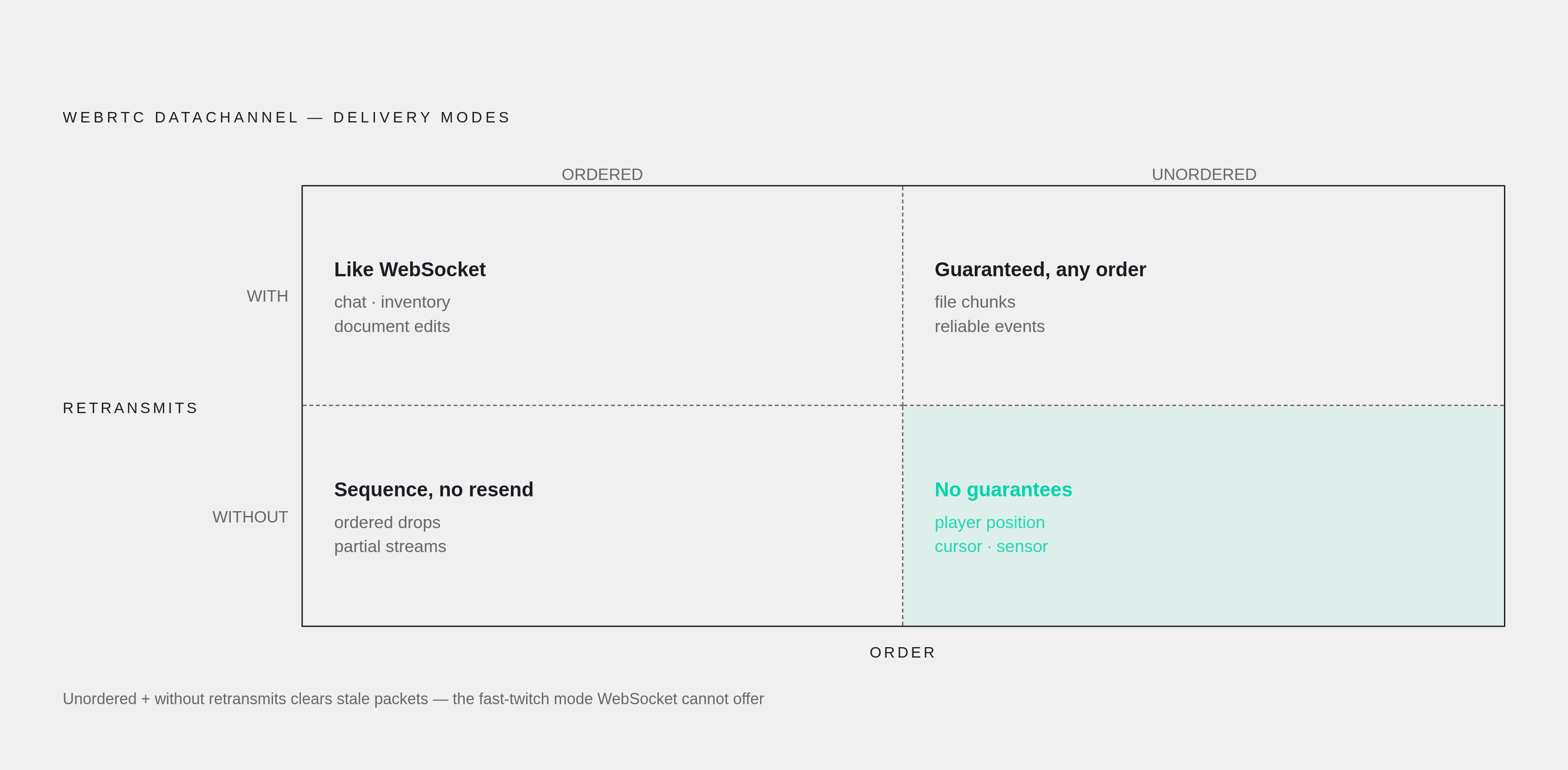
Latency benchmarks get all the attention in these comparisons, but delivery guarantees are the more honest signal, because they force a concrete question: what should the application actually do with a message that shows up late or out of order?
WebRTC DataChannel gives four distinct answers to that question, not two. A developer can choose ordered-with-retransmits, which behaves just like WebSocket. Ordered-without-retransmits keeps sequence but drops anything that needs a resend. Unordered-with-retransmits guarantees delivery but not sequence. Unordered-without-retransmits guarantees neither, trading all of it for speed. Four contracts, each suited to a different kind of data, all available inside the same API.
Take a chat message, an inventory change, a score update, a document edit: in every one of those cases, a late arrival still needs to be processed, not thrown away. Ordered, reliable delivery is the actual requirement there, and WebSocket fits it naturally. Now take a player's position, a cursor's location, a sensor reading: a late one is worthless the moment a newer one exists. Ordered, reliable delivery turns into a liability there, since it forces the useful new packet to wait behind the useless old one. Unordered WebRTC DataChannel clears that jam by just letting the stale packet go.
Audio makes the same point from a different angle. WebSocket has no concept of jitter or stale media chunks, so sending audio over it means the application has to invent its own timestamping and discard logic from scratch. Fixing a dropped TCP packet and fixing a late audio frame are not the same job, even though both get called "handling a glitch."
Figma's collaborative editor is the clean illustration of the ordered-and-reliable case. Document edits sync through a server-authoritative, last-writer-wins model: the server puts concurrent property changes in order, and whichever value arrives later wins. Reliability there is not a nice-to-have, it is load-bearing, since losing an edit or reordering two edits would corrupt the document. Cursor movements, by contrast, get treated as disposable. They never get persisted, because a cursor position from two seconds ago is just noise.
Fast-twitch multiplayer games sit at the opposite end. A stale position packet that blocks the fresh one behind it makes the game feel broken to a player, even if the underlying network connection is technically healthy. The ability to just drop retransmissions and let old data disappear is the feature that makes the game playable at all there.
Where the hybrid pattern came from
Most production systems answer the "WebSocket or WebRTC" question with both, deployed side by side, each one doing the specific job it was built for.
Browser games show the pattern most clearly. A WebSocket connection handles signaling first, along with chat, inventory, and scores, exactly the data where nothing can be allowed to vanish. Once that setup finishes, a WebRTC DataChannel takes over the fast-twitch game state, the stream of position and action updates where a stale packet blocking a fresh one would ruin the experience. Neither protocol is doing the other's job. Each one is doing the job it was actually designed for.
The same split appears in video conferencing. Google Meet and Microsoft Teams run their media over SRTP and RTP across ICE, using WebRTC-adjacent standards without necessarily running the full WebRTC stack underneath, while session management, participant events, and presence travel over separate, reliable channels built for exactly that kind of control-plane traffic. Even in an app built primarily around WebRTC media, a WebSocket-style control plane still earns its keep handling signaling, transcripts, session events, and tool state, the stuff that absolutely cannot go missing.
None of this is a workaround for something broken in either protocol. WebSocket and WebRTC DataChannel operate at different layers of the communication stack, built to complement each other. The question worth asking on any new real-time project is which messages go where, and why, a reframing that produces a better architecture than any feature checklist ever will. Phantom Farm's engineering teams treat that question as the actual starting point of any real-time build, before a single library gets installed.
WebTransport as the third option that changes the calculus in 2026
A third option now sits between those two established choices. WebTransport reached baseline browser support across all major browsers as of March 2026, and it changes the calculus for a meaningful slice of real-time use cases.
That combination is the headline feature: multiple independent reliable byte-streams running alongside unreliable datagrams, all on one connection, which clears out the per-stream head-of-line blocking that plagues single-stream WebSocket traffic, without requiring the full weight of WebRTC's peer-connection setup and signaling stack.
That positions WebTransport as neither a WebSocket replacement nor a WebRTC replacement, but a genuine third lane for teams that want QUIC's multiplexing without taking on peer-to-peer topology, NAT traversal, and the TURN provisioning bill that comes with it. The architecture question from the top of this piece has not gone away: it has gained a third answer to weigh alongside the first two, and the same diagnostic questions, topology, delivery guarantees, and cost structure, apply to evaluating it.
Sources
- WebSocket vs WebRTC DataChannel: Choosing the Right Real-Time Tech - VideoSDK
- What Is Replacing WebSockets? 2026 Real-Time Protocol Guide - VideoSDK
- WebRTC vs WebSocket: 6 Key Differences and When to Use Each
- WebRTC Data Channels
- RFC 8832: WebRTC Data Channel Establishment Protocol
- Send data between browsers with WebRTC data channels
- WebSockets and WebRTC - Daily.co
- Which is Better, and When to Use It: WebRTC or WebSocket (2025 Guide) - VideoSDK