gRPC vs HTTP for Service-to-Service Communication
Start with REST and switch only when performance benchmarks prove gRPC's specific advantages matter.
Choosing between gRPC and REST for service-to-service communication is not a taste question anymore. Default to REST until a specific, measured problem shows up, then move only the pieces that need gRPC. Most engineers skip that order: they pick a protocol based on preference, hit a wall once traffic scales, and pay for the switch at a much higher price than if they had planned for it from day one.
Protocol choice used to be a fringe argument. Not anymore. Postman's 2025 State of the API Report found 69% of developers spend more than 10 hours a week on API-related work. REST still sits at 93% adoption against gRPC's 14%, and that gap reflects ecosystem maturity and genuine fit rather than a verdict on quality.
More services means more connections between them, and every connection carries whatever protocol was chosen. The real question is which protocol wins under which conditions, and that breaks down into a handful of concrete factors below.
gRPC and REST Differ at the Transport Layer
REST is not a protocol. It is a style: standard HTTP methods (GET, POST, PUT, DELETE), stateless request-response, and usually JSON as the payload format. It was built for the web, where interoperability between browsers and servers mattered more than minimizing response time.
gRPC is a different design. Google announced it in 2015 and shipped version 1.0 in August 2016. It runs over HTTP/2 and serializes data with Protocol Buffers (Protobuf) instead of JSON. It also supports four call patterns: unary (equivalent to REST's request-response) plus three streaming modes.
The transport layer is where most of the performance difference originates. HTTP/1.1, which REST typically uses, handles requests sequentially with plaintext headers and human-readable JSON bodies. HTTP/2 multiplexes many streams over a single connection, compresses headers with HPACK, and frames everything in binary. Protobuf's binary, schema-defined encoding reduces payload size significantly. However, the common claim that Protobuf payloads are ten times smaller than JSON almost always compares against uncompressed JSON. Enabling gzip compression for REST endpoints closes a meaningful portion of that gap without any protocol change.
The advantage gRPC holds that compression cannot replicate is schema enforcement. Its contract-first model, built on .proto files, requires a schema for every API call. REST leaves schema validation optional, and Postman's 2025 report found only 17% of API teams do contract testing at all. The practical consequence is not bytes saved on the wire but whether data shape is verified before a mismatch causes a production failure.
Benchmarks Show gRPC Wins Under Load
Tech Insider's April 2026 benchmark measured gRPC at 2.3 milliseconds median latency versus REST's 10.1 milliseconds on 1 KB payloads. That is a 77% reduction, and the gap grows with payload size and concurrency rather than staying fixed.
At least one independently documented case found REST delivering lower latency for small payloads on the same local machine. gRPC's latency advantage becomes consistent as load and payload size increase, not before that threshold.
Whether the real-world difference is substantial or negligible depends on test conditions: same host or cross-network, connection pooling configured or left at defaults, and how carefully each server implementation is written. Published benchmarks measure a specific system under specific conditions. The only results that matter for a given deployment are those measured against its actual payloads at its actual scale.
Streaming Is Native to gRPC, Not REST
REST's model is one request followed by one response. Real-time patterns such as long polling, Server-Sent Events, and WebSockets exist because developers needed behavior that REST does not provide natively, and each of those approaches adds a separate layer of infrastructure to maintain.
gRPC ships four communication modes natively. Unary matches REST's request-response pattern. Server streaming supports use cases like live price feeds or log tailing, where the server continues sending data after a single client request. Client streaming supports large file uploads or continuous sensor data. Bidirectional streaming enables chat applications, multiplayer games, and live location tracking, where both sides send and receive concurrently over a single multiplexed HTTP/2 connection with built-in backpressure.
This is a structural difference, not a configuration option. Postman's 2025 report found WebSocket adoption at 35% among API teams. A substantial portion of the industry is already operating two separate protocol layers to achieve real-time behavior that gRPC provides within a single connection.
This also applies directly to AI workloads. Server streaming maps naturally to token-by-token output from a language model. Bidirectional streaming supports interactive agents that send and receive continuously. For teams integrating AI features into their infrastructure, these are common workload shapes rather than edge cases.
gRPC Tooling Has a Real Learning Cost
REST's ecosystem is extensive. Every browser supports it by default, curl and Postman work without configuration, and OpenAPI tooling is widely available. Error responses arrive as plain text that requires no specialized tool to read.
gRPC's tooling has matured considerably, but the browser gap remains. Language support is strong across Go, Java, Node.js, Python, C++, C#/.NET, Kotlin, and Swift. However, gRPC-Web requires a proxy, typically Envoy, between the browser and the server to translate calls into HTTP/2 framing. That proxy must be deployed, configured, and maintained, which is a real operational cost for any public-facing service.
Debugging is an additional overhead that is often underestimated. Binary payloads are not human-readable in logs the way JSON is, so teams need gRPC reflection or tools like grpcurl and BloomRPC to inspect message contents. Schema management adds a learning curve that REST teams do not face.
The trade is worthwhile in the right context. The schema-first workflow generates strongly typed client and server code automatically, reducing integration errors caused by API documentation drifting out of sync with the actual implementation. The ongoing cost is that someone must own .proto governance and versioning as a continuous responsibility. A well-designed REST API outperforms a poorly governed gRPC implementation, and the reverse is equally true. Protocol choice does not substitute for disciplined API design, testing, and backward compatibility practices.
Netflix, Square Confirm the Hybrid Pattern
Netflix runs a microservices fleet handling billions of internal calls per day. The company migrated its highest-traffic internal paths from REST to gRPC and reported meaningful p99 latency improvements and CPU savings on services with heavy fan-out. Its public-facing interfaces, including the Open Connect APIs used by partners, remained on REST.
Square's payments-fraud platform processes hundreds of thousands of transactions per second and requires a decision within 100 milliseconds. The team migrated its inference path from REST plus WebSockets to bidirectional gRPC streaming. The result was a 35% reduction in p99 latency, a significant reduction in connections per node, and one unified code path replacing a previous multi-protocol combination.
A smaller-scale case documented on the Boundev blog shows the same pattern: switching a critical data pipeline from JSON over REST to Protobuf over gRPC produced a large p99 latency reduction with no changes to business logic.
The counterexamples are equally consistent. Stripe, Twilio, and Slack all expose REST as their primary public API interface. GitHub's main public API runs on GraphQL. The pattern across all of these organizations is stable: gRPC handles internal, east-west traffic where latency is measured precisely, while REST handles external, north-south traffic where developers need to understand and call the API without reading a protocol specification first.
Six Factors That Determine the Right Protocol
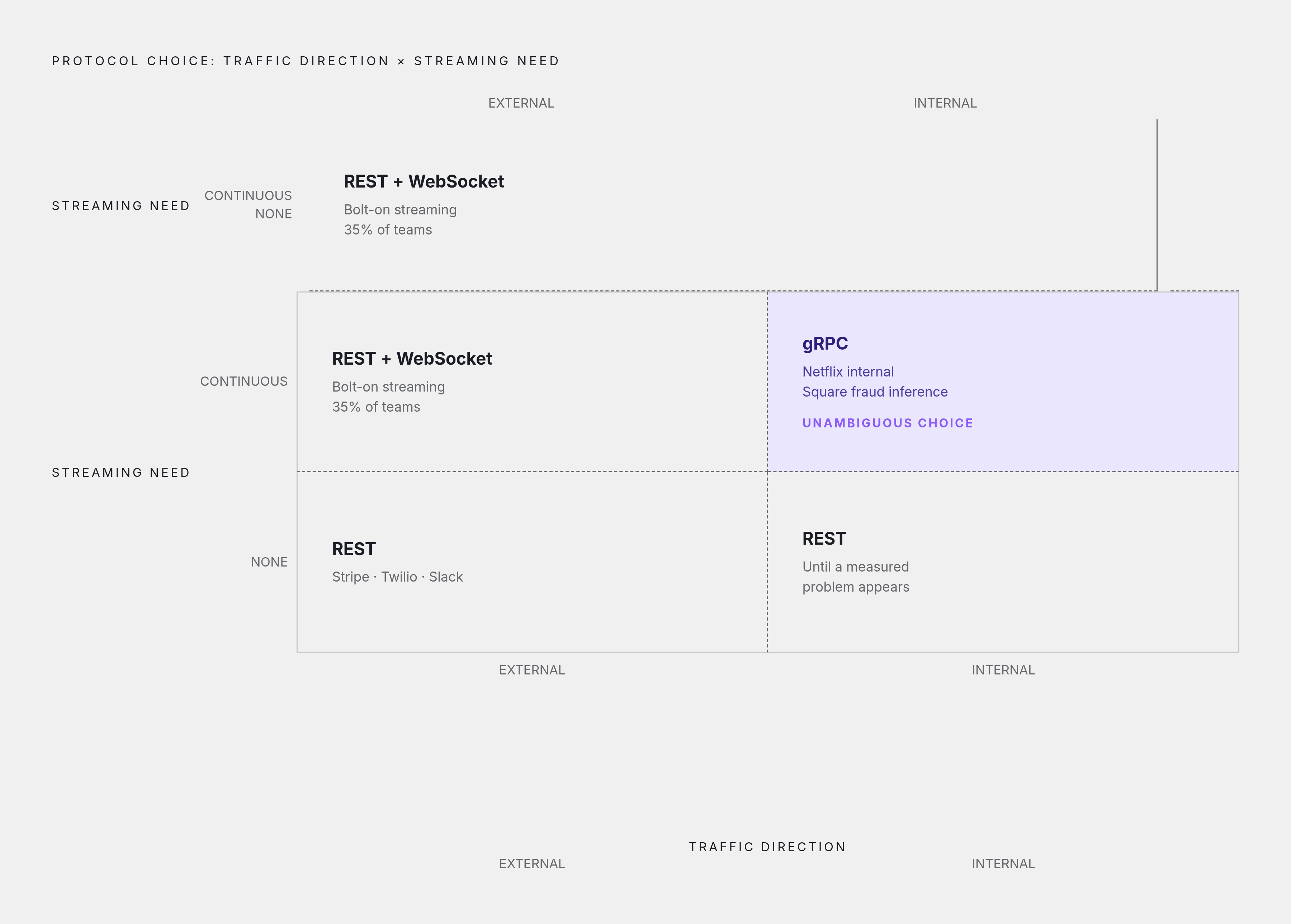
Traffic direction is the first decision point, and it is the one most frequently reversed. Internal service-to-service calls favor gRPC once performance is a documented requirement. External APIs favor REST because of browser compatibility and the breadth of tooling that external developers expect.
Streaming requirements come next. If the workload involves continuous data flow or high-frequency bidirectional communication, gRPC's native streaming eliminates the need to add WebSockets as a separate layer.
Payload size and throughput matter, but the honest answer is that results vary. gRPC's advantage is modest on small payloads and grows as payload size and concurrency increase. Testing against actual traffic is necessary because synthetic benchmarks rarely match production workload shape.
Team size and operational maturity deserve direct consideration. A small team shipping a SaaS API should weigh the overhead of managing Buf tooling and Envoy configuration against the performance gains gRPC provides. That overhead is real and scales inversely with team size.
Language ecosystem is a secondary factor. gRPC libraries are mature in Go, Java, Node.js, Python, C++, and C#. Teams already using those languages encounter less adoption friction.
Contract discipline is the final factor. Teams that already enforce strict API contracts gain that enforcement structurally with gRPC's schema-first model. REST teams must build equivalent discipline through process and tooling, and the 17% contract testing figure from Postman's report indicates most do not.
The production pattern that recurs consistently is to run both protocols: REST for external interfaces, gRPC for internal services. Introduce gRPC only when a specific, measured problem justifies it, and migrate the affected services rather than rewriting the entire system.
Migrate Incrementally Using the Strangler Pattern
The strangler-fig pattern applies directly to protocol migration. Stand up a new gRPC endpoint alongside the existing REST one. Migrate consumers service by service rather than all at once.
Start with the service that has the clearest, most precisely measured latency or throughput problem, one with documented numbers behind it rather than an intuition that performance is insufficient. The Boundev and Square cases both began from a specific, documented bottleneck: a fraud model with a hard latency requirement, a pipeline stuck at an unacceptable p99. Neither started from a general dissatisfaction with REST.
Write the .proto contract before writing any implementation code. Schema-first discipline is the difference between a clean migration and one that recreates REST's loose contract habits in a different serialization format.
Use a gateway such as Envoy, AWS API Gateway, Google Cloud Endpoints, Azure API Management, or gRPC-Web as the boundary between internal gRPC services and any external REST surface. This is the pattern Netflix, Square, and Stripe all operate: the external API remains stable for outside consumers while the internal implementation changes independently.
Measure before and after using real production payloads and real concurrency levels. Results vary significantly based on workload shape, so internal measurements are more reliable than any external benchmark.
Budget for the migration honestly. Costs typically run two to five times the original build effort when the migration is unplanned, so a phased rollout with defined rollback criteria at each step keeps that risk bounded.
For teams without a measurable latency or throughput problem, the protocol that ships and functions correctly today produces more value than a technically superior alternative that requires six months to adopt properly.