Why Security Review Slows Down Every Integration Your Team Ships
Security review sits on the critical path of modern CI/CD pipelines.
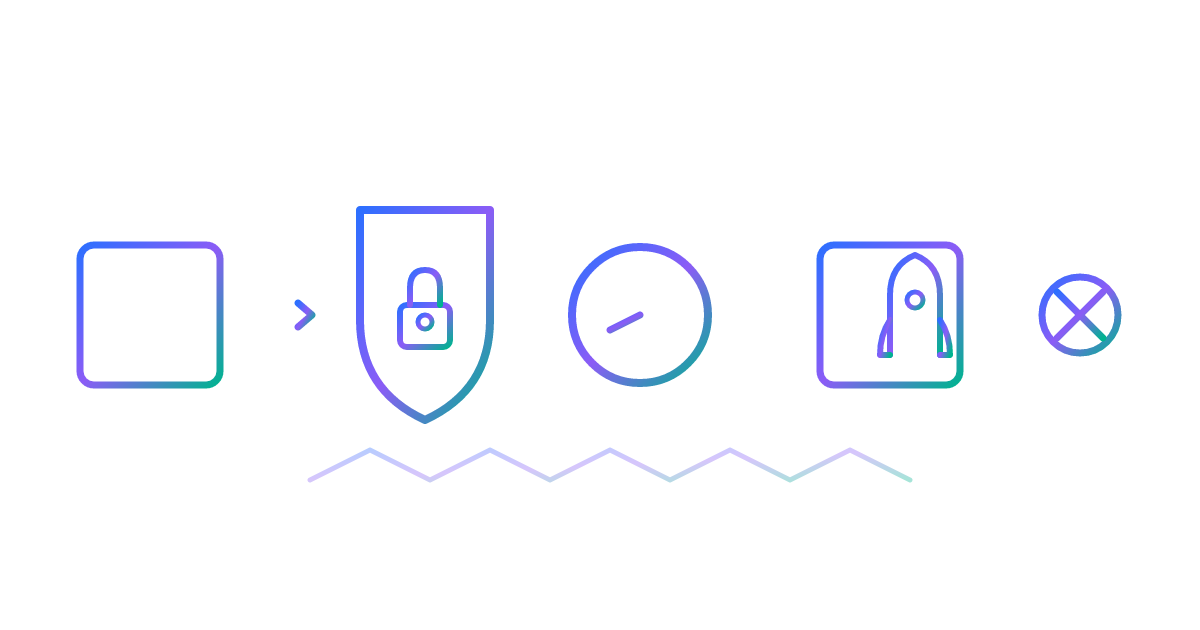
Security testing was originally designed as a final gate. Build the thing, hand it off, get it inspected before it ships. That model made sense when releases happened quarterly. There was enough calendar space for the gate to open and close without anyone noticing.
Then CI/CD happened. Daily deploys. Rolling releases. The gate didn't evolve. It just got hit more often, by more things, with less runway around it.
The same inspection overhead that once ran comfortably alongside a months-long release cycle now sits directly on the critical path of a week-long sprint. Security review didn't get slower. The release cycle got shorter. Which means the problem isn't the review itself. It's where the review lives in the timeline. Think of it like a toll booth on a dirt road that suddenly became a highway: the booth didn't change, but everything around it did.
Gartner has said this plainly: security becomes an afterthought or a bottleneck precisely because it was designed to be the last check, not an embedded one. And the gate model is sticky for an obvious reason. It works. Security teams catch real issues at the gate, so the organizational response is to strengthen it, not relocate it. The bottleneck gets reinforced by its own track record. That's the trap.
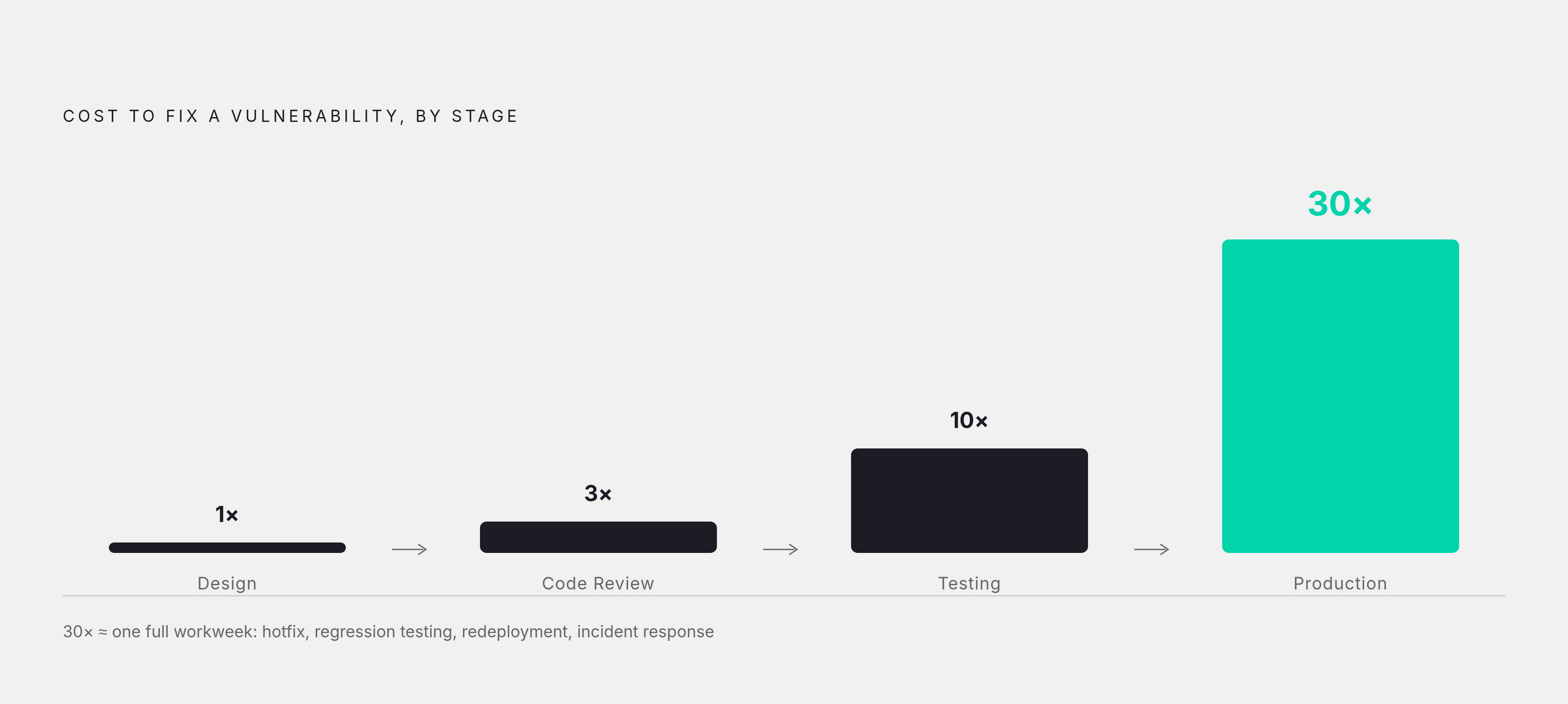
IBM's research puts the remediation cost of a vulnerability found in production at up to 30 times what it would cost to catch during design. A flaw that takes an hour to fix in a code review can consume the equivalent of a full workweek if it reaches production. Hotfix, regression testing, redeployment, incident response. Shifting left often just moves the gate slightly earlier in the timeline without changing the underlying model. The chokepoint relocates. It doesn't disappear.
How opaque approval chains turn review into a waiting game
New infrastructure, security exceptions, and networking changes each require different sign-offs. That part everyone knows. What actually kills velocity is that the approval chain is rarely documented in a way engineers can navigate without asking around first.
The bottleneck usually isn't waiting for a decision. It's figuring out who makes it. That's a specific and underrated form of pain. You're sitting on a connector that's been "under review" for eleven days and you genuinely don't know if someone is actively working on it or if it's parked in an inbox somewhere. Knock knock. Who's there? Your approval. Your approval who? That's exactly the problem — nobody knows.
DORA research identifies centralized Change Approval Boards as a well-documented pitfall. CABs are effective at broadcasting that a change is happening. They're far less effective at evaluating what the change actually means, because reviewers that far removed from the work often don't have the context to assess its implications. You get delay without proportional risk reduction. That's not a tradeoff. That's just waste.
Treating all changes equally makes this worse. When every change goes through the same approval process regardless of risk profile, reviewers can't concentrate their attention on the things that actually warrant it. DORA flags this directly as a suppressor of delivery performance.
For integrations specifically, this plays out in a predictable way. Each new connector typically involves new credentials, new data flows, and new external dependencies. Even when the integration pattern is nearly identical to one that shipped six months ago, the approval process often treats it as net new. Because from the approval chain's perspective, it is.
What happens to review capacity when AI lets developers write code faster
AI coding assistants are genuinely useful. They make individual developers more productive. Nobody is arguing with that.
The problem is that productivity doesn't disappear at the end of the pipeline. It accumulates downstream, in the review queue. Gartner's research is direct about this: improved coding efficiency creates a bigger backlog for code reviews and security reviews. The gain at the writing stage becomes a cost at the review stage. Teams celebrating AI-accelerated output are sometimes just moving the traffic jam one step to the right.
The behavioral shift matters too. Developers producing more code faster tend to create larger changesets, and larger changesets are slower to review than smaller, incremental ones. DORA researchers describe what happens with AI-generated code specifically as a "verification tax." The code reads as correct. It can pass superficial inspection. But it still requires the same depth of scrutiny as human-written code. The review work doesn't shrink just because the writing was faster.
For integration teams, this plays out concretely. If a developer can scaffold a new connector in hours instead of days, the review queue for that connector doesn't shrink. It just arrives sooner. And in greater volume. You haven't made review easier. You've made it more urgent.
Organizations investing in AI tooling to accelerate development without a corresponding investment in review infrastructure aren't closing the bottleneck. They're widening it on purpose.
The specific friction points that make API integrations harder to review than general software changes
An API integration isn't just a code change. It's a new trust relationship with an external system. That distinction triggers a different category of review, and a more thorough one.
Authentication complexity alone generates recurring, unplanned review cycles. OAuth tokens expire and need re-authorization workflows. API keys rotate, especially during vendor security incidents. Schema updates break existing field mappings, and someone has to validate the new mapping against the data contract. None of these are one-time events. They arrive unpredictably, on the vendor's schedule, not yours.
Shadow APIs make this worse. Research from 2025 found that 68% of organizations lack visibility into shadow APIs. These are endpoints operating outside governance workflows that security teams can't review because they don't know the endpoints exist. You can't review what you can't see. That's not a clever observation. It's a genuine operational problem.
Zombie APIs are the companion issue. Nearly 70% of organizations cite active-but-forgotten endpoints as their top API security concern. These are connectors that were reviewed once and then drifted out of governance. The review problem isn't only prospective. It's also retrospective, and most teams don't budget for that part.
APIs are growing at 167% year-over-year. Only a small fraction of organizations have dedicated API testing programs. The volume of what needs reviewing is outpacing the infrastructure built to review it, and that gap widens a little bit every quarter.
Why every third-party integration triggers its own mandatory security assessment cycle
When a third-party vendor gets access to your data or your systems, a compliance and risk obligation activates. It doesn't matter how well the integration code is written. The obligation is triggered by the access itself.
The business case for this rigor is real. Mitratech's 2024 Third-Party Risk Management Study found that 61% of organizations experienced a third-party data breach or security incident in the past year. That's a 49% jump from the prior year. The risk isn't theoretical, and it's getting less theoretical over time.
A standard Tier 1 vendor assessment typically requires SOC 2 Type II reports, FedRAMP authorizations where applicable, HITRUST certifications in healthcare contexts, NIST 800-53 control mappings, and completed security questionnaires. Even with a responsive vendor, a thorough pre-signing assessment takes one to two weeks. Before a single line of integration code is written.
Then there's the subjectivity problem, which doesn't get talked about enough. Risk determination has no shared standard. What one authorizing official accepts, another may reject. Teams end up re-justifying the same vendor relationship across different reviewers, filling out the same documentation in slightly different formats, waiting for slightly different people to sign off on the same conclusion. The treadmill keeps spinning. It's the kind of thing that sounds like a minor annoyance until you're three cycles deep on a connector you needed two months ago.
For teams shipping multiple integrations per quarter, this means running several independent vendor assessment cycles simultaneously. Each with its own paperwork, its own approvals, and its own waiting periods that don't coordinate with each other.
How security review delays compound as integration portfolios grow
Each new integration doesn't just require upfront review. It requires ongoing review whenever the vendor changes their API, rotates credentials, updates their security posture, or whenever your internal compliance standards shift. The upfront cost is the visible part. The maintenance tail is what sneaks up on you.
MuleSoft's 2026 research found that the average enterprise operates nearly 900 separate applications. Despite significant middleware investment, 95% of IT leaders still report ongoing integration difficulties. The volume of what's in production and needs maintaining is enormous, and it grows every quarter regardless of whether the team grows with it.
A team managing 50 integrations isn't doing the same review work 50 times and moving on. They're doing it continuously. Connectors break. Credentials rotate. APIs evolve on the vendor's schedule. DORA's research on lead time for changes is consistent on this point: slowness is almost always about process, review queues, approval chains, deployment gates, not about how fast engineers write code. Every new connector adds to all three simultaneously.
The Black Duck/Synopsys 2023 survey of over 1,000 IT professionals found that more than 80% said a critical security issue had impacted their DevOps delivery schedule in the past year. This isn't a tail risk or a worst-case scenario. It's the median experience.
The math compounds fast. A team shipping two integrations per quarter faces manageable review overhead. A team shipping ten, while maintaining the previous forty, faces a review burden that is structurally incompatible with normal sprint velocity. Not because any single review is unmanageable in isolation. Because of the accumulated weight of all of them, arriving continuously, without a predictable schedule, each one technically urgent. Managing a growing integration portfolio without scaling review capacity is like trying to empty a bathtub while leaving the faucet running — the water level only goes one direction.
What the bottleneck actually costs in delivery time and incident exposure
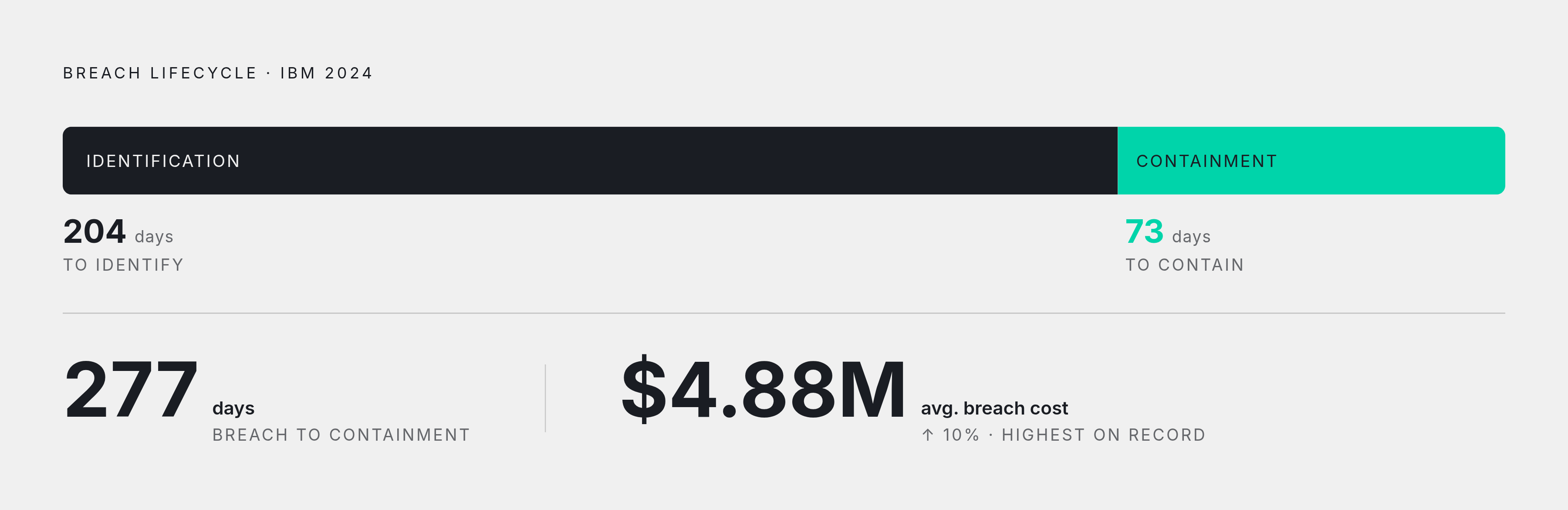
IBM's 2024 Cost of a Data Breach Report put the global average cost of a data breach at $4.88 million. That's a 10% increase over 2023 and the highest figure on record.
The timeline is what makes the number real. IBM's 2024 data shows it took an average of 204 days to identify a breach and another 73 days to contain it. That's 277 days, on average, between when a vulnerability starts causing damage and when it's actually stopped. A vulnerability that slips through a rushed or skipped review has nearly ten months to do what it's going to do before anyone stops it.
At that point the 30x remediation cost stops being a productivity argument. It becomes an exposure argument. The longer a vulnerability lives in a live integration, the more data has transited the compromised path. Time is the variable that turns a fixable problem into an expensive one. That's not a framing choice. That's the actual mechanism.
The third-party dimension adds concrete actuarial weight to this. Resilience found that third-party risk, including ransomware and vendor outages, accounted for 31% of all cyber insurance claims in 2024. Delayed or inadequate vendor security assessment doesn't just create theoretical risk. It has a measurable claims cost attached to it.
When security review gets treated as a speed tax to minimize, teams aren't eliminating review cost. They're deferring it into a window where it costs 30 times more and shows up without warning.
What a review process designed for integration velocity would actually look like
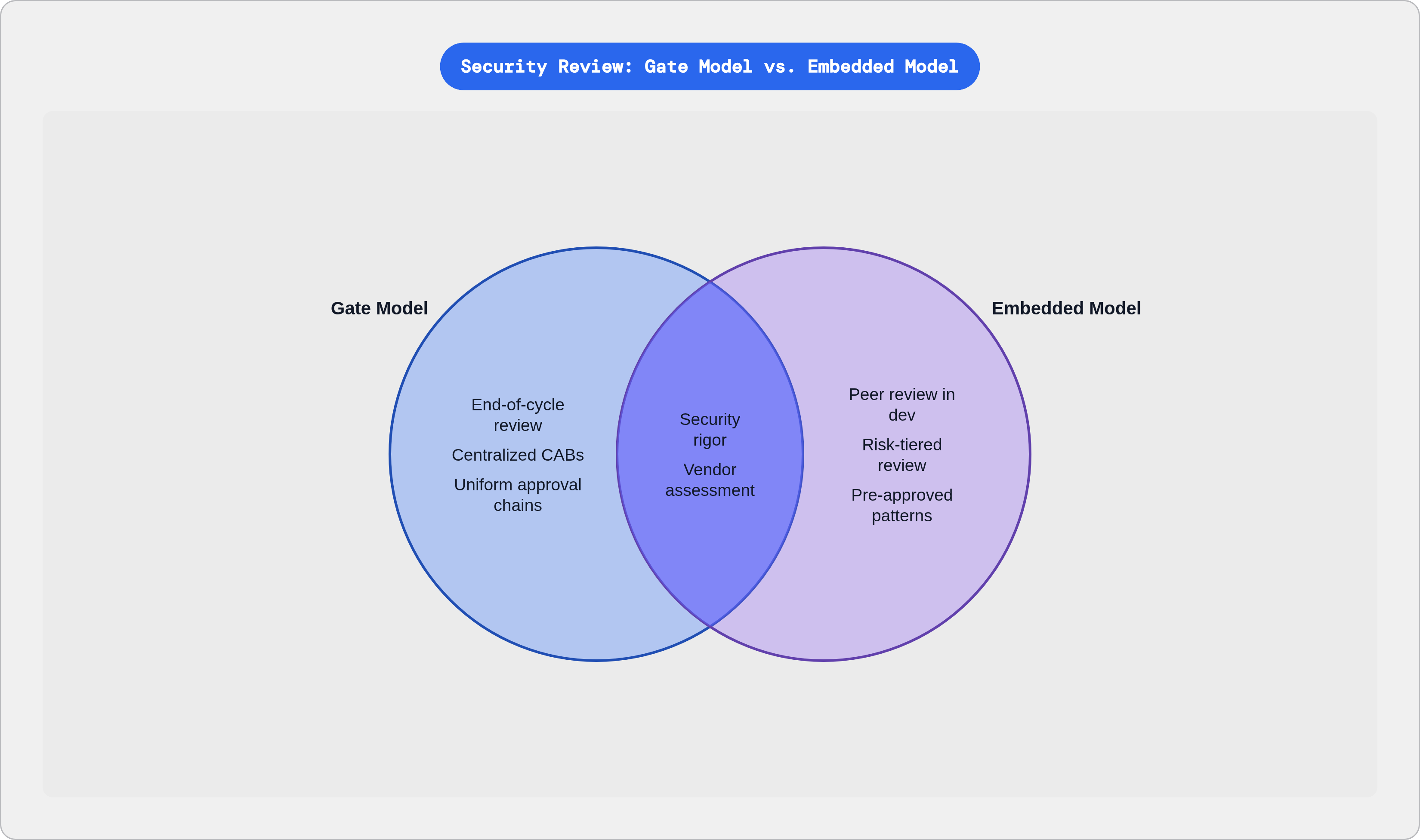
DORA's principle here reframes the whole problem. Change approvals work best when they happen through peer review during development, supplemented by automation that catches problems early. Not through a centralized gate that activates at the end of the cycle.
The teams that have actually reduced integration review bottlenecks aren't the ones skipping steps. They're the ones that moved standardized, repeatable review work out of the critical path by resolving it upstream, in advance, and once. That shift takes a few concrete forms.
Risk-tiered review. Treating all changes equally is the documented source of inefficiency. A credential renewal for a stable, existing connector is not the same risk event as a new integration with a new vendor accessing a new data category. Review processes that treat them identically waste attention on the former and sometimes shortchange the latter. This is the most obvious fix that organizations consistently don't make.
Pre-approved connector patterns. If an OAuth 2.0 flow with a known vendor scoped to read-only data has been reviewed and approved, subsequent implementations of the same pattern shouldn't restart the full review cycle. The review should cover what's different, not re-litigate what's already been settled.
Vendor assessment portability. Requiring teams to independently assess the same vendor across multiple internal projects is a process design failure, not a security requirement. Shared, maintained vendor assessments updated on a regular cadence reduce duplication without reducing rigor. These are not the same thing.
Automation at the points of recurring overhead. Credential rotation, schema validation, dependency scanning. These are the recurring review triggers that generate unplanned work on unpredictable schedules. Automation doesn't eliminate the security work. It catches the change before it requires a human escalation, which is the part that actually jams the queue.
Developer experience as a structural input. Research published in ScienceDirect in 2025 found that most developers don't incorporate security during the planning and design phase, and threat modeling is rarely practiced. That's not carelessness. It's a signal that the tooling and process aren't meeting developers where they actually work. Review processes that generate noisy, complex output drive developers away from security tooling, not toward it. If the process is unusable, people will route around it.
The structural shift isn't about doing less security work. It's about doing the predictable, repeatable parts of that work earlier, faster, and once. So the critical path stays clear for the decisions that actually require human judgment. That part can't be automated. Everything upstream of it, ideally, should be.