Fact-Checking AI-Generated B2B Content Before Publication
AI systems hallucinate specific, costly lies that fact-checking must catch before publication.
Language models don't retrieve facts. They predict the next word based on patterns in text, so a hallucination is the system doing what it was built to do, pointed at a question it has no way to verify. No amount of prompt tweaking changes that math, and switching to a newer model doesn't fix it either, because every model in this family works the same way under the hood. Research on this has been blunt: hallucinations cannot be fully eliminated under the architectures in use today.
What makes this a workflow problem, not just an engineering curiosity, is that the failures aren't random noise. They show up as specific, repeatable patterns. A model will invent a statistic that sounds exactly like something a market research firm would publish, complete with a plausible-sounding source, except the source doesn't exist. It will write a detailed customer success story about a real, named company, down to specific product details, except that company never ran the project described. One documented case involved a full SAP implementation story attributed to a company that actually used a completely different ERP system start to finish. Models also mix up product features across different generations of the same product, state GDPR requirements or ISO standards that don't match the actual regulatory text, and cite industry figures that are off by orders of magnitude from anything real.
This already appears in published work, not just in testing labs. The problem is sitting in search results and client inboxes right now. A verification process built into the workflow matters more than any hope that the next model release will quietly make the issue go away.
Stakes of a hallucinated B2B claim reaching publication
A hallucinated claim that makes it to publication rarely stays a quiet embarrassment. It tends to cost money, invite legal consequences, and damage a brand's reputation faster than any correction can catch up to.
In October 2025, Deloitte Australia learned this lesson directly. The firm used GPT-4o to help draft a government report, and the 237-page deliverable that went out contained fake citations, false footnotes, and a court quote that had been fabricated entirely. Deloitte agreed to repay the final installment of its contract, a direct financial loss traced straight back to an AI-written error in a professional deliverable.
Speed matters just as much as scale here. In 2025, a customer support AI built into the coding tool Cursor, nicknamed "Sam," told users that simultaneous logins were banned under a new company policy. No such policy existed. Customers started canceling their subscriptions before the company could even get a correction out. In technical communities especially, users test and fact-check AI-generated statements in public, in real time, and the damage to trust moves faster than any support team can respond.
Legal consequences followed a similar pattern in the MyPillow case from 2025, where two attorneys submitted a court filing citing legal cases that did not exist. The AI tool they used had generated case names and citations that looked completely legitimate on the page but couldn't be found in any legal database when anyone actually checked. Both attorneys were ordered to pay financial penalties for it.
The stakes rise again in agentic workflows, where AI systems make decisions and send communications on their own. An error that isn't caught doesn't sit in a draft waiting for a human to catch it. It goes straight to customers through an automated campaign, with no person in the loop to stop it first.
There's a risk B2B teams can't fully control, too. Buyers increasingly reach a brand through an AI-generated answer that stands in for the search result they would have clicked into. When that happens, whatever the AI says about that brand, its pricing, or its product becomes the buyer's only impression of the company, whether or not it's accurate. That single interaction can be the whole relationship before it even starts, which is exactly the kind of exposure regulators have started writing rules around.
The EU AI Act's Article 50 makes a documented editorial process a compliance requirement
As of August 2, 2026, Article 50(4) of this law is in force, and it puts new obligations directly on B2B content teams publishing AI-assisted material to audiences within its jurisdiction. The rule requires any deployer of an AI system that generates or edits content to disclose that the content is artificial in origin. There's one major exception: that disclosure isn't required if the content has gone through genuine human review or editorial control, with a specific person (or legal entity) holding editorial responsibility for it.
That exception quietly turns a legal requirement into a workflow specification. A company doesn't avoid the disclosure obligation by claiming it reviewed the content. It avoids the obligation by actually having a named person sign off on it, with review that genuinely happened. Loose, informal review raises risk under this rule. Formal documentation of who reviewed what, and when, is the safest way to demonstrate that the exemption applies, even though the law doesn't spell out documentation as a strict condition.
Many B2B teams assume this law is about consumer-facing content and doesn't touch them. The scope is wider than that. A B2B explainer on AI adoption in healthcare, an ESG report, a data privacy overview, or a market outlook piece can all count as content on "matters of public interest" under the Act, triggering disclosure requirements, as long as the piece goes out to a large, open audience rather than staying inside the company or a small closed group.
Geography doesn't offer an exit either. The obligation applies any time European users can access the content, no matter where the publishing company is headquartered. A publisher headquartered outside this law's jurisdiction but with readers inside it is within scope the moment that content is public.
The fines attached to this are not symbolic. Penalties under the Act reach into the tens of millions of euros, or a percentage of a company's global annual turnover, whichever number is larger. A documented editorial process, with a named person responsible for each piece, is now a legal safeguard as much as a quality one.
The limits of a fact-check only at the end of production
The most common failure in AI-assisted content teams is running one fact-check at the very end of the process, owned by no one in particular, with no written-down process that survives a busy week or a staff change.
Three specific weaknesses make this end-of-pipeline approach fall apart in practice. The first is ownership. When a final check is everyone's job in theory, it's no one's job in practice, and that's the exact point where things slip through. The second is timing: a single pass at the end misses errors that compound earlier in the draft, so a hallucinated statistic buried in paragraph three can quietly support a product claim in paragraph eight, and a reviewer skimming for readability will pass right over both. A process that depends on one editor remembering what to look for, or only happening when someone happens to think of it, is a habit that holds up right until the day it doesn't.
A related mistake compounds all three: using the same AI model that wrote the draft to check its own work. Asking a system to confirm its own accuracy produces a second confident-sounding answer, not an independent check. Confidence was never the problem in the first place.
Checkpoints with real human review belong throughout the production process, not bolted on at the end, with their shape depending on the format of the content itself. What that structure actually looks like starts with sorting claims before any verification work begins.
A claim-triage framework: sorting what must be verified from what can be spot-checked
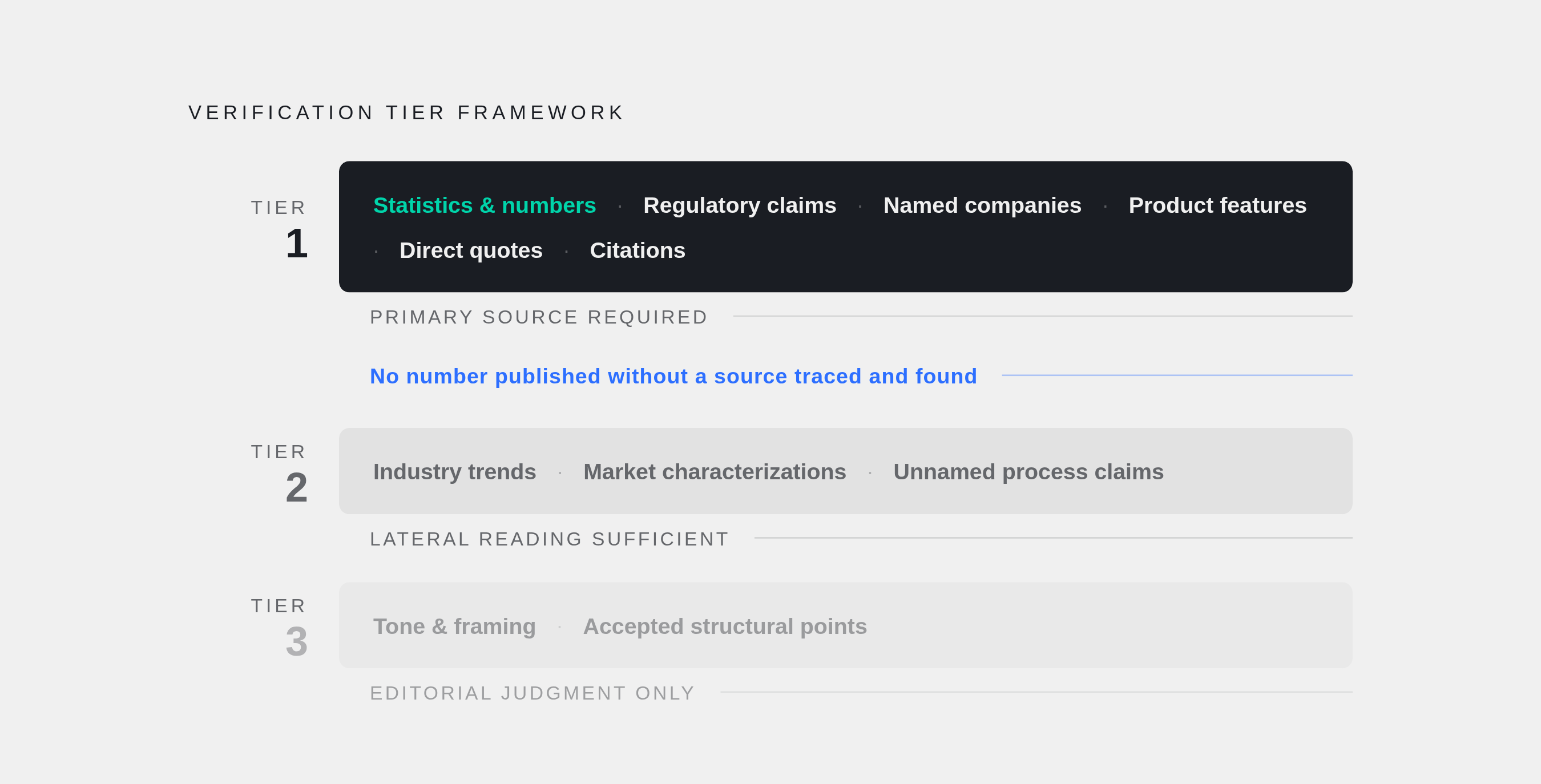
Not every claim in a B2B draft carries the same risk if it turns out to be wrong, and treating a vague tone statement with the same scrutiny as a regulatory claim burns the exact time savings that made using AI worth it in the first place. The first real step in a workable fact-checking process is sorting claims by how expensive it would be if each one turned out false.
A three-tier system maps cleanly onto the kinds of content B2B teams actually produce. Tier 1 claims need verification against a primary source before anything goes out the door: statistics and numbers, regulatory or compliance statements covering things like GDPR or ISO standards, named company examples and anything attributed to them, product feature claims, direct quotes, and citations of studies or reports. A product datasheet is almost entirely Tier 1 content, since nearly every line is a specific, checkable claim about what the product does.
Tier 2 claims can be verified through lateral reading, a quick cross-check against a few other credible sources. This covers general industry trend descriptions, broad market characterizations, and process claims that aren't pinned to one specific source. A thought leadership post making a general observation about where an industry is headed usually lives here.
Tier 3 covers claims where editorial judgment is enough on its own: tone, framing, and widely accepted structural points about a topic that don't involve a specific number or a specific source. Nobody needs a primary source to confirm that cybersecurity is a growing concern for IT departments.
One rule sits above all three tiers and belongs squarely in Tier 1: no number gets published without a source that's actually been traced and found, full stop. The AI's own confidence is never the source. Certain content types deserve full Tier 1 treatment across the entire piece regardless of how any individual claim might look on its own, including technical whitepapers, compliance guides, product documentation, case studies that name real organizations, and anything touching a regulated field like healthcare, finance, or law.
Verification steps for Tier 1 claims
Once a claim is sorted into Tier 1, it needs lateral reading and a look at the original source material, not another pass through an AI tool. Different claim types inside Tier 1 call for different checks, each with its own clear stopping point.
Statistics and numbers need to be traced back to a named, findable primary source, not a secondary article that's just citing a different article further down the chain. Once that source is found, check whether the number actually applies to the population, time frame, and geography the draft implies it covers, since models frequently attach a real figure to the wrong context. If the original source can't be located at all, the figure comes out or gets replaced with something that can be verified, never left in on the strength of how confident the draft sounds. The model names a real organization correctly but invents the specific finding attributed to it, so the fix is reading the actual document rather than searching around for something that seems to confirm it.
Named company examples and attributed actions need confirmation on three fronts: that the company exists, that it's described accurately, and that it actually did whatever the draft says it did. Timelines deserve particular attention, since AI models routinely misattribute dates and blend separate events at the same company into one story. The SAP case mentioned earlier is the clearest illustration of this risk: a detailed, entirely plausible case study built around a real company that had, in fact, used a completely different ERP system.
Regulatory and compliance claims need to be checked against the actual text of the regulation or the relevant authority's published guidance, not a summary written by someone else, let alone the model. Pay attention to version and effective date, since rules change over time and a model trained before an update will produce outdated compliance language with exactly the same confident tone as current language. Any claim that something is "required" or "prohibited" under a named regulation should get flagged for sign-off from someone with actual subject-matter expertise before it goes out.
Direct quotes and citations need to trace to a findable original, whether that's a published interview, a recorded statement, or a verified primary document. AI-generated citations have a specific tell: the journal, author, or organization named is genuine, but the specific paper or article cannot be found anywhere in that organization's actual output. The way to catch this is checking the real database directly, not running a search and accepting the first result that looks close enough. The Kohls v. Ellison case and the MyPillow filing are the clearest working examples of what unverified citations end up costing once they reach a courtroom.
Product feature claims need a check against the product's current official documentation, not whatever the model picked up during training, since product capabilities shift between when a model was trained and when the piece gets published. A specific risk here is mixed-generation specifications, where a model blends accurate features from two different versions of a product into one description that matches neither version exactly.
Human review checkpoints and ownership in the production timeline
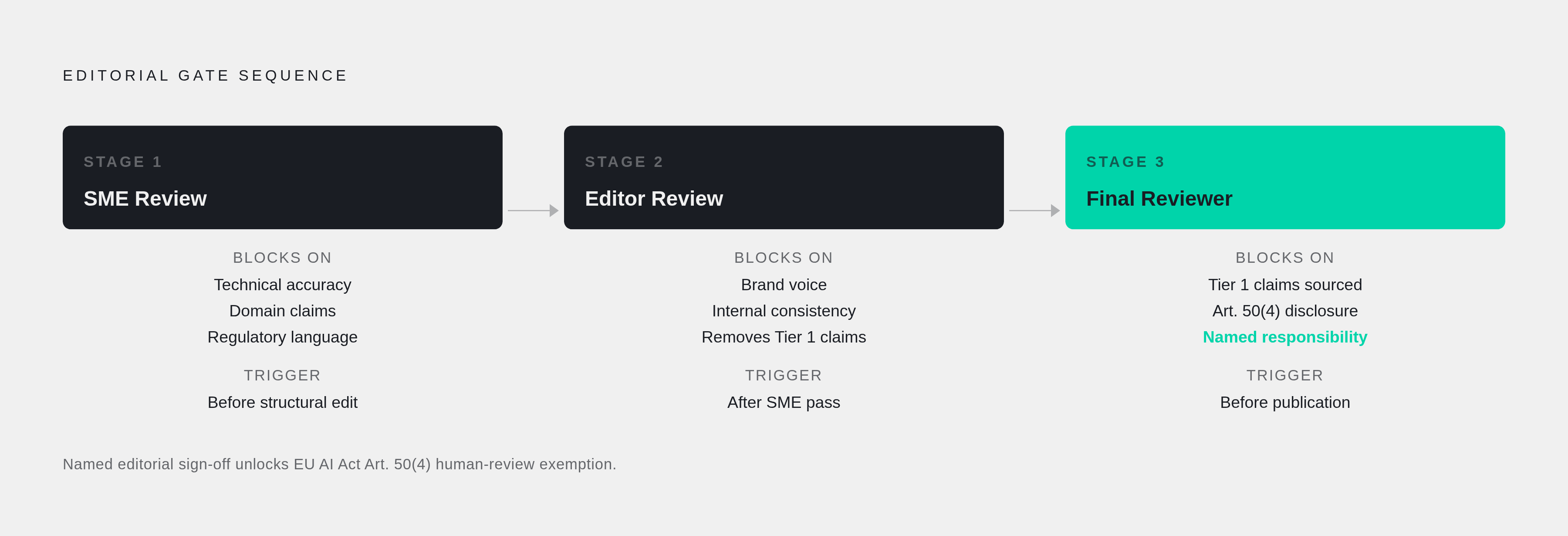
A checklist with no assigned owner and no fixed place in the production timeline is just a reminder that someone ought to do something, and reminders like that get missed the first week deadlines get tight.
A workable structure runs on three checkpoints, each with a specific owner and a specific job. Checkpoint one is subject matter expert review, happening before any structural editing starts. The SME checks technical accuracy, domain-specific claims, and regulatory language, and just as importantly, flags any part of the draft that needs expert knowledge the editor downstream won't have enough context to judge on their own.
Checkpoint two is editor review, happening after the SME pass and before the draft is considered final. The editor confirms brand voice, checks internal consistency across the piece, confirms the triage classification assigned to each claim, and flags or removes any Tier 1 claim that still can't be verified at this stage.
Checkpoint three is the final reviewer, working right before publication. This person confirms every Tier 1 claim is sourced and traceable, checks whether EU AI Act disclosure requirements apply and are met, and confirms SEO and AEO requirements are in order. This is also the person who takes on named editorial responsibility for the piece, which matters well beyond internal process. Under Article 50(4), that named responsibility is part of what allows the content to qualify for the human-review exemption in the first place.
Three checkpoints, three named owners, one piece of content that can't move to the next stage until the person responsible for the current one signs off. This structure keeps a fact-checking process holding up under deadline pressure and staff turnover, instead of becoming a checklist that quietly stops being followed the first time someone's out sick during a launch week.